.svg)






Subscriber Churn Prediction Calls: AI Voice for OTT and Streaming
October 10, 2026
|

12 min read
Where pre-auth delays cost patients cashless admissions, AI voice agents handle the full TPA call loop so hospital staff do not have to.
Insurance pre-auth calls with voice AI cut the delay between a doctor's admission decision and the insurer's cashless approval. An AI voice agent handles the notification call to the TPA, follows up on document requirements, and gives the patient's family real-time status updates, all without tying up hospital staff. The result: faster approvals, fewer cashless admissions falling through, and a better experience for patients at their most stressful moment.
A patient is told they need surgery tomorrow. The treating doctor sends the case for cashless admission. And then the family waits.
The pre-authorisation process sits between that decision and the procedure. Someone has to call the TPA or the insurer, notify them of the planned admission, confirm the policy is active, collect the document checklist, follow up when the approval is pending, and keep the family updated. In most hospitals, that "someone" is a billing coordinator or insurance desk executive who is also managing five other admitted cases.
Calls go unanswered. Follow-ups are delayed by hours. Documents are submitted incomplete because the checklist was read out over a noisy line. Approvals that should arrive in a few hours take the better part of a day, and cashless admissions sometimes convert to reimbursement simply because the process broke down under volume.
This is not a knowledge problem. Every insurance desk executive knows what to do. It is a coverage and latency problem, and that is exactly what AI voice agents fix.
Pre-authorisation is the insurer's advance approval of a planned admission or procedure. For a cashless admission to work, the hospital must contact the TPA or insurer before or immediately after the patient is admitted, confirm the policy details, submit the clinical justification and supporting documents, and receive a sanction letter before the claim is processed.
Without that approval, the patient either pays out of pocket or files for reimbursement after discharge. Both outcomes erode trust and often result in claim disputes.
The pre-auth workflow involves three parties: the hospital's insurance desk, the TPA, and the insurer. Calls travel in both directions. The hospital notifies the TPA of the admission. The TPA may call back to request additional documents or clarifications. The insurer may partially approve and request enhancement. Each step is a phone call, and each phone call that is missed or delayed extends the approval timeline.
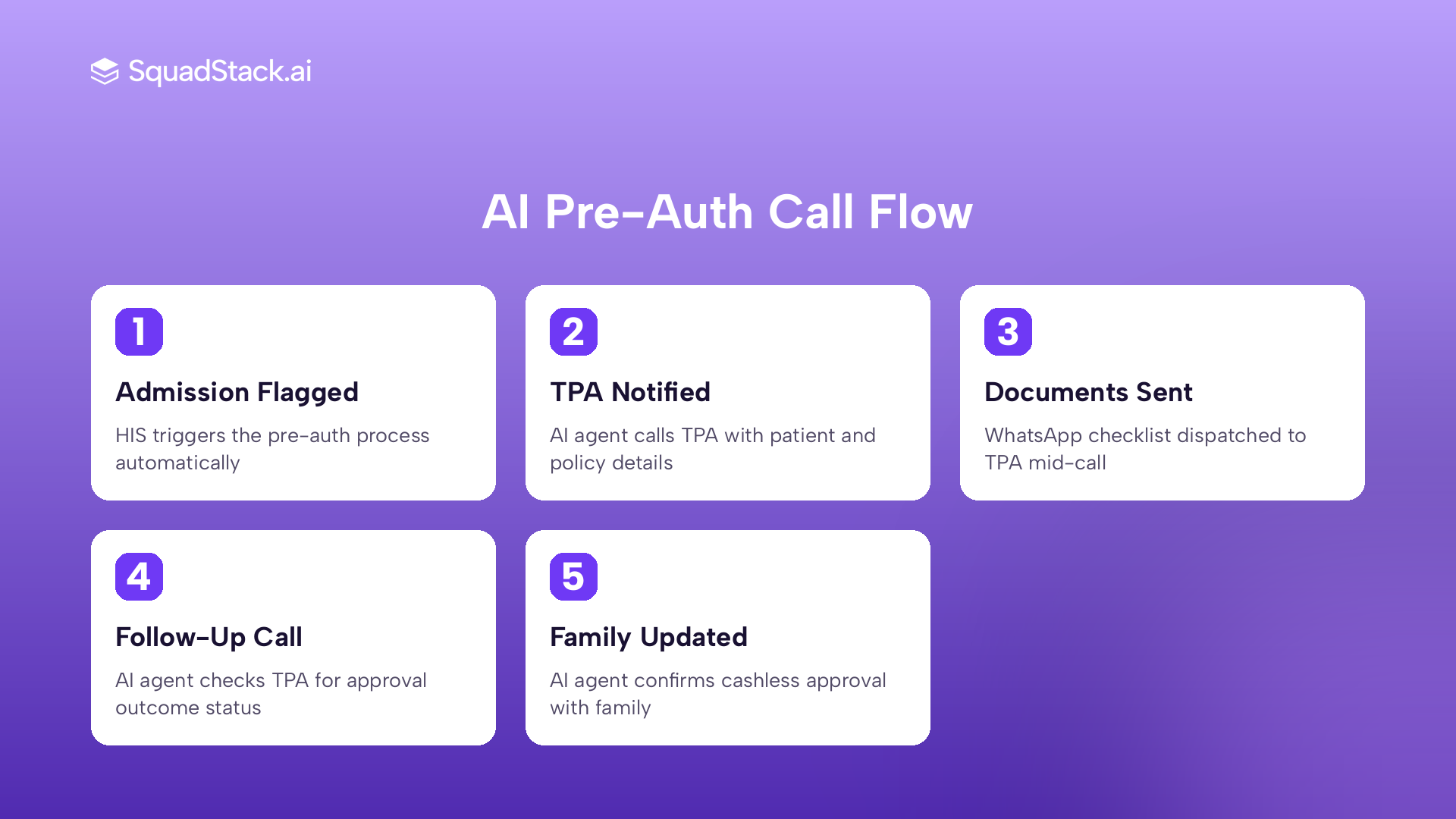
Here is the step-by-step flow a voice AI agent runs on a cashless admission case.
Step 1: Admission notification call. As soon as the hospital marks a patient for cashless admission in the HIS, the AI agent places an outbound call to the TPA. It provides the patient's policy number, the treating doctor's name, the diagnosis code, the planned procedure, and the expected length of stay. It confirms receipt and logs the TPA's acknowledgement.
Step 2: Document checklist delivery. The agent asks the TPA what documents they need and delivers the checklist to the patient's family via an in-call WhatsApp message while still on the line. The family receives a written checklist immediately, not a handwritten note from a harried billing counter.
Step 3: Status follow-up. If approval is not received within the agreed window, the agent makes follow-up calls to the TPA on a configured cadence. It checks approval status, asks whether any clarification is needed from the treating doctor, and escalates to a human insurance coordinator if the TPA raises a clinical query.
Step 4: Family update calls. The agent calls the patient's attendant at each stage: when the pre-auth request is submitted, when documents are confirmed received, and when the sanction letter arrives. Families are told what is happening without having to chase the billing desk.
Step 5: Enhancement requests. If the approved amount needs to be enhanced mid-admission due to complications, the agent initiates the enhancement call to the TPA, reads out the treating doctor's justification, and follows up until a revised sanction is issued.
Step 6: Continuous learning. Every call feeds outcome data into the ROI Optimizer. Which follow-up timing got the fastest TPA response? Which document checklist wording reduced incomplete submissions? Which language choice led to fewer escalations? The agent gets sharper with each round of calls, not because it was manually reprogrammed, but because outcomes drive the next set of decisions automatically.
For a detailed look at how SquadStack's voice agents are deployed across the broader healthcare journey, see the AI voice agent for healthcare overview and the full healthcare playbook.
The pre-auth use case sits in a cluster of high-stakes, time-sensitive calls that hospitals run daily but rarely have dedicated staff for. Other calls in the same cluster include appointment confirmation, discharge follow-up scheduling, and health-check outreach. The SquadStack healthcare industry page maps all of them.
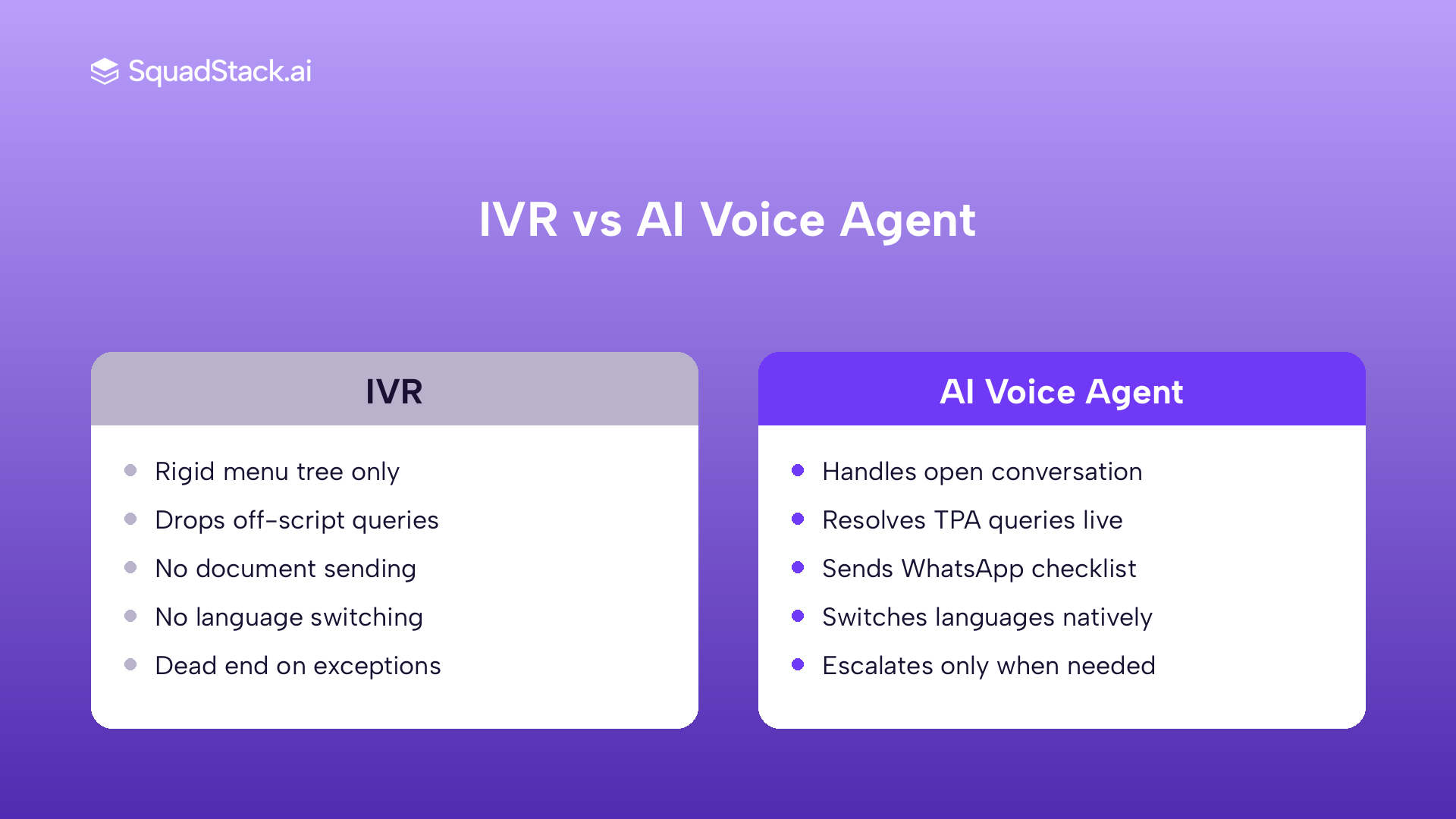
IVR systems exist at most hospitals. They are not the answer for pre-auth calls. Here is why.
| Dimension | IVR | AI Voice Agent |
|---|---|---|
| Conversation type | One-way menu navigation. The TPA or family member must press a number or say a keyword. | Two-way dialogue. The agent listens, interprets free-form speech, and responds to whatever is actually said. |
| Handling a TPA query | Cannot process an unscripted question like "Can you confirm the treating doctor's registration number?" The call either loops or drops. | Retrieves the answer from the hospital's knowledge base in under 100 milliseconds and responds without breaking conversational flow. |
| Document checklist delivery | Can play a pre-recorded list, but cannot confirm receipt or send it to the family's WhatsApp while on the call. | Sends the checklist to WhatsApp mid-call. The family has it in writing before the call ends. |
| Follow-up on an unanswered call | Redials on a fixed schedule with no memory of previous attempts. Treats every attempt as the first. | Remembers every previous interaction and adjusts follow-up timing based on when the TPA actually picks up. |
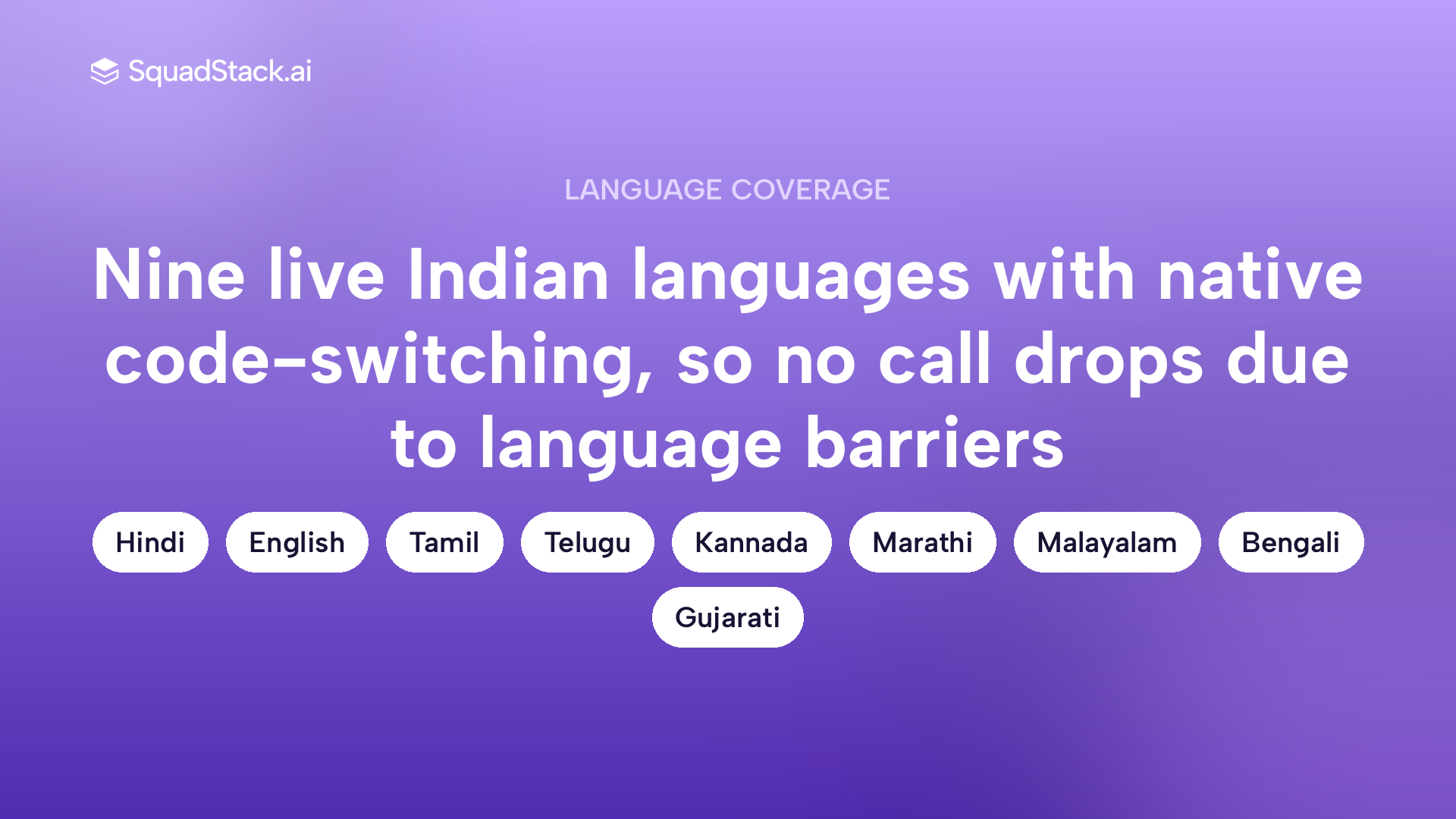
| Language switching | Fixed to one language per IVR tree. A TPA executive who replies in Tamil on a Hindi IVR hits a dead end. | Switches languages mid-conversation the way a bilingual agent does, across 9 live Indian languages with native code-switching. |
The practical cost of the IVR gap in pre-auth is that a TPA executive who cannot get a sensible answer on one call simply processes the approval when they get around to it. An AI voice agent that can hold a real conversation keeps the TPA engaged and the approval moving.
For a broader comparison of voice AI approaches in insurance contexts, see insurance voice AI and AI voicebot for insurance.
Pre-auth is a high-stakes, high-regulation workflow. Not every voice AI product is built for it. Before choosing a platform, hospital CXOs and insurance desk heads should ask these questions.
Can it handle a two-way conversation with a TPA? TPAs ask questions. If the platform cannot respond intelligently to an off-script query, it will not reduce your team's workload; it will create new problems.
Does it support all the languages your TPAs and patients use? A platform that covers only Hindi and English will fail on Tamil-speaking patients and South India TPAs. You need native, code-switching support across the languages your teams actually use, not just listed languages.
Does it carry DPDP and IRDAI-relevant compliance? Pre-auth calls involve policy numbers, diagnosis codes, and patient identity. The platform must be DPDP compliant and hold ISO 27001 certification at minimum.
Can it integrate with your HIS and TPA portals? The trigger for a pre-auth call should come directly from your Hospital Information System when a cashless admission is flagged. Manual triggers create the same gaps you are trying to close.
Does it learn from outcomes? A platform that runs the same script on every call regardless of what worked last week is not getting better. The ROI Optimizer loop matters: it is what makes a voice AI platform a long-term asset rather than a point solution.
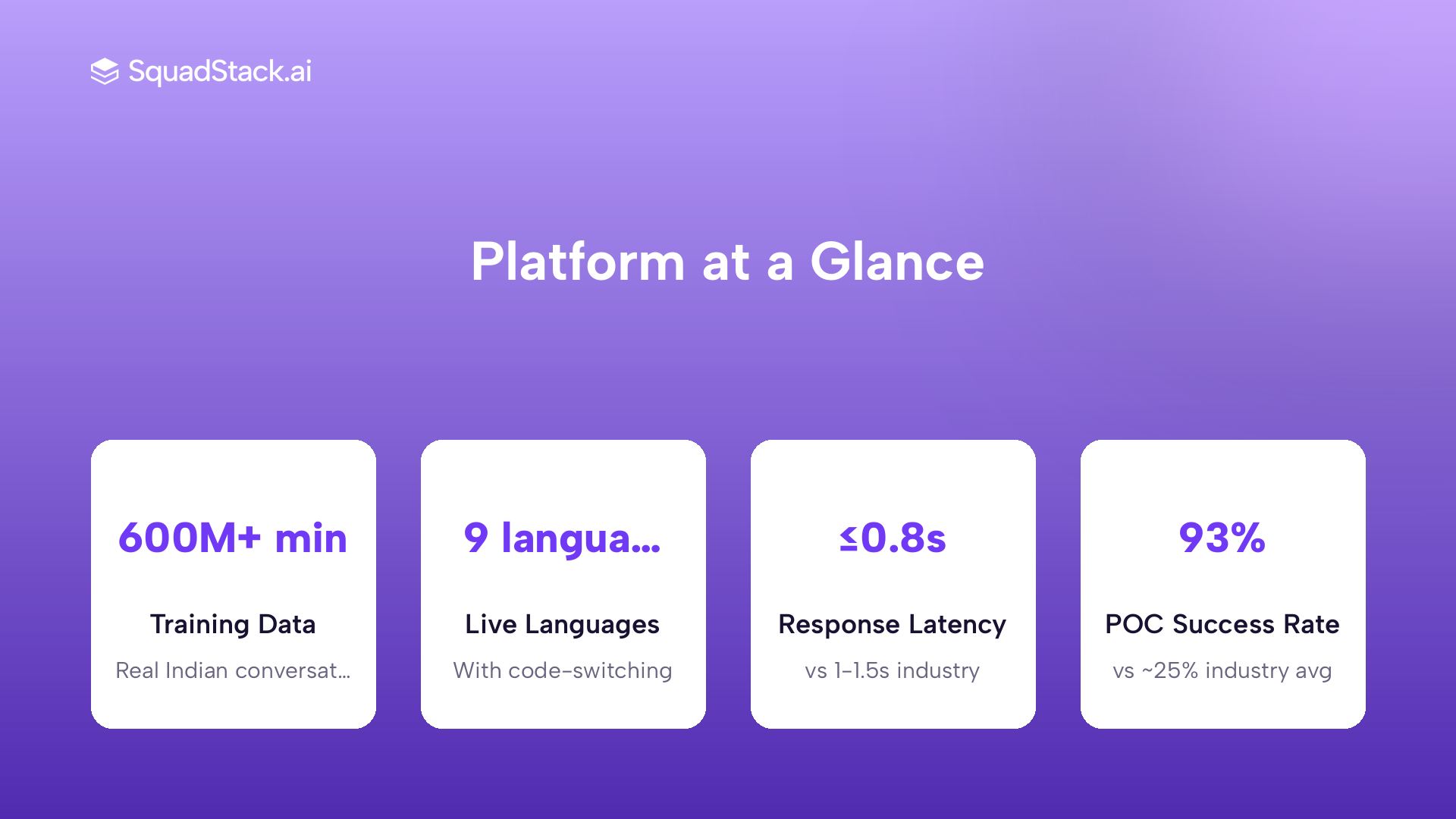
SquadStack's proprietary speech model, Arth, is trained on 600M+ minutes of real Indian telephony conversations, including code-switched speech like Hinglish and Taminglish, on noisy 8kHz telephone lines. That training data is the reason the agents sound native to a TPA executive in Chennai or a billing coordinator in Lucknow, not like a system reading from a script.
The platform runs 50 lakh+ calls daily across 60+ large consumer brands in India. In live pilots, it has delivered up to 90% lead connectivity against a 40 to 60% industry norm. The POC success rate is 93%, compared with an industry average of around 25%.
For healthcare specifically, the Medfin case study shows how SquadStack's voice AI handled a high-volume, detail-sensitive calling workflow in a medical context. Medibuddy, India's corporate health platform, runs appointment confirmation on both the patient and hospital legs using SquadStack's agents.
Every campaign ships with dual-layer QA through the Eval System: each call is scored on Outcome, Sentiment, and Execution, by both AI and human reviewers. For a pre-auth workflow, where a missed escalation or a wrong document checklist can delay a procedure, that audit trail matters.
The platform is ISO 27001, ISO 27701, SOC 2 Type II, DPDP and TRAI compliant. Patient policy data stays within India's data residency requirements.
Go-live on a new campaign takes around two weeks. The squad that builds and runs the campaign includes a Conversational AI Designer who writes the dialogue in the hospital's languages and a Forward Deployed Engineer who handles HIS integration.
Pre-auth delays are a coverage and latency problem. There are not enough calls, they do not happen fast enough, and the follow-up cadence breaks when the insurance desk gets busy. Voice AI does not replace your insurance team. It handles the call volume they cannot reach so approvals move faster and cashless admissions actually complete as cashless.
To see how this works on your patient volumes, book a demo with SquadStack. You can also explore the full generative AI in healthcare overview for adjacent use cases.
Which is the best voice AI solution for insurance pre-auth calls in Indian hospitals?
A platform built specifically on Indian telephony data, with native code-switching across the languages your TPAs and patients use, and with DPDP compliance for patient data, is the right fit. SquadStack's Arth speech model is trained on 600M+ minutes of real Indian contact-center conversations and supports 9 live Indian languages with native code-switching, making it purpose-built for this workflow.
Can a voice AI agent handle insurance pre-authorisation calls automatically without hospital staff?
Yes, for the administrative leg of the process. An AI voice agent can notify the TPA of the admission, deliver the document checklist, follow up on approval status, and update the patient's family, all without manual intervention. Clinical queries from the TPA are escalated to a human coordinator via warm transfer, so nothing gets lost.
How does AI voice for insurance pre-auth calls work with a hospital's HIS?
The HIS triggers the pre-auth call when a patient is flagged for cashless admission. The AI agent pulls the relevant admission data, places the call, and writes outcomes back to the system after each interaction. Integration is handled by SquadStack's Forward Deployed Engineer as part of the campaign setup.
What happens if a TPA asks a question the AI agent cannot answer?
The agent retrieves answers from the hospital's knowledge base in under 100 milliseconds for standard queries. If the TPA raises a clinical question that requires a doctor or a senior coordinator, the agent escalates via warm transfer and passes full call context to the human who picks up.
How does voice AI compare to a human insurance desk team for pre-auth calls?
A human team is capacity-constrained. Pre-auth follow-up calls get missed when the desk is handling multiple admitted patients at once. A voice AI agent runs the full follow-up cadence on every case, at any hour, and without dropping calls when volume spikes. Human coordinators remain on the loop for escalations and clinical queries.
Is patient data safe when pre-auth calls are handled by voice AI?
SquadStack is ISO 27001, ISO 27701, SOC 2 Type II, DPDP and TRAI compliant. All models are hosted in India, meeting data residency requirements under the DPDP Act. Policy numbers, diagnosis data, and patient identity are handled within the platform's compliance perimeter.
What Indian languages does the voice AI agent support for pre-auth calls?
Nine languages are live today: Hindi, English, Tamil, Telugu, Kannada, Marathi, Malayalam, Bengali, and Gujarati, with native code-switching so the agent handles a TPA who shifts between Hindi and English mid-call. Additional regional languages can be added based on business requirements.
How long does it take to go live with an AI voice agent for insurance pre-auth?
Most campaigns go live in around two weeks. Setup covers the call flow design, HIS integration, document-checklist configuration, and UAT. The timeline depends partly on client-side dependencies like data feeds and compliance sign-off, not on the build itself.
Does the voice AI agent improve over time on pre-auth calls?
Every call feeds outcome data into the ROI Optimizer. Follow-up timing, document-checklist wording, language selection, and escalation triggers are all refined based on what actually produced faster approvals in previous calls. The agent gets better with each campaign cycle.
Can the same AI voice agent handle both TPA calls and patient family update calls?
Yes. The same campaign workflow covers both legs: outbound calls to the TPA for notification and follow-up, and outbound calls to the patient's family for status updates. Both call types run on the same persistent memory so the agent carries context from one leg to the other without repeating information.