Voice AI Onboarding Failures: What Goes Wrong and Why
November 2, 2026
|

13 min read
A closer look at how AI voice agents handle TPA pre-auth escalation calls for network hospitals, cutting wait times and staff workload.
TL;DR: TPA pre-auth escalation AI voice hospital workflows let network hospitals automatically follow up with insurance TPAs on stalled cashless admission requests, provide case details, chase turnaround times, and escalate to human coordinators when needed. This reduces the time patients wait for admission approval and cuts the revenue loss that comes from beds sitting empty while paperwork stalls.
Network hospitals in India lose meaningful revenue every day to a problem that has nothing to do with clinical quality. A patient is ready for admission. The surgeon has scheduled the procedure. But the cashless pre-authorisation request sent to the TPA is sitting in a queue, and nobody knows why.
The hospital's insurance coordinator calls the TPA helpline. The line is busy. They try again. The call connects but the case file cannot be found. The call drops. They try a third time and the case status is "under review." Two days pass. The bed sits empty, the patient is anxious, and the procedure gets rescheduled. This is the daily reality for hospital revenue cycle teams across India, and it is a coverage and latency problem, not a process design problem. There are not enough people to make enough calls fast enough.
TPA pre-auth escalation AI voice hospital tools exist precisely for this bottleneck. Read on for how they work, where they fit, and what to look for when evaluating one.
TPA pre-auth escalation AI voice is the use of a conversational AI voice agent to make outbound calls to a Third Party Administrator (TPA) on behalf of a network hospital, with the goal of advancing a stalled cashless pre-authorisation request. The agent dials the TPA's helpline, identifies the case using the patient's policy number and hospitalisation details, asks for the current approval status, relays any missing information the TPA needs, and, if the case is flagged as pending beyond a defined threshold, escalates the call to a human coordinator.
The distinction from a general AI calling tool is specificity. This is not a bot reading out a number from a script. It is an agent that carries case context, handles the TPA's conversational responses, adapts when the status changes mid-call, and knows when to hand off.
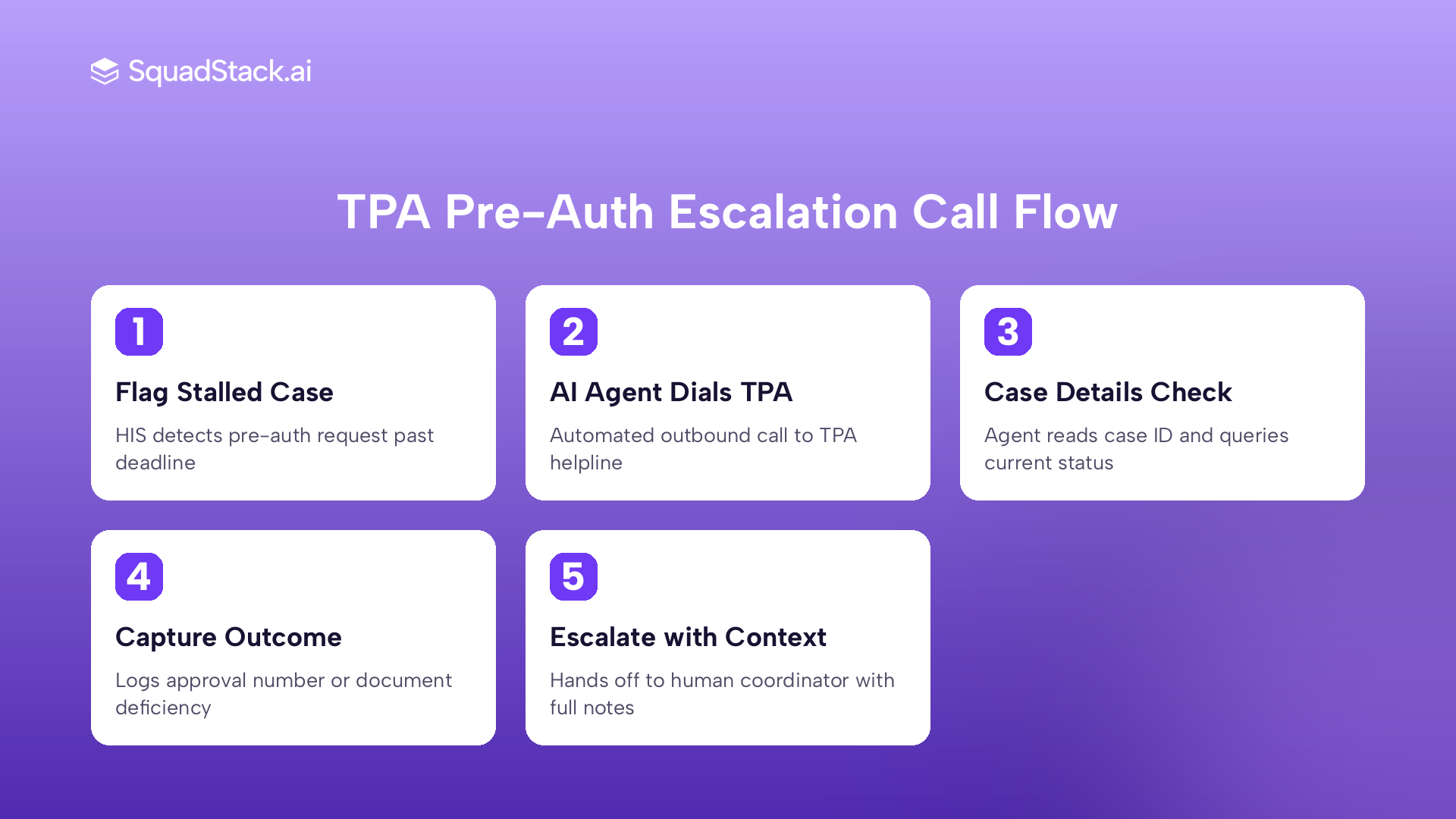
The call flow has five clear stages, and each one addresses a real failure point in the manual process.
1. Case identification and call trigger. The hospital's HIS or claims management system flags a pre-auth request that has exceeded the expected turnaround time. That flag triggers the AI voice agent, which loads the case details: patient name, policy number, admission date, diagnosis code, proposed procedure, and the treating doctor's name.
2. Outbound call to the TPA helpline. The agent dials the TPA. It navigates the TPA's IVR if one exists, reaches an agent, and identifies the hospital and the case. The agent speaks in the language the TPA representative picks up in, switching naturally between Hindi, English, or a regional language as needed.
3. Status check and case update. The agent asks for the current pre-auth status. If the TPA needs additional documents or clarifications, the agent captures what is needed, logs it against the case, and, where authorised, provides the clarification on the call. If the status is approved, it captures the authorisation number and writes it back to the system.
4. Escalation trigger. If the TPA's response indicates the case is pending beyond the hospital's escalation threshold, the agent transfers the call live to a senior insurance coordinator, passing full context so the coordinator does not start from scratch. If no coordinator is available, the agent books a scheduled callback.
5. Continuous learning loop. Every call outcome feeds back into the platform's ROI Optimizer. Call results, escalation rates, TPA response patterns, and common documentation gaps are all captured. The system uses this data to sharpen the agent's script, adjust the timing of follow-up calls, and identify which TPA queries resolve in one call versus which ones need a human from the start. The agent gets better with each campaign cycle.
For a broader picture of how AI voice agents are reshaping patient-side and operations-side hospital workflows, see the SquadStack healthcare industry overview.
The use cases sit squarely in the administrative layer of the patient journey, well within the safe scope defined by India's Telemedicine Practice Guidelines. The agent is never counselling the patient or discussing clinical decisions. It is chasing paperwork.
Cashless admission clearance. The highest-volume use case. For any planned procedure at a network hospital, the clock starts when the pre-auth request is submitted. Every hour of delay is a bed held back. AI voice agents run follow-up calls at defined intervals without waiting for a coordinator to be free.
Document deficiency follow-up. TPAs frequently return pre-auth requests with a list of missing documents. Getting those documents and confirming receipt is a series of calls that most hospital teams log in a spreadsheet and chase manually. An AI agent can handle this loop end to end.
Denial review escalation. When a pre-auth is denied and the hospital intends to appeal, the first step is getting the denial reason in writing and understanding whether an escalation is warranted. The agent can make this call and flag cases where a human coordinator should intervene.
Post-discharge settlement follow-up. After a cashless admission, the final settlement claim goes back to the TPA. Long settlement cycles affect hospital cash flow. Follow-up calls on ageing claims fit the same pattern as pre-auth follow-up.
For a closer look at how AI voice supports the full patient lifecycle in hospital and diagnostics settings, the AI voice agent for healthcare page covers the broader picture. The Medfin case study also shows how SquadStack has delivered outcomes in a healthcare financial workflow context.
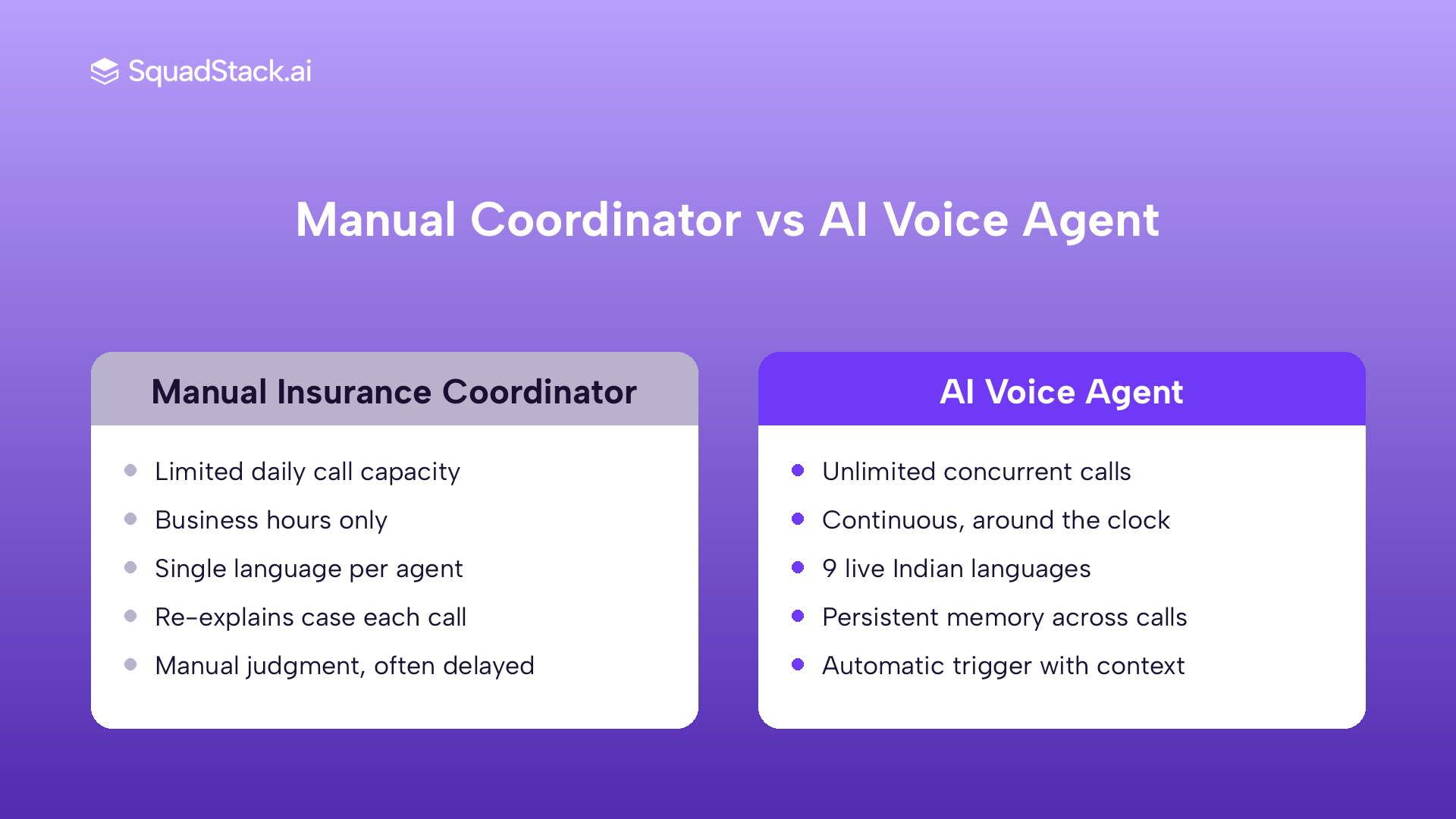
IVR systems are still common in hospital operations, but they were not built for a use case that requires dynamic, two-way conversation with a TPA agent. Here is how the two approaches differ on the dimensions that matter for pre-auth escalation.
| Dimension | Traditional IVR | AI Voice Agent |
|---|---|---|
| Handling TPA responses | Cannot process a free-form response like "the case is pending because the discharge summary is missing." Fails and drops the call. | Understands the TPA agent's spoken response, extracts the key information, and responds appropriately. |
| Language flexibility | Typically fixed to one language. If the TPA helpline agent responds in Tamil or Bengali, the IVR cannot adapt. | Switches languages mid-call with native code-switching. Handles Hinglish, Tamil, and other regional speech naturally. |
| Escalation logic | Can only transfer to a human if a DTMF key is pressed. Cannot make a judgment call about whether the case needs escalation. | Detects escalation triggers in the conversation itself (e.g. "pending for seven days", "heading to rejection") and transfers with full case context. |
| Case context | No memory. Every call starts cold and cannot reference the prior call's outcome. | Carries persistent memory across calls. The follow-up call knows what the TPA said last time. |
| Response speed | IVR prompts run on a fixed timing cycle, creating awkward gaps. | Median response latency of 0.8 seconds or less, within natural conversational timing. |

Indian telephony performance. TPA helplines in India run on standard PSTN lines with noise, crosstalk, and variable audio quality. The speech recognition model must be trained on real Indian telephony audio, not clean studio data. Ask vendors where their training data comes from.
Multilingual fluency, not multilingual menus. A hospital network covering multiple states needs an agent that can speak Hindi in one call and Telugu in the next, within the same session if needed. Check whether code-switching is native to the model or just a language-selection menu.
Warm transfer with context. When the agent hands off to a human coordinator, the coordinator should receive the case details, the TPA's last response, and the escalation reason. A cold handoff wastes the whole call.
System integration. The agent needs to read pre-auth case data from the hospital's HIS and write approval numbers and case updates back. Evaluate the integration depth carefully.
Compliance and data handling. Patient policy data and admission details are sensitive. Check for ISO 27001, SOC 2 Type II, and DPDP compliance at minimum.
Audit trail. Every call should produce a transcript, an outcome classification, and a recording. This matters for both internal QA and for any dispute with a TPA.
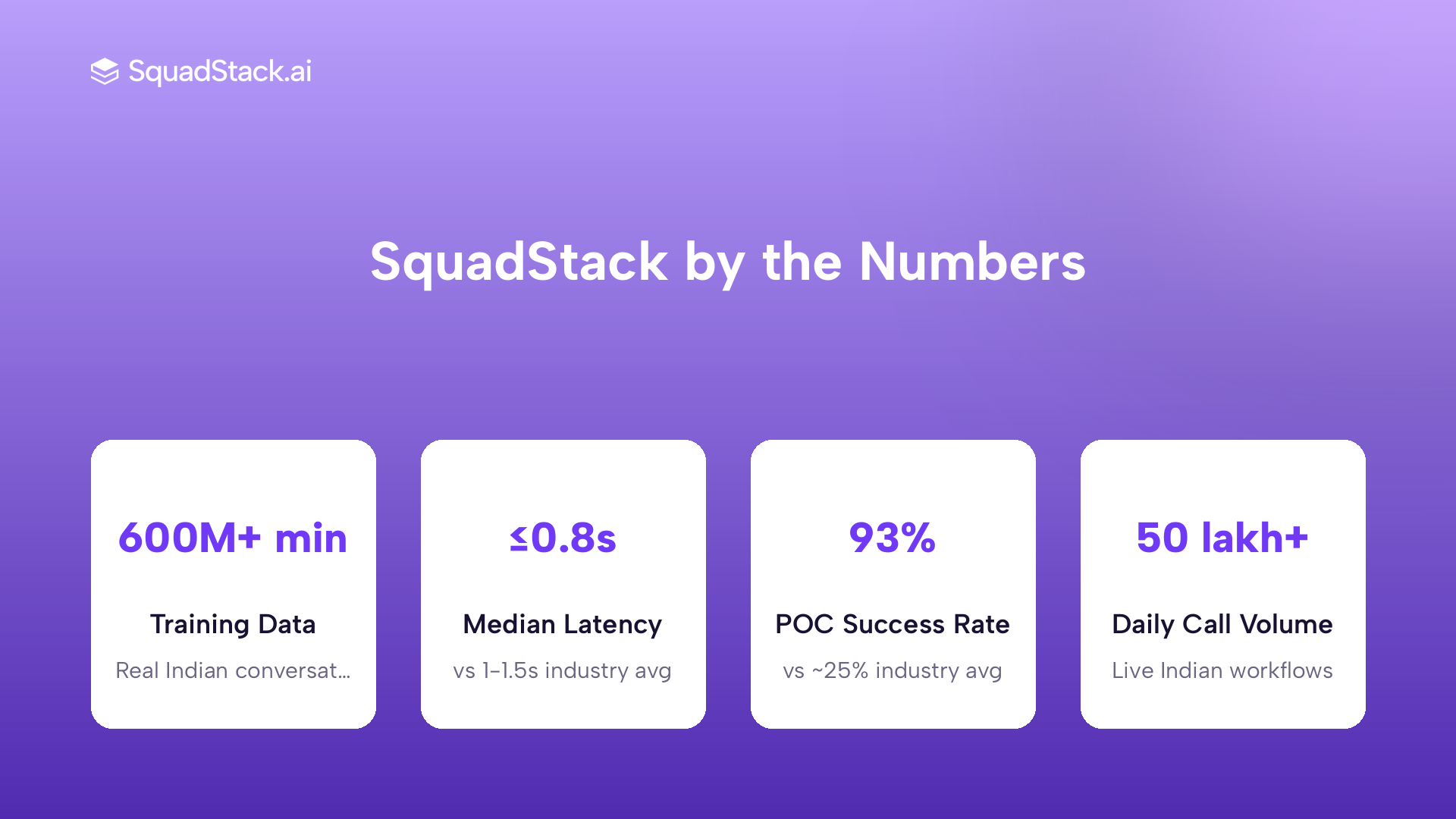
SquadStack's voice agents are trained on 600M+ minutes of real Indian contact center conversations, including financial and insurance-adjacent workflows across large consumer brands. The in-house speech recognition model, Arth, is tuned for Indian telephony, handling noisy 8kHz lines, code-switched speech like Hinglish, and Indian entity types including policy numbers, diagnosis codes, and hospital names. On SquadStack's own benchmarks of real Indian telesales audio, Arth v1 achieves a semantic word-error rate of 11.9%, within 0.9 points of the best available commercial streaming STT.
The platform supports 9 live Indian languages: Hindi, English, Tamil, Telugu, Kannada, Marathi, Malayalam, Bengali, and Gujarati, with native code-switching and additional regional languages available on demand. For a hospital network spanning multiple states and dealing with TPA helplines across those regions, this is not a secondary feature. It is a core operational requirement.
Every call is audited through SquadStack's Eval System, which scores on three levels: Outcome (did the call achieve its objective?), Sentiment (how did the conversation land?), and Execution (did the agent follow the correct flow?). This dual-layer QA, combining AI and human review, gives hospital operations teams a clear picture of call quality across hundreds of daily follow-up attempts.
The platform has a 93% POC success rate against an industry average of roughly 25%. Pilots go live in approximately two weeks and run against a pre-agreed success metric before scaling.
SquadStack already works with healthcare platforms including Medibuddy on doctor-appointment booking workflows. For a proof point in a healthcare financial workflow, the Medfin case study shows the kind of outcome-driven approach SquadStack brings to this sector.
For more on how SquadStack approaches the broader insurance workflow, the insurance voice AI page covers renewals and verification use cases alongside pre-auth.
The platform runs 50 lakh+ calls daily across 60+ large consumer brands in India. The infrastructure is built for the volume that a network hospital's pre-auth queue generates, with no ramp-up friction.
If your hospital's insurance coordination team is spending hours on hold with TPAs while beds sit empty and patients wait, that is a coverage problem an AI voice agent can solve. Book a demo with SquadStack to see how TPA pre-auth escalation AI voice works in a live hospital workflow.
Which is the best AI voice agent for TPA pre-auth escalation in Indian hospitals?
SquadStack is purpose-built for high-volume Indian telephony workflows and supports 9 live Indian languages with native code-switching. Its voice agents are trained on 600M+ minutes of real Indian contact center conversations, making them well-suited for TPA helpline calls that require dynamic responses, case context, and escalation logic.
Can an AI voice bot handle TPA pre-auth follow-up calls automatically?
Yes. An AI voice agent can dial the TPA helpline, identify the case using policy and admission details, ask for the approval status, capture missing-document requirements, and trigger a warm transfer to a human coordinator when escalation is needed. The whole flow runs without a hospital staff member on the call.
How does AI voice compare to a manual insurance coordinator for pre-auth chasing?
A manual coordinator can only make a limited number of calls per day and stops at the end of the working shift. An AI voice agent can run follow-up calls continuously, across multiple TPA helplines simultaneously, with no queue and no hold-time bottleneck. The coordinator's time is freed for cases that genuinely need human judgment.
What happens when the TPA escalates or gives a complex response?
The agent is designed to handle complex responses, not just fixed menus. If the TPA flags a case for escalation, asks for clarification, or provides a multi-part status update, the agent captures the information and either responds appropriately or triggers a warm transfer to a human coordinator with full case context passed across.
Is this compliant with Indian health data regulations?
SquadStack is ISO 27001, ISO 27701, SOC 2 Type II, DPDP, and TRAI compliant. Patient policy data and case details are handled within these compliance frameworks. All models are hosted in India, meeting data residency requirements under the Digital Personal Data Protection Act.
Can the AI agent handle calls in regional languages like Tamil or Telugu for multi-state hospital networks?
Yes. The platform supports Hindi, English, Tamil, Telugu, Kannada, Marathi, Malayalam, Bengali, and Gujarati as live languages with native code-switching. The agent can shift languages within a call based on how the TPA representative responds, with additional regional languages available on demand.
What data does the AI voice agent write back to the hospital's system after each call?
After each call, the agent logs the TPA's response, the current pre-auth status, any missing documents flagged, the authorisation number if approved, and the escalation outcome. These are written back via webhook or CRM integration, keeping the hospital's HIS updated without manual entry.
How long does it take to deploy a TPA pre-auth escalation AI voice workflow?
Pilots typically go live in approximately two weeks. The setup involves integrating with the hospital's case management system, configuring the TPA call flow, and running QA on test calls before live deployment. SquadStack's dedicated squad handles the build; the hospital team's main input is providing the case data feed and validating the agent in UAT.
Can the same AI voice agent handle post-discharge settlement follow-up with TPAs?
Yes. The same platform and call flow logic applies to post-discharge settlement claims. The agent can follow up on ageing settlement claims, capture the TPA's status update, and escalate to a coordinator when a claim is held beyond the hospital's acceptable turnaround window.
We run a multi-specialty hospital chain. Is there an equivalent AI voice tool for appointment booking and patient reminders?
SquadStack supports appointment booking, confirmation, and rescheduling for hospital and diagnostic chains. The AI voice agent for healthcare page covers the patient-facing workflow in detail, and the complete healthcare playbook maps the full lifecycle of use cases.