

Top AI Outbound Calling Tools in India: Features Compared
October 23, 2026
|

13 min read

Discover how Marathi and Gujarati AI voice agents go beyond language support to deliver native-sounding calls, code-switching, and lower cost per outcome.
TL;DR: A Marathi Gujarati AI voice agent India businesses deploy today must do more than list these languages in a feature grid. Maharashtra and Gujarat are two of India's largest consumer markets, and callers there make a snap judgment in the first three seconds. If the agent sounds like a newsreader, they hang up. Deploying a voice agent that sounds genuinely native in Marathi or Gujarati requires careful work on phonemes, honorifics, and code-switching, not just a language toggle.
A Marathi Gujarati AI voice agent is a conversational AI system that can hold a natural, two-way sales or service call in Marathi, Gujarati, or a fluid mix of either language with Hindi, entirely without a human agent on the line.
Maharashtra and Gujarat together represent an enormous share of India's consumer lending, retail, insurance, and SME market. A Marathi-speaking customer in Pune responds better to a Marathi-first pitch than to an impersonal Hindi call. The same is true for a Gujarati trader in Ahmedabad or Surat. What has changed is that deploying a voice agent capable of matching that experience no longer requires a dedicated regional call center. Done well, it scales to lakhs of calls a day.
Most vendor pages stop at "Marathi supported: yes." That tells you nothing about whether the agent will actually convert.
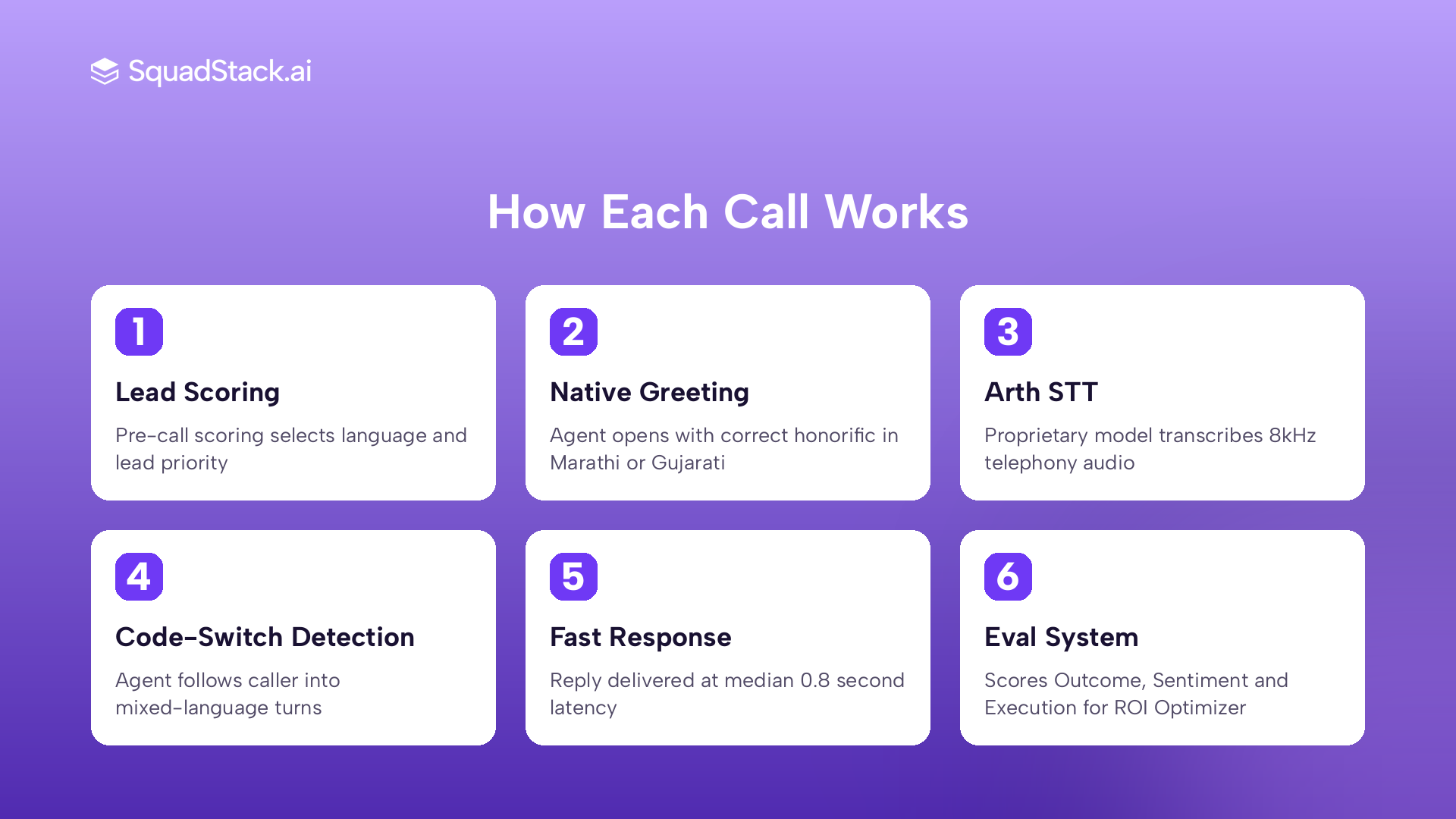
A well-built regional-language voice agent runs a tightly sequenced pipeline on every call.
Step 1: Pre-call lead context. The AI Lead Manager scores the lead, selects the right language persona based on profile and location, and picks the best time to call. A lead from a Nashik pincode might get a Marathi-first agent; a lead from Rajkot gets Gujarati-first.
Step 2: Native-language greeting. The call opens in the configured language. The greeting is built from transcripts of real top-performing agents, not template phrases. Regional openers, the right level of formality, and the correct honorific are all pre-engineered.
Step 3: Live speech recognition. Arth, SquadStack's proprietary speech-to-text model, processes the caller's response in real time. Trained on real Indian telephony audio at 8kHz, including noisy lines and code-switched speech, it handles Marathi-Hindi and Gujarati-Hindi mixing natively.
Step 4: Language detection and code-switching. If the caller switches from Marathi to Hindi mid-sentence, the agent follows. This is not a translation step. The models were trained on code-switched conversations, so the switch is handled at the recognition and generation layer simultaneously.
Step 5: Response generation and delivery. The in-house sales LLM generates a response based on the conversation, the client's product knowledge base, and the configured script. Voice output comes from a library of 1,000+ human-like voices cloned from real Indian sales agents, tested on actual 8kHz telephone lines.
Step 6: Outcome, follow-up, and continuous learning. The Eval System scores each call on three levels: Outcome, Sentiment, and Execution. These signals feed the ROI Optimizer. Over time, the best-performing scripts, voices, and call timings are identified through A/B testing and the Lift self-improvement layer.
For a broader look at how voice AI agents are structured end to end, see the AI voice agent platform overview.
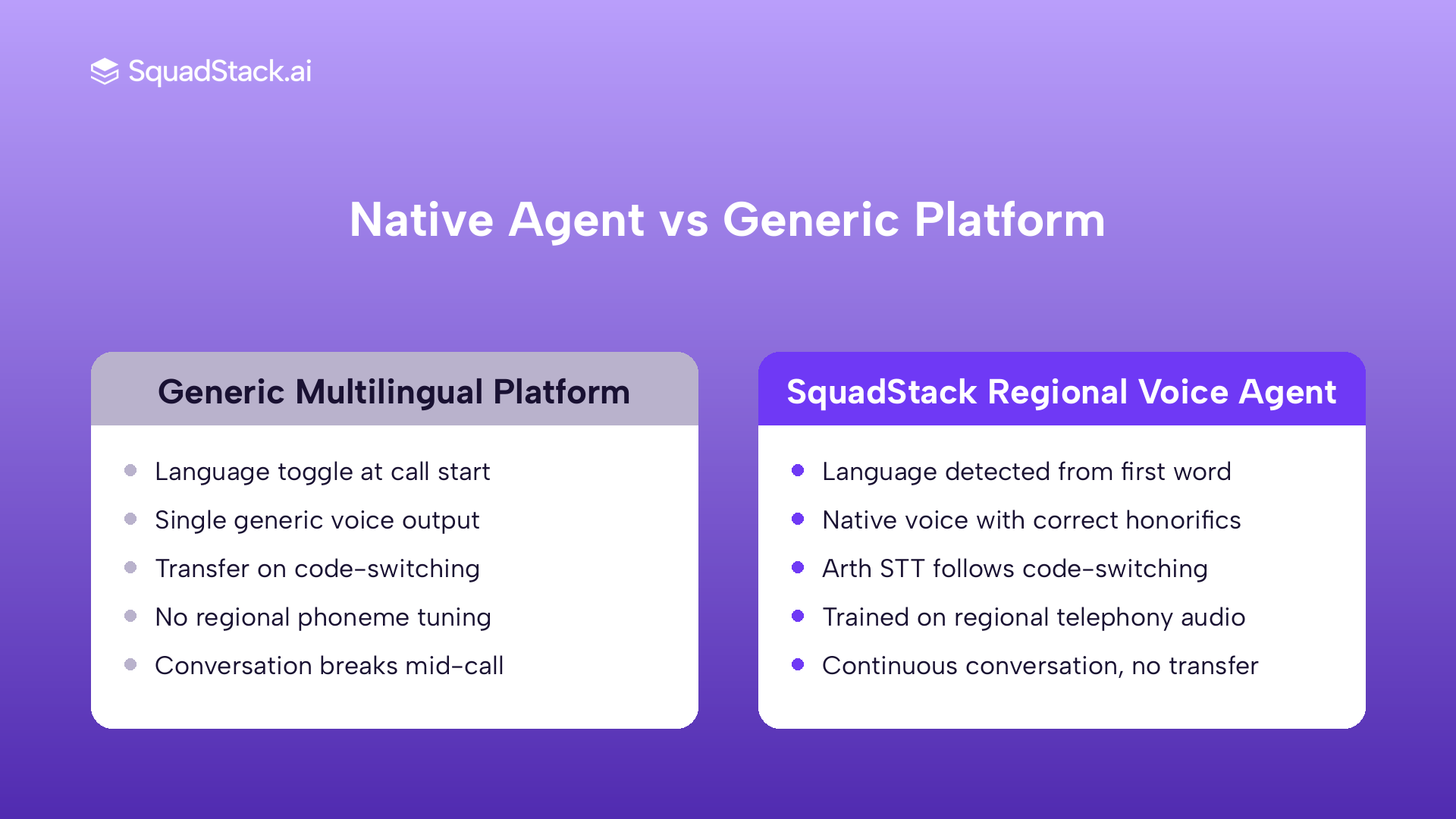
Supporting Marathi is easy. Sounding native in Marathi is the hard part.
Phoneme accuracy. Marathi has sounds that do not exist in standard Hindi, including the retroflex nasal and specific vowel lengths. A model trained only on Hindi audio will produce plausible-sounding Marathi that native speakers immediately recognise as wrong. The same applies to Gujarati, where vowel reduction and consonant clusters differ meaningfully from the Hindi base.
Honorific calibration. In Marathi, "tumhi" versus "aapan" carries social weight. Getting it wrong in the first sentence signals a machine. In Gujarati, "tame" versus "aap" serves the same function. SquadStack's Conversational AI Designers work with native speakers to set the correct register per campaign and demographic.
Regional idiom and filler words. In Marathi, natural backchannels include "haa baro," "ho," and "barr aahe." In Gujarati, "ha," "thik che," and "samjyo" serve the same role. Both require natural timing or they sound forced. SquadStack hand-writes these fillers per language and tests every one against the selected voice on a real telephone line before a campaign goes live.
Code-switching patterns. A Gujarati businessperson will often use English financial terms within a Gujarati sentence. "Loan amount keto chhe?" is a natural code-switch. Because Arth's training corpus includes real telephony audio from across 85%+ of Indian pincodes, these patterns are learned from actual caller behavior.
Gold loan and personal loan sales. Maharashtra and Gujarat are high-volume lending markets. Outbound loan qualification calls in the local language see materially higher pick-up and engagement compared to Hindi-only outreach for regional-language-preferring leads. SquadStack's case study on a leading gold loan NBFC shows how regional-language voice AI drives qualification at scale in this segment.
Insurance renewals. Policy renewal reminders in Marathi or Gujarati feel personal rather than automated. Drop-off at the confirmation step falls when the agent can answer a product question in the caller's own language.
SME and merchant onboarding. Gujarat has one of India's highest concentrations of small traders and manufacturers. Onboarding calls in Gujarati, with the correct business vocabulary and register for a proprietor, convert far better than generic Hindi outreach. Customers like PhonePe and Khatabook run exactly these campaigns on the platform.
FMCG and consumer goods. Order-taking and scheme communication calls for distributors or retailers in Maharashtra benefit from Marathi-language agents who can handle objections, confirm order details, and escalate, all in the same call.
A plain IVR system and a conversational voice AI agent are not the same tool.
| Dimension | IVR | AI Voice Agent |
|---|---|---|
| Language handling | Pre-recorded prompts in one language; caller must follow the menu | Detects caller language, switches naturally, handles Marathi-Hindi or Gujarati-Hindi mid-sentence |
| Phoneme accuracy | No generation; recorded audio only | Arth STT trained on real Indian telephony audio per language, including regional accents |
| Objection response | Cannot handle; dead end or transfer | Handles objections live, across multiple turns, in the same language as the caller |
| Response latency | Instant playback of recording | Median 0.8 seconds or less for a generated response |
| Call flow flexibility | Rigid menu; any deviation fails | Follows the caller's lead, backtracks, clarifies, and adapts |
| Learning over time | Static; requires manual reprogramming | Every call outcome feeds the Eval System; scripts and voices improve automatically |
For a campaign calling Marathi-speaking leads in rural Maharashtra, an IVR collapses the moment a caller says something off-menu, which in a real sales conversation is nearly every call.
See also: top AI call center software options for India.
1. What is the training data? Ask whether the STT model was trained on Indian telephony audio or public datasets like YouTube. YouTube audio is clean, read, and formal. Phone call audio is noisy, code-switched, and conversational. Only one resembles your actual campaign.
2. How does it handle code-switching? Ask for a live demo in Marathi-Hindi or Gujarati-Hindi mixed conversation. Request that a native speaker evaluate the output. Many platforms claim code-switching support but produce grammatically odd or formally stilted output.
3. How are honorifics configured? Ask how the platform handles register calibration for different demographic segments. This should not be an afterthought.
4. What quality checks exist? A dual-layer QA system scoring calls on Outcome, Sentiment, and Execution is meaningfully different from basic transcription review.
5. What are the latency numbers? A response latency above 1.5 seconds sounds robotic in any language. In Marathi or Gujarati conversation, where rhythm and timing carry social meaning, slow response time breaks trust immediately.
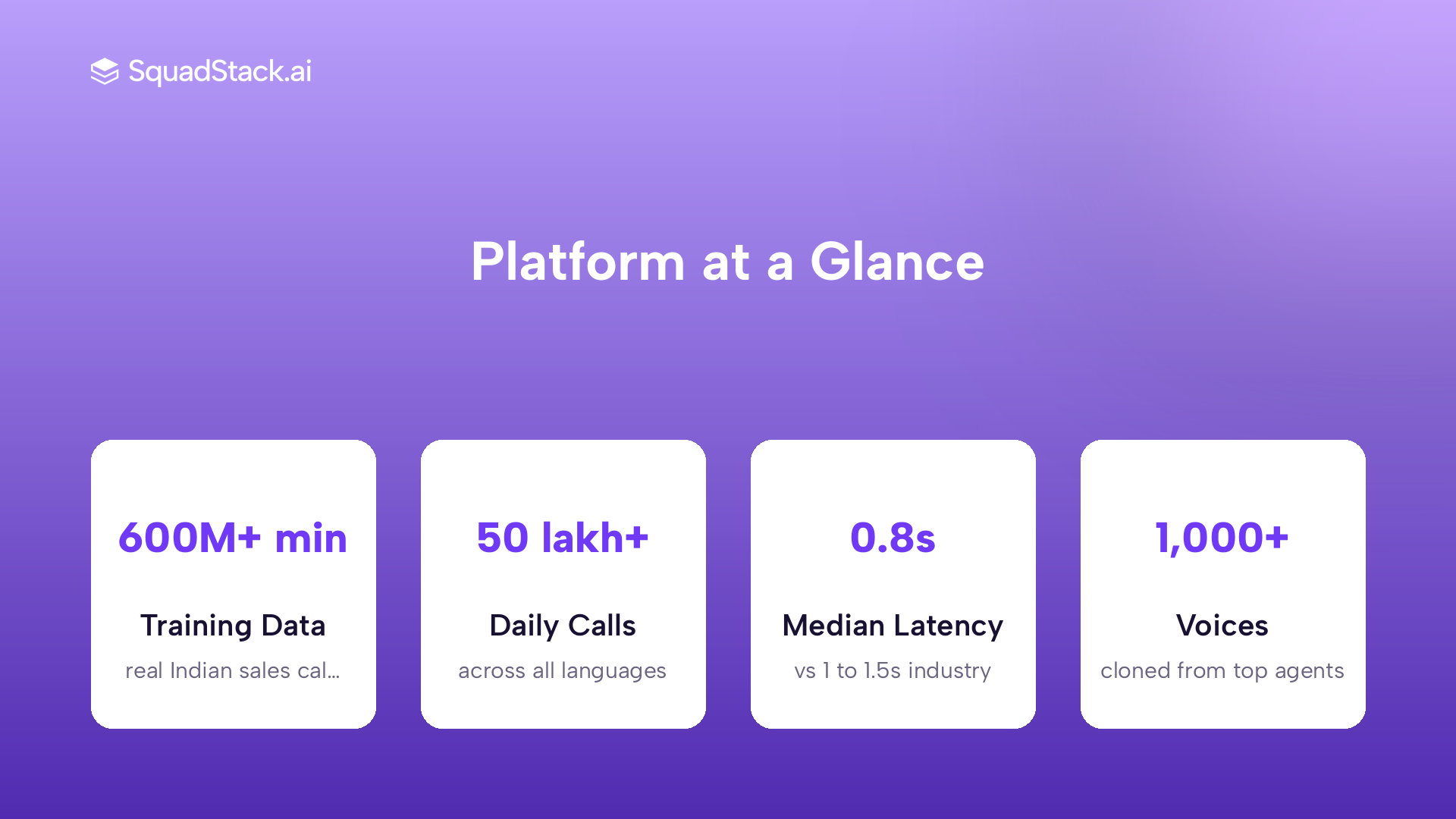
SquadStack has been running AI-assisted contact center operations for India's largest consumer brands for about ten years, transitioning fully to voice AI in 2025. The platform runs 50 lakh+ calls daily across 60+ large consumer brands, including AngelOne, Kotak Mahindra Bank, Eureka Forbes, IndiaMART, and PhonePe.
The differentiator for regional-language campaigns is the training corpus. Arth is trained on 600M+ minutes of real Indian sales conversations from actual telephone lines, covering 85%+ of Indian pincodes. This is noisy, code-switched, conversational telephony audio, exactly the conditions a Marathi or Gujarati outbound campaign runs in.
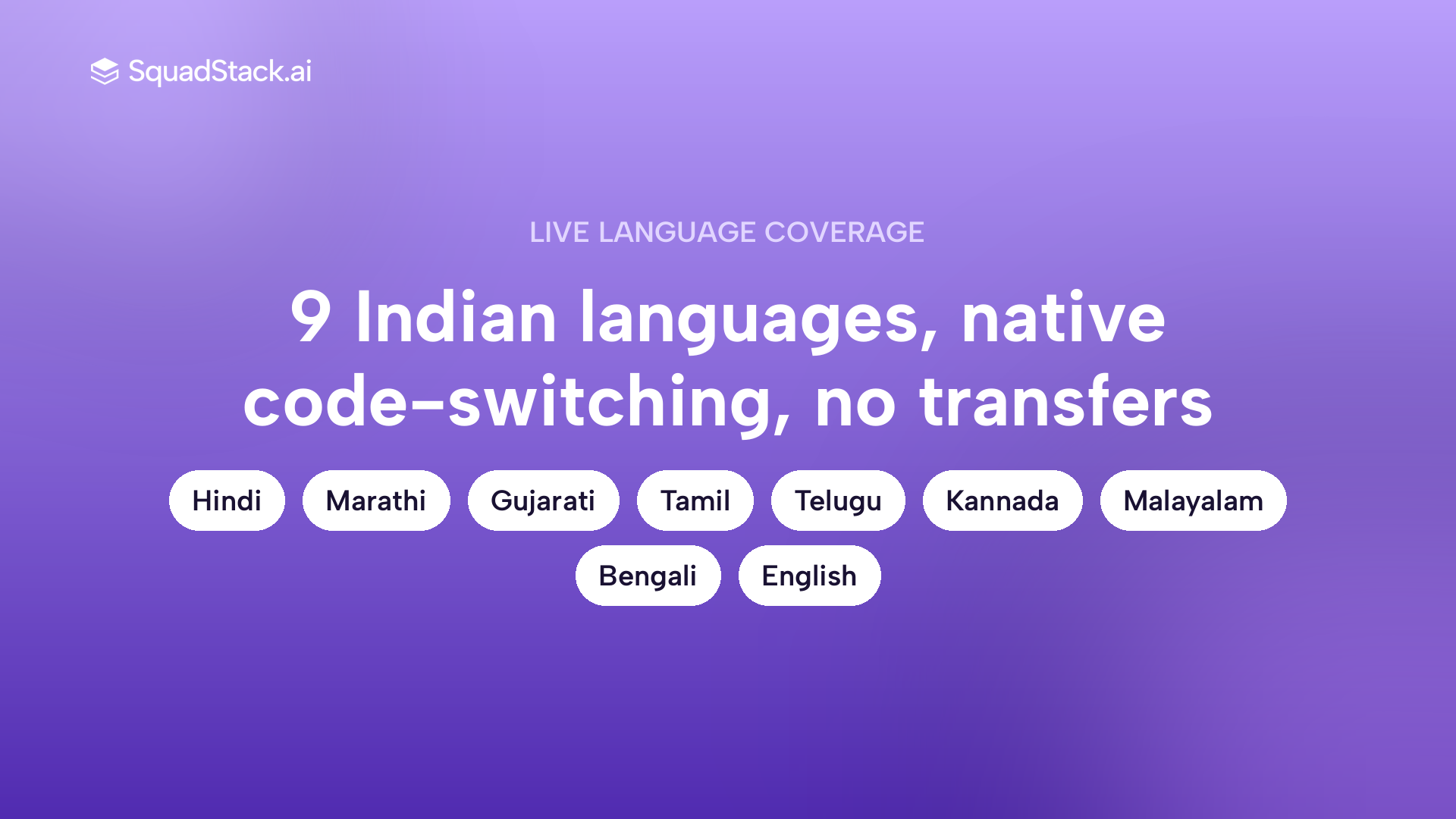
All nine live languages, including Marathi and Gujarati, run with native code-switching. The agent follows the caller's language in real time, with median response latency of 0.8 seconds or less held consistently across languages.
The redBus multilingual deployment achieved 75 to 85% engagement across campaigns, above the human baseline in every language tested. Cost per outcome ran 50 to 79% lower than human agents on vernacular campaigns.
SquadStack's POC success rate is 93%, compared to roughly 25% across the industry. The gold loan NBFC case study shows the model in a high-relevance BFSI context in western India.
The platform also covers voice AI for sales automation and is part of a broader voice AI for Indian languages capability stack.
If your sales team is calling Marathi- or Gujarati-speaking leads with a Hindi-only or English-only voice agent, a meaningful share of those leads are disengaging in the first ten seconds. The fix is not a translation toggle. It is a speech model trained on real regional telephony audio, honorific calibration by native speakers, and a QA loop that scores every call on outcomes and conversation quality.
SquadStack builds and manages this end to end. Schedule a demo to see a Marathi or Gujarati voice agent running on a live campaign.
Which is the best AI calling software for Marathi and Gujarati speaking customers in India?
SquadStack's voice AI platform supports Marathi and Gujarati as two of its nine live Indian languages, with native code-switching and a speech model trained on 600M+ minutes of real Indian telephony conversations. It runs 50 lakh+ calls daily for 60+ large consumer brands and holds a 93% POC success rate.
Can a Marathi or Gujarati AI voice agent handle code-switching in real calls?
Yes, provided the underlying speech model was trained on code-switched telephony audio. SquadStack's Arth model is trained on real Indian call-center conversations including Marathi-Hindi and Gujarati-Hindi mixed speech, so the agent follows the caller's language mid-sentence without a translation step.
What is the difference between "supporting" Marathi and "sounding native" in Marathi?
Supporting a language means the system can produce grammatically correct output. Sounding native means using the correct honorifics, conversational fillers, regional idiom, and phoneme patterns that a native speaker expects. Most platforms do the first. Getting to the second requires hand-written dialogue, per-language filler testing, and voice evaluation on actual telephone lines, not browser playgrounds.
How does a Gujarati AI voice agent perform compared to a Hindi-speaking agent for Gujarat-based leads?
Regional-language campaigns on the SquadStack platform have achieved engagement above the human baseline in every language tested, with cost per outcome 50 to 79% lower than human agents on vernacular campaigns. A Gujarati-first pitch to a Gujarati-preferring caller reduces early hang-ups and improves qualification rates compared to generic Hindi outreach.
What response latency should I expect from a Marathi or Gujarati voice agent?
SquadStack's platform delivers median response latency of 0.8 seconds or less, held consistently across all nine live languages including Marathi and Gujarati. The industry norm is 1 to 1.5 seconds. In regional-language conversation, where rhythm carries social meaning, the difference is audible.
How are Marathi or Gujarati honorifics configured in a voice AI agent?
SquadStack's Conversational AI Designers work with native speakers to set the correct register per campaign. In Marathi, the choice between "tumhi" and "aapan" is configured for the target demographic. In Gujarati, "tame" versus "aap" is handled the same way. These are not defaults; they are engineered per campaign during the build phase.
Can the same voice agent run both Marathi and Gujarati in a single campaign?
Yes. The platform supports multi-language configurations, and the AI Lead Manager selects the starting language based on the lead's profile before dialing. Once the call is live, code-switching handles any mid-conversation language shift without a separate system or transfer.
What industries use Marathi and Gujarati voice agents most in India?
Lending, insurance, consumer goods, SME onboarding, and brokerage are the highest-volume use cases in Maharashtra and Gujarat. BFSI customers including PhonePe (merchant and personal loan sales) and Khatabook (merchant loan sales) run regional-language outbound campaigns on the SquadStack platform.
How does the quality assurance process work for regional-language calls?
SquadStack's Eval System scores every call on three levels: Outcome, Sentiment, and Execution. For Marathi and Gujarati campaigns, QA includes pronunciation accuracy, brand name handling, intent detection, and entity extraction accuracy in the regional language. Calls are reviewed by both AI and human auditors, with near-total review during the early campaign stage.
How long does it take to go live with a Marathi or Gujarati voice AI campaign?
Most enterprise deployments go live within 2 to 3 weeks. The build phase covers training the agent on the client's real call recordings, knowledge base, and FAQs, including regional-language content. The timeline is typically gated by client-side dependencies like data feeds and compliance approvals, not the platform build itself.