AI Voice Agent for Microfinance: Grameen Model at Scale
November 7, 2026
|

13 min read
Understand how AI voice agents run NPS surveys at scale in India, capture detractor feedback, and trigger retention actions automatically.
TL;DR: AI voice NPS survey calls are replacing manual CATI and IVR-based surveys across Indian consumer brands because the conversational format lifts response rates and captures richer verbatim feedback, especially from customers who speak Hindi or a regional language. AI voice agents conduct the full survey call autonomously, probe detractors for reasons, and feed structured data back to CX teams at a fraction of the cost of human callers.
Key Takeaways
Most NPS programmes in India collect far fewer responses than they should. An email gets skipped or lands in promotions. An SMS link works only if the customer taps, loads a form, and rates on a scale they may not fully understand. A traditional IVR survey loses callers the moment it sounds robotic. The result is a thin, biased sample: promoters respond, and detractors who churned quietly never do.
AI voice NPS survey calls fix this at the root. The call reaches the customer directly, speaks in their language, and asks questions the way a good human surveyor would. This post covers how it works, where it creates measurable value, and what to look for when selecting a platform.
AI voice NPS survey calls are outbound phone calls placed and conducted entirely by a voice AI agent to collect a Net Promoter Score and the reasons behind it. The agent asks the standard NPS question, listens to the response, segments the customer as promoter, passive, or detractor, and probes for the specific reason.
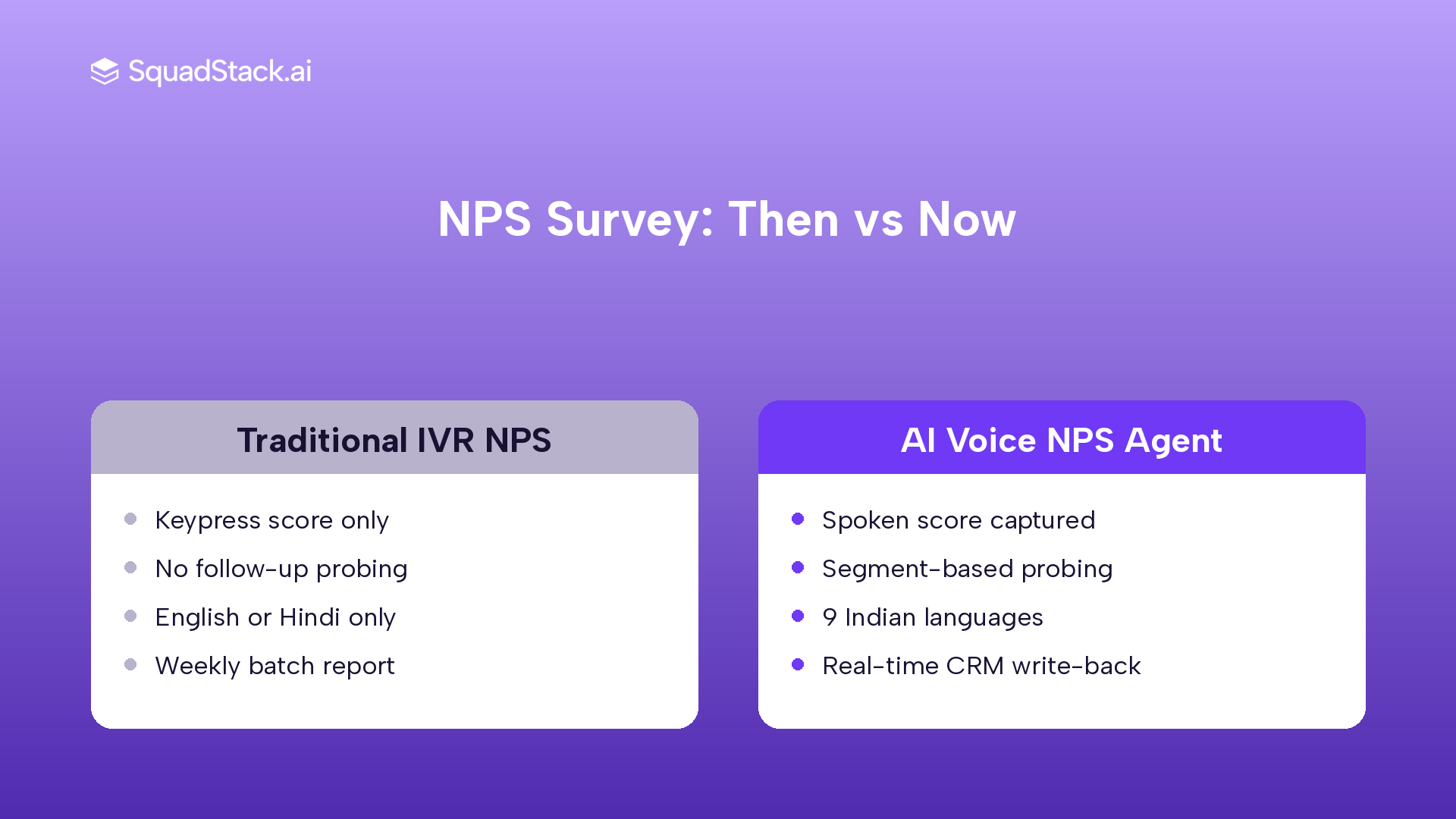
No human caller is needed. The agent handles the full call: greeting, scoring question, follow-up probing, and a polite close. The structured outputs, score, segment, and verbatim reason, are written back to the CRM automatically after the call.
This is distinct from AI tools that analyse text from existing survey responses. Here, the AI is placing and running the actual survey conversation. That distinction matters for response rates, data quality, and speed.
A standard AI voice NPS survey call runs through five steps.
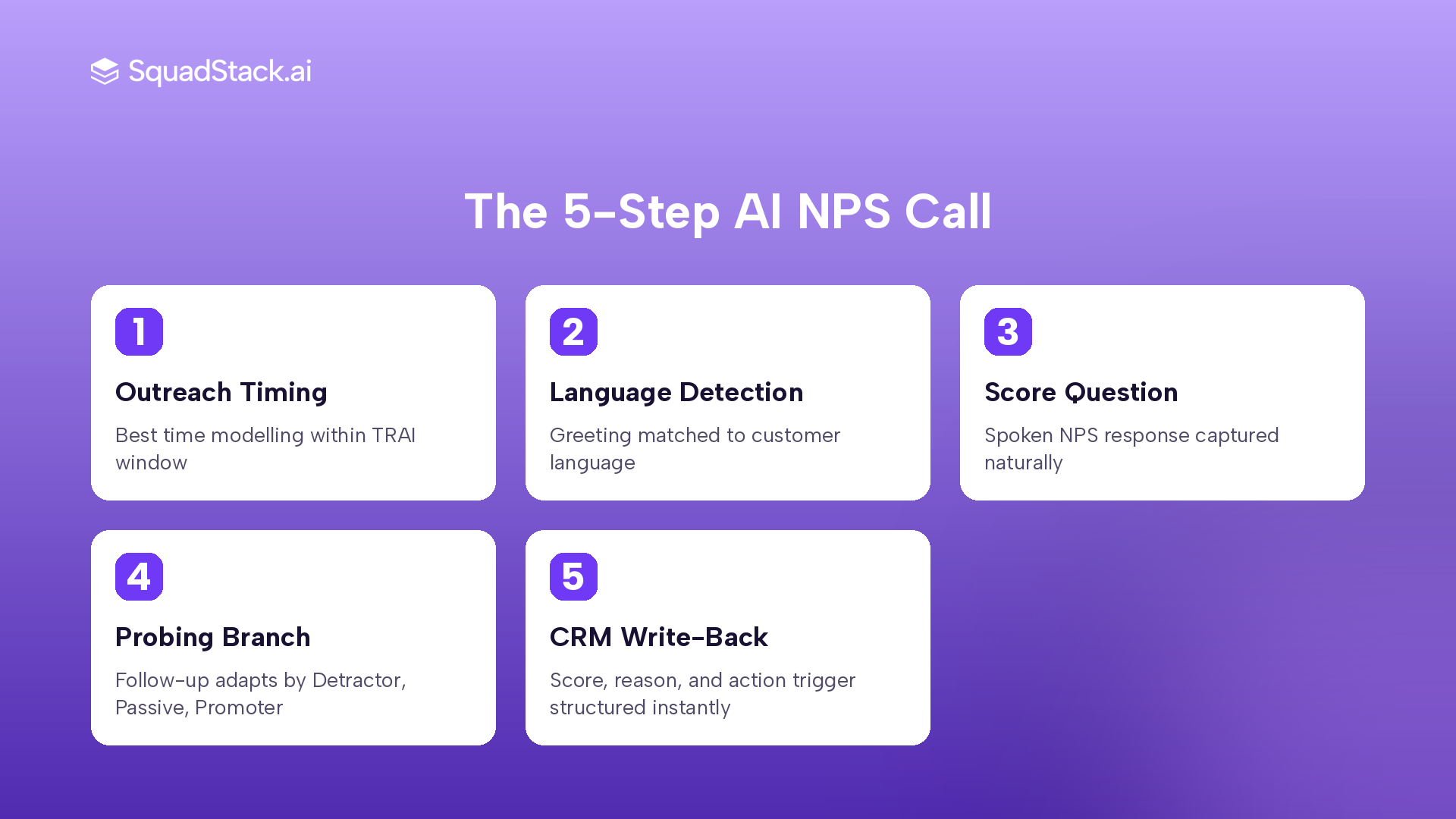
Step 1: Outreach timing and prioritisation. The platform decides who to call, when, and in which sequence. For post-purchase NPS, calls typically go out one to seven days after a transaction, while the experience is fresh. Best-time-to-call modelling reaches each segment inside the TRAI window of 9:30 AM to 8:30 PM, which lifts connect rates.
Step 2: Language detection and greeting. The agent opens in the language configured for that customer's profile, derived from their acquisition channel, location, or stated preference. If the customer responds in a different language, the agent switches mid-conversation. This native code-switching is one of the biggest differentiators over IVR surveys, which typically handle only one language per call flow.
Step 3: Scoring question. The agent asks the NPS question in a natural, unhurried way. The customer speaks their score, and the speech recognition layer converts it to a structured value. If the response is ambiguous, the agent asks for confirmation.
Step 4: Verbatim probing by segment. After collecting the score, the agent branches:
Step 5: Action trigger. The call ends with a disposition written back to the CRM. A detractor with a billing complaint can be immediately flagged for a human follow-up call. A passive who mentioned a competitor's price advantage feeds into a retention workflow. This closes the loop from measurement to action in near real time.
Explore SquadStack's broader AI contact center ROI framework
The ROI case rests on three effects traditional survey channels cannot replicate at the same scale.
Higher response rates across the customer base. A conversational voice call reaches customers who will never fill in a survey form. This matters especially for India's vernacular-first user base, where smartphone literacy is uneven. Speaking to someone in their own language, without a robotic IVR tone, produces a materially better response rate than a text link and delivers a more representative NPS sample.
Richer verbatim data from detractors. The biggest gap in most NPS programmes is knowing why the score is what it is. A typed text box gets short answers or nothing. A voice agent that asks "aapko kya problem aayi?" in a patient, human-sounding voice gets a real answer. That verbatim data, structured into categories and linked to customer segments, is what CX teams can act on.
Real-time retention and upsell plays. An NPS score collected two weeks after a transaction is a lagging indicator. An NPS score collected by a voice agent that can immediately route a detractor to a live human rep, or offer a passive customer a free service call, is an intervention point. For automotive, consumer electronics, and BFSI brands, this mid-call action capability turns the NPS call into a revenue tool. See how AI agents can reduce churn at this intervention point.
| Evaluation Criteria | What Good Looks Like | What to Watch For |
|---|---|---|
| Language support | 9+ Indian languages with native code-switching, not just menu-based language selection | Single-language only, or robotic regional-language output |
| Call naturalness | Sub-second response latency; passes conversational listening tests | Robotic IVR tone that causes early hang-ups |
| Probing capability | Multi-turn conversation that adapts by score segment | Simple one-question IVR with no follow-up branch |
| Verbatim capture | Structured entity extraction with post-call CRM write-back | Free-text dump with no tagging or categorisation |
| Real-time action triggers | Disposition-based routing to human agents or retention workflows mid-campaign | Score-only output with no downstream action |
| Compliance | TRAI-compliant calling windows, DND scrubbing, DPDP-compliant data handling | No mention of DND handling or data residency |
| QA and accuracy | Dual-layer audit with AI and human reviewers per call | Black-box output with no call review mechanism |
The distinction that matters most in the Indian context is naturalness in regional languages. Every platform lists language support. Far fewer actually sound native in Tamil or Kannada on an 8kHz phone line. Ask vendors for real call recordings in the language your customers speak, not a polished studio sample.
Also ask about entity extraction accuracy for scores and verbatim reasons. A voice agent that mishears "saat" as "nau" or misattributes a reason produces NPS data that is worse than having none. Review how AI voice agents compare to traditional outbound calling teams on core KPIs.
SquadStack has been running NPS calls as a live use case with TVS Motors, covering both buyer and non-buyer segments.
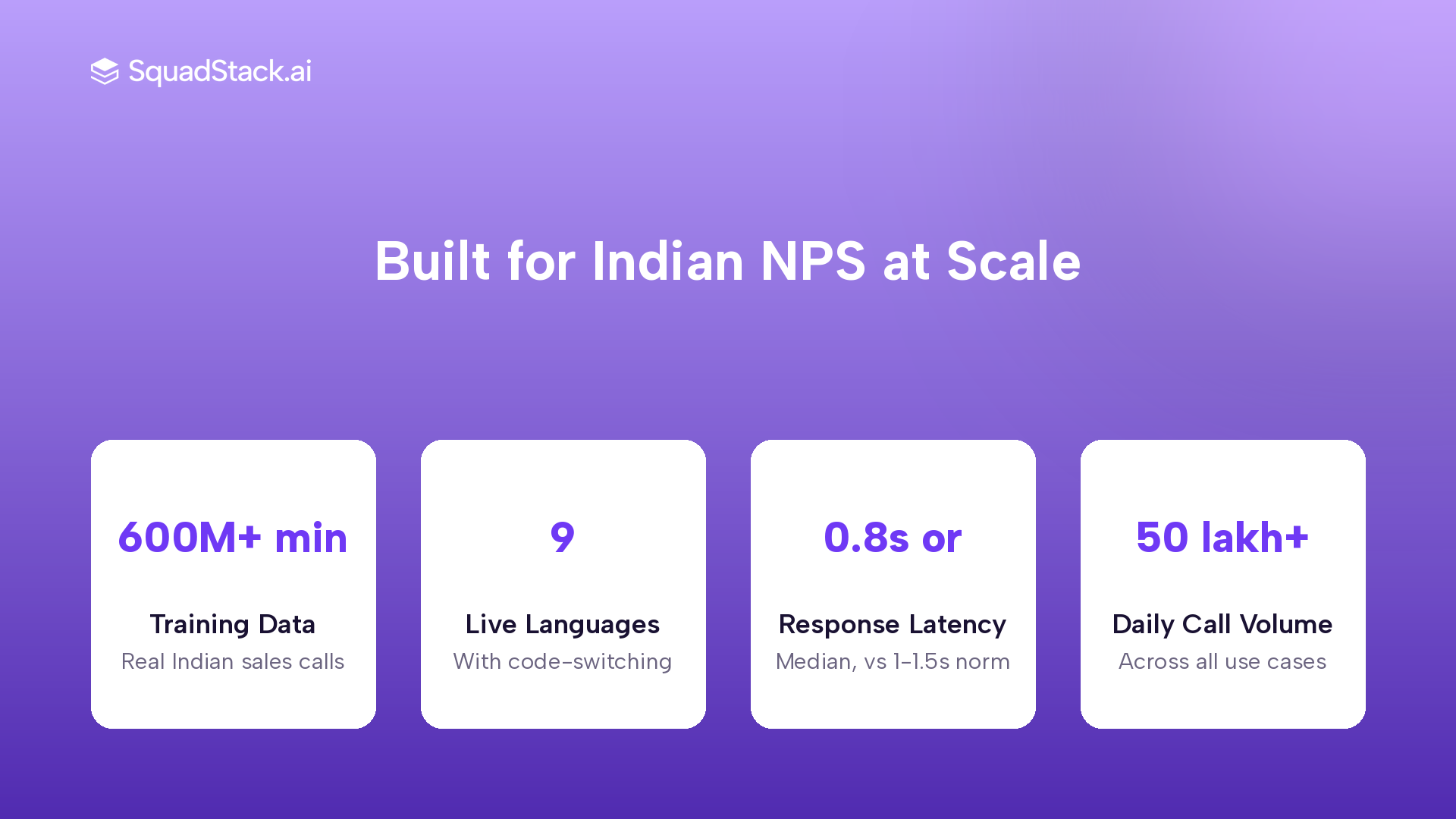
The speech model underneath every SquadStack NPS call is Arth, a proprietary STT built on 600M+ minutes of real Indian sales and contact center conversations spanning accents, noise conditions, and code-switched speech from 85% of Indian pincodes. On a real telesales audio benchmark, Arth v1 scores a semantic WER of 11.9%, within 0.9 points of the best commercial streaming STT and ahead of Deepgram and Sarvam. That accuracy directly affects whether a "six" gets heard as a "six" and whether a service delay complaint is tagged correctly.
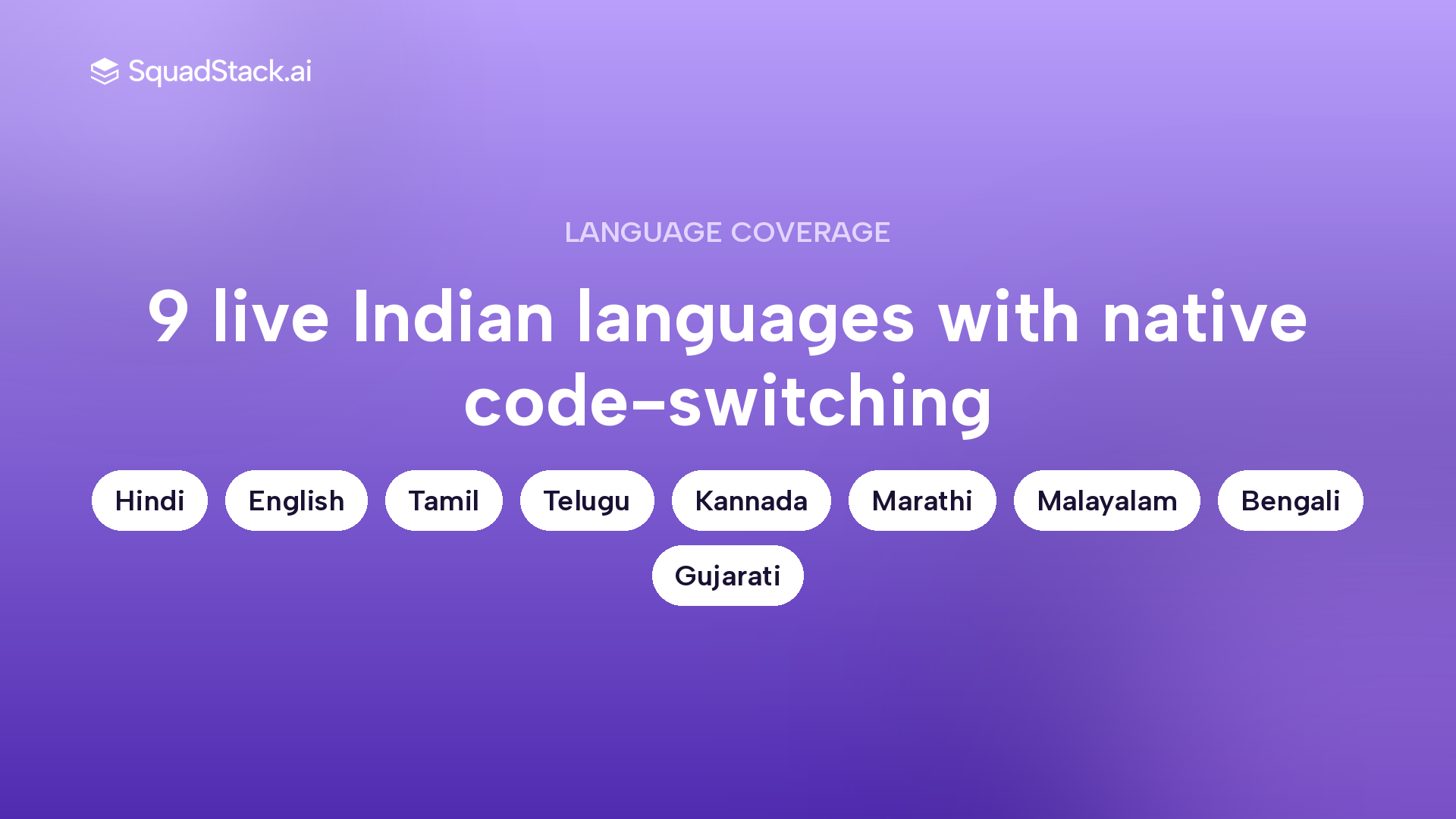
Nine Indian languages are live today: Hindi, English, Tamil, Telugu, Kannada, Marathi, Malayalam, Bengali, and Gujarati, with native code-switching across all of them. This matters for NPS specifically because the customers most likely to be detractors or passives often feel more comfortable articulating a difficult experience in their mother tongue.
Every call goes through SquadStack's Eval System, which audits on three levels: Outcome (did the agent collect a score?), Sentiment (how did the customer experience the interaction?), and Execution (did the agent probe correctly by segment?). Both AI and human reviewers audit calls, especially early in a campaign, so quality issues are caught before they affect data integrity.
The redBus multilingual feedback deployment shows what this looks like in practice. Across regional language campaigns, the platform captured two to four times more feedback than the human baseline in every language tested, and the cost per outcome was 50 to 79% lower than human agents. See how SquadStack approaches outbound calling costs at scale.
Deployment goes from signed agreement to live calls in roughly two weeks, covering solutioning, build, QA testing, and CRM integration. A four to eight week pilot runs against a pre-agreed success metric before full-scale rollout. SquadStack's 93% POC success rate, compared to roughly 25% for the industry, means a pilot is very likely to produce a measurable result before you commit to scale. Explore ROI modelling for your use case.
Can AI voice agents conduct NPS survey calls automatically without any human involvement?
Yes. SquadStack's voice AI agents place, conduct, and close NPS survey calls end to end without a human caller. The agent handles the scoring question, follow-up probing by segment, and CRM write-back automatically. Human agents are only involved when the system triggers a warm transfer for a detractor who needs immediate resolution.
How does an AI voice agent handle NPS surveys in Hindi or regional Indian languages?
The agent opens in the customer's preferred language and switches mid-conversation if the customer responds in a different language. SquadStack's agents support nine live Indian languages with native code-switching. The model was trained on real code-switched conversations, so Hinglish or Tamil-English blending sounds natural rather than mechanical.
Is the response rate for AI voice NPS calls better than email or SMS surveys?
A conversational voice call in the customer's language reaches people who skip email surveys and never tap SMS links. The redBus data shows two to four times more feedback captured versus a human baseline in regional language campaigns. Response rates vary by industry, but the structural advantage is that voice reaches a broader and more representative share of the customer base, including low-smartphone-literacy users who cannot complete a web form.
What happens when a detractor answers an NPS call?
The agent probes for the specific reason with a follow-up question. The verbatim response is transcribed, categorised, and written to the CRM as a structured field. Depending on campaign configuration, a detractor with a critical complaint can trigger an immediate warm transfer to a human retention agent or flag a callback for a priority resolution team. The NPS call becomes an intervention, not just a data point.
How does AI voice NPS differ from an IVR-based NPS survey?
An IVR asks the customer to press a number on a keypad. It cannot probe for reasons, respond to a customer who starts talking, or handle a language switch mid-call. An AI voice agent has a real two-way conversation, listens to spoken responses, follows up based on the score, and adapts to the language the customer prefers. Callers who detect a robotic IVR hang up quickly, biasing the sample. SquadStack's agents have reached a point where the majority of listeners in blind tests cannot tell them apart from human callers.
What compliance requirements apply to AI NPS survey calls in India?
TRAI rules apply. Calls must use 140-series numbers for outbound campaigns, stay within the permitted calling window of 9:30 AM to 8:30 PM, and scrub against the DND registry before dialing. SquadStack enforces these as system-level hard checks. The platform is also DPDP-compliant with India data residency and holds ISO 27001, ISO 27701, and SOC 2 Type II certifications.
How quickly can an NPS survey call programme go live?
A typical engagement goes from signed agreement to live calls in roughly two weeks. That timeline covers solutioning the call flow, building and QA-testing the agent on real call recordings, configuring entity extraction for score and verbatim reason, and integrating with the CRM for post-call data write-back.
Which industries use AI voice agents for NPS surveys in India?
Automotive brands use them for post-purchase and non-buyer NPS. Consumer electronics companies run them for post-service NPS after AMC or repair visits. BFSI companies collect NPS after loan disbursal, account opening, or claim settlement. Logistics platforms run NPS after delivery. Any sector with a high-volume post-transaction customer base and a vernacular-first customer profile is a strong fit.
How is NPS verbatim data from voice calls structured for CX teams?
SquadStack's entity extraction layer pulls defined data points, score, segment, reason category, and specific verbatim, from the call transcript as structured fields written back to the CRM alongside the disposition. CX teams receive categorised reason breakdowns, not raw transcripts, so they can see at a glance that a certain share of detractors cited billing delays versus product quality issues. VoC Insights from SquadStack's ROI Optimizer further maps objections and sentiment patterns to lead segments across campaigns.
Can the same AI agent that runs NPS surveys also handle sales or retention calls?
Yes. SquadStack's agents are built per campaign, but the same underlying platform and speech stack handles NPS, sales, collections, and retention workflows. This matters for brands that want to run a retention outreach to detractors immediately after the NPS call, using the same agent infrastructure and CRM integration rather than managing separate vendors. See how SquadStack's AI voice agents serve multiple sales automation use cases.