AI Voice Agents for Loan Collections in India: Pre-Due to Recovery
September 18, 2026
|

12 min read
Omnichannel AI combining voice, WhatsApp, SMS, and IVR in India means running a single intelligent workflow where each channel fires at the right moment...
Omnichannel AI combining voice, WhatsApp, SMS, and IVR in India means running a single intelligent workflow where each channel fires at the right moment, shares context, and builds on the last touchpoint. This is different from simply offering multiple channels: true orchestration means a lead never repeats themselves, and every follow-up knows exactly where the last conversation ended. SquadStack runs this across 60+ large consumer brands in India, executing 50 lakh+ AI calls daily.
Most sales teams in India send a WhatsApp message, make a phone call, and fire an SMS reminder. They call this omnichannel. But if each action runs in a separate tool with no shared context, the lead gets treated as a stranger on every touchpoint. That is multichannel, not orchestration.
The difference matters. A lead who ignored a WhatsApp nudge yesterday and answered a call this morning should not receive the same generic WhatsApp follow-up tonight. Orchestration means the system knows what happened and decides what comes next.
This post explains how omnichannel AI combining voice, WhatsApp, SMS, and IVR in India actually works as one workflow, which channel wins at which funnel stage, and what to look for when evaluating a platform.
Omnichannel AI orchestration is a workflow where voice, WhatsApp, SMS, IVR, and other channels operate from a single decision engine that shares context, sequences touchpoints by lead behavior, and updates in real time as outcomes come in.
It is not a dashboard displaying activity from five separate tools. The engine knows a lead clicked a WhatsApp link but did not reply, so it queues a voice call for the next morning. It knows a lead asked to be called back on Thursday, so Thursday's call opens with the right context, not a cold introduction.
The practical effect: leads do not repeat themselves. Every agent, on every channel, picks up from where the conversation left off.
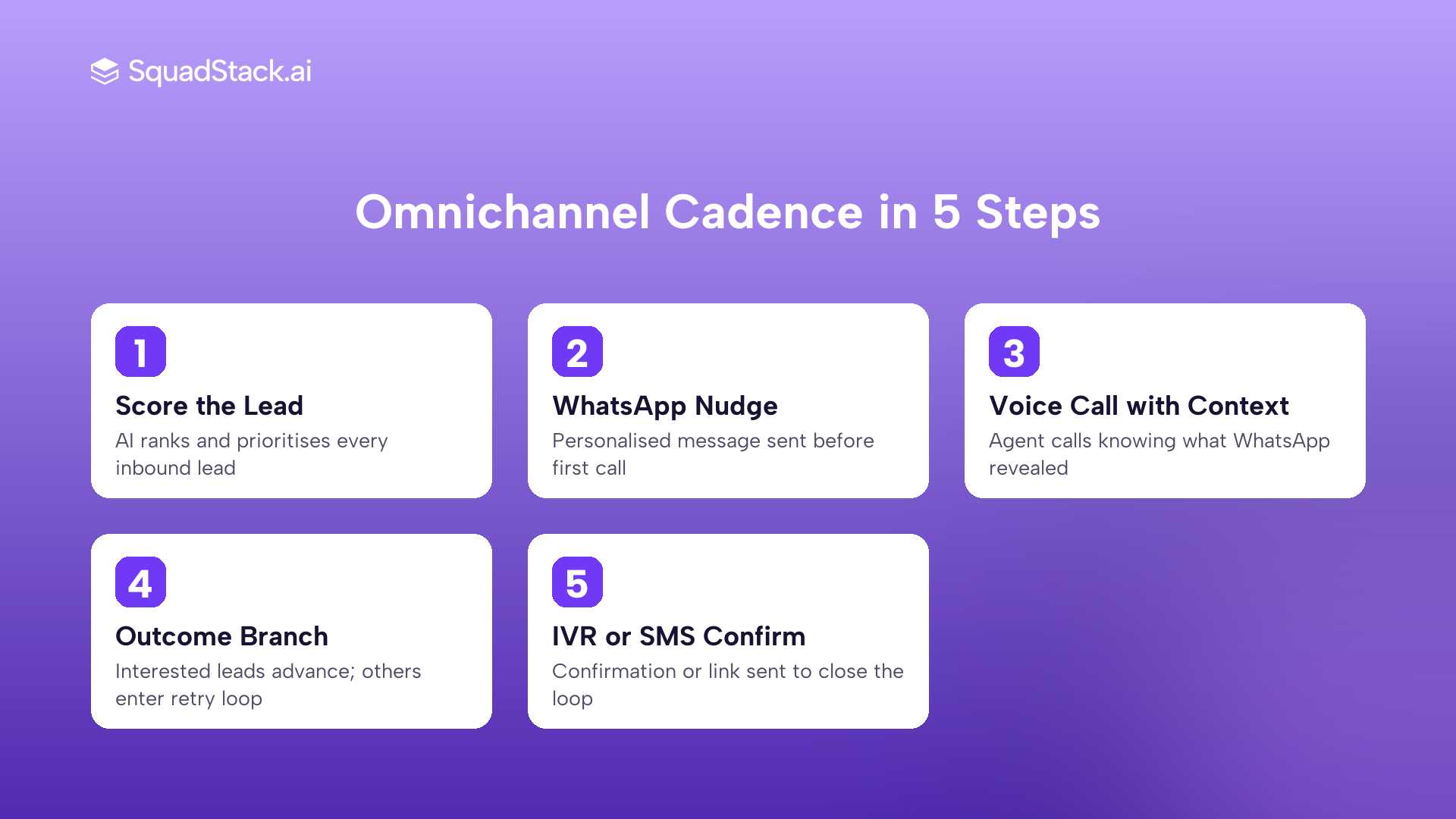
Step 1: Lead enters and gets scored. The AI Lead Manager assigns a propensity score based on profile, source, language preference, and past behavior. This determines priority, timing, and the starting channel.
Step 2: The first touchpoint fires. For cold leads on high-value products, this is usually a voice call. For warm leads who have already engaged digitally, it might be a WhatsApp message with a product link.
Step 3: Outcome-based branching. Every outcome triggers the next step automatically. Not connected: retry with a different time slot. Interested but asked for more information: send a WhatsApp document and call back in 24 hours. Partial application completed: queue a follow-up call that resumes from the exact drop-off point.
Step 4: IVR handles structured data capture. Where the task is confirmatory (verifying an address, confirming appointment time, collecting a rating), IVR runs the interaction at scale without consuming a full conversational voice agent.
Step 5: SMS for nudges and links. Short transactional prompts, OTP confirmations, and payment links work well as SMS, especially in regions where WhatsApp adoption is lower.
Step 6: Context persists. Every interaction is written to a shared memory. The next call, the next WhatsApp message, and the next IVR session all start with full history. This is the connective tissue that separates orchestration from a collection of tools.
Step 7: Continuous learning. Every call outcome feeds back into the ROI Optimizer. Script variants, voice choices, channel sequencing, and retry timing are tested through live A/B experiments. The system learns which sequence converts best for which lead type and updates automatically.
For more on how AI voice agents integrate into full sales workflows, see SquadStack's AI voice agent for sales automation.
Voice is the conversion channel. For complex or high-value sales (personal loans, demat account opening, insurance renewals, AMC sales), voice drives the majority of conversions. A two-way voice conversation handles objections, verifies documents, and completes application steps in ways a WhatsApp message cannot. Eureka Forbes runs AMC and product sales through voice. Kotak Mahindra Bank runs personal loan sales through voice. AngelOne runs demat account opening through voice.
WhatsApp handles document delivery and warm follow-ups. Sending a policy document, brochure, or payment link mid-call while the lead is still on the phone improves completion rates. SquadStack's voice agents can send WhatsApp messages as on-call actions without breaking the conversation. Between dials, WhatsApp nudges keep the lead warm without requiring another full call.
SMS works for time-sensitive nudges. Appointment reminders, OTP delivery, and callback confirmations map naturally to SMS. It is not a conversion channel, but it reduces no-shows and keeps leads in the funnel between voice touchpoints.
IVR suits high-volume, structured tasks. Collecting ratings, confirming delivery addresses, or verifying eligibility can run at scale through IVR without the full conversational stack. RedBus runs review and rating collection this way.
Each channel has a different job. Orchestration means assigning the right job to the right channel for the right lead, at the right time.
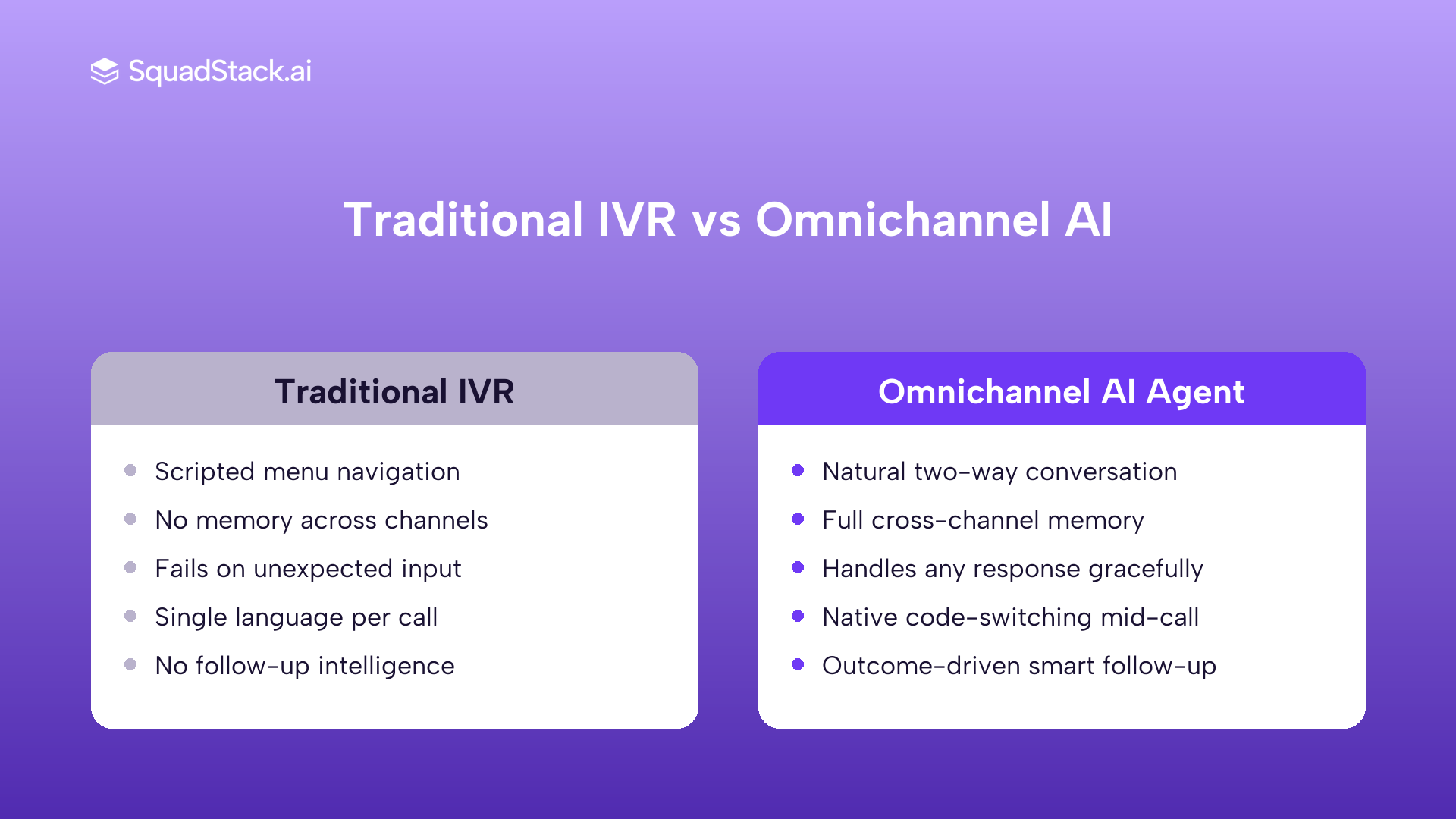
Traditional IVR and an orchestrated AI voice agent are not the same thing. Here is how they compare on the dimensions that matter for outbound sales.
| Dimension | Traditional IVR | Omnichannel AI Agent |
|---|---|---|
| Conversation type | Fixed menu, press 1 for X | Natural two-way conversation, handles any input |
| Channel awareness | Operates alone, no cross-channel memory | Knows what happened on WhatsApp, SMS, and previous calls before dialing |
| Handling off-script inputs | Loops or dead-ends when the caller says something unexpected | Responds to objections, detects intent, and adjusts dynamically |
| Response latency | Near-instant but rigid | Median 0.8 seconds, with full reasoning behind every response |
| Language switching | Single language per session | Native code-switching mid-sentence across live Indian languages |
| Follow-up intelligence | Resets on every call | Picks up from the last confirmed step in the application |
A concrete example: a lead on a personal loan campaign asks "Mera CIBIL score theek hai kya?" on a voice call. An IVR cannot answer. An orchestrated AI agent retrieves the relevant answer, handles the question in Hinglish, and moves the conversation forward. If the lead drops off, the next call resumes from that exact moment rather than restarting with an introduction.
For a broader look at AI contact center platforms, see 10 best AI call center software solutions and 8 best AI tools for contact centers.
Is memory truly shared, or channel-specific? A WhatsApp reply should update the state that the next voice call reads from. If the answer is "those two tools sync via a webhook every few hours," that is not orchestration.
Does the speech stack handle Indian telephony conditions? Public speech models are trained on clean studio audio. Indian outbound calls run on 8kHz telephone lines with background noise, code-switching, and regional accents. The gap between lab accuracy and production accuracy shows up as misheard names, amounts, and PAN numbers.
Is compliance built in or bolted on? TRAI DND scrubbing, calling windows (9:30 AM to 8:30 PM), and DPDP-compliant data handling need to be enforced at the platform level, not managed manually.
Can cadence and sequencing be configured per campaign? A collections campaign has different retry logic than a new lead qualification campaign. The platform should allow full control over attempt count, gaps, calling windows, and channel order without rebuilding from scratch.
Does the vendor own their speech models, or resell third-party APIs? Ownership matters for fine-tuning on your outcomes, India-specific entity handling, and latency. A reseller cannot optimize the model for your product names and campaign vocabulary.
See also: agentic AI contact center platform for a deeper breakdown of what the agentic layer adds.
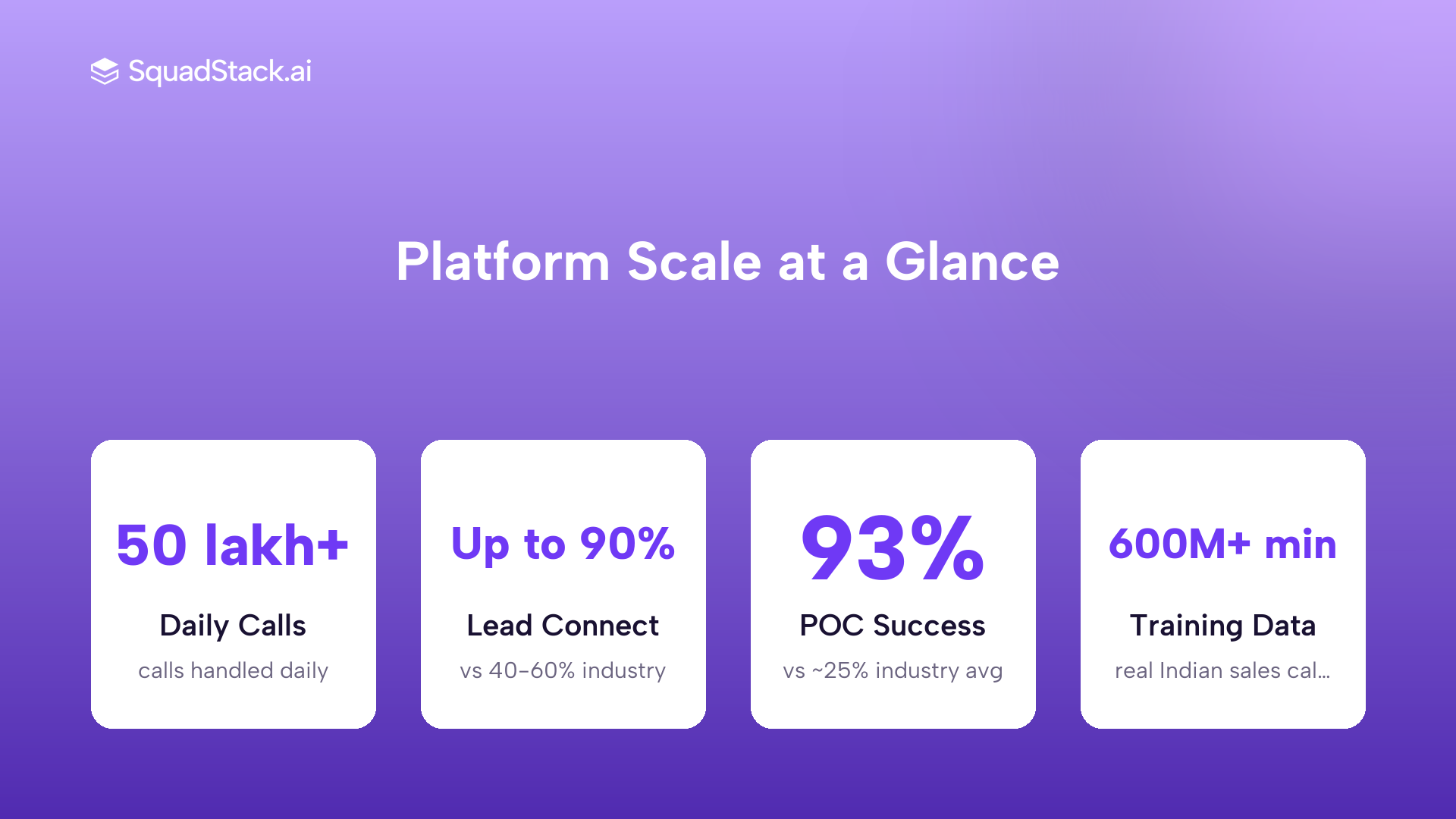
SquadStack built its speech model, Arth, on 600M+ minutes of real Indian sales conversations, including code-switched Hinglish, Taminglish, and high-noise 8kHz telephone audio. No public dataset comes close for Indian telephony. The result is an STT that handles PAN numbers, city names, loan amounts, and product terminology accurately in production, not just in a demo.
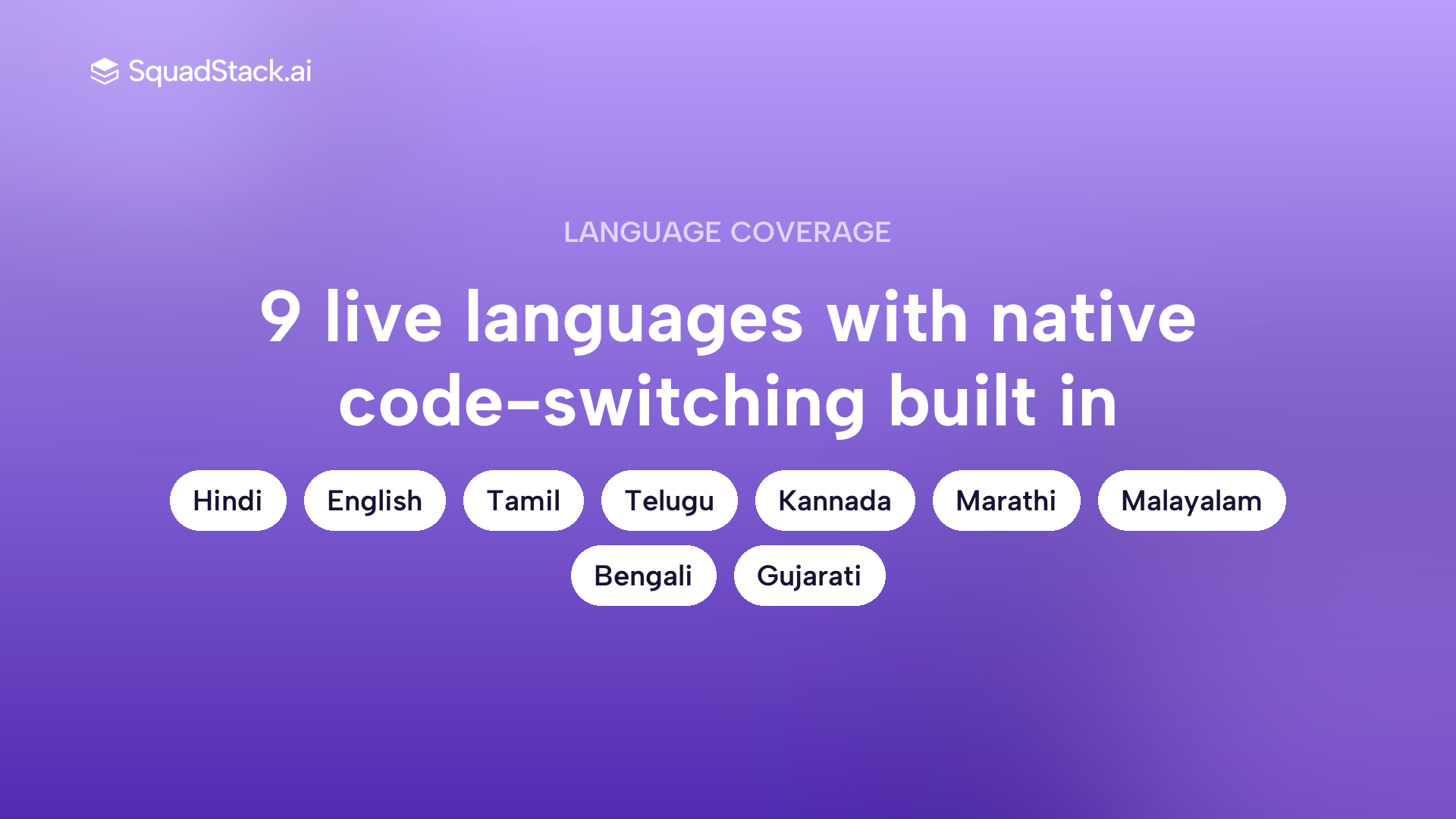
The platform runs 9 live languages with native code-switching: Hindi, English, Tamil, Telugu, Kannada, Marathi, Malayalam, Bengali, and Gujarati. Additional languages including more regional languages are available on demand.
Every call is scored on three levels through the Eval System: Outcome (did the call hit its goal?), Sentiment (how did the conversation land?), and Execution (did the agent run the flow correctly?). This is dual-layer QA, combining AI scoring with human review, on every campaign.
At scale: 50 lakh+ calls daily, 60+ large consumer brands, 93% POC success rate versus roughly 25% industry average. Customers include AngelOne, Kotak Mahindra Bank, Eureka Forbes, IndiaMART, and PhonePe.
The IndiaMART deployment is a useful reference for orchestration specifically. The campaign runs buyer-seller matching through voice AI at over 1 lakh AI calls daily, with 20% higher conversions and 15% lower CAC versus the prior approach. Read the IndiaMART case study.
The full AI voice agent overview covers the platform architecture in detail.
Omnichannel AI works when every channel shares the same context, fires at the right moment, and learns from every outcome. Platforms that deliver this in India need deep voice capabilities first, because voice is still where the hardest conversations happen and where the most revenue is won or lost. Text channels amplify voice; they do not replace it.
If you are evaluating omnichannel AI for outbound sales or contact center operations in India, SquadStack offers a 4 to 8 week pilot with a pre-aligned success metric and a 93% POC success rate. Schedule a demo to see a live campaign setup.
Which is the best omnichannel AI solution for outbound sales in India?
The best solution for Indian outbound sales combines a speech model trained on Indian telephony audio, native code-switching across Indian languages, TRAI and DPDP compliance, and a shared memory layer across voice, WhatsApp, SMS, and IVR. SquadStack meets all of these criteria and runs 50 lakh+ calls daily for 60+ large consumer brands in India.
Can AI handle voice, WhatsApp, SMS, and IVR from a single workflow in India?
Yes. SquadStack's Workflow Builder connects call, WhatsApp, SMS, and IVR blocks in a single campaign workflow with outcome-based branching. Every channel shares the same lead memory, so a lead who replied on WhatsApp is not treated as a cold lead when the voice agent calls the next morning.
When does voice outperform WhatsApp or SMS in an outbound funnel?
Voice wins at conversion for complex or high-value products: personal loans, demat account opening, insurance renewals, and AMC sales. WhatsApp is better for sending documents and warm nudges between voice touchpoints. SMS suits time-sensitive confirmations. The right answer depends on the product, the lead's stage, and their prior behavior on each channel.
How does SquadStack handle Indian languages in an omnichannel workflow?
SquadStack's AI agents run 9 live Indian languages: Hindi, English, Tamil, Telugu, Kannada, Marathi, Malayalam, Bengali, and Gujarati, with native code-switching mid-sentence. The speech model, Arth, is trained on 600M+ minutes of real Indian sales conversations including Hinglish and Taminglish. Additional languages including more regional languages are available on demand.
What is the difference between multichannel and omnichannel AI?
Multichannel means using several channels without coordination. Omnichannel means those channels share context and sequence intelligently based on what happened last. In a true omnichannel system, a lead who started a loan application on a call and dropped off at document upload receives a follow-up that resumes from that exact step, not a fresh introduction.
Is outbound AI calling in India compliant with TRAI rules?
SquadStack's platform enforces TRAI-compliant calling windows (9:30 AM to 8:30 PM) as a hard system block, not a manual setting. All outbound calls use 140-series numbers as required for cold calling. Lead lists are scrubbed against the TRAI DND registry before any dial. The platform is also DPDP compliant with ISO 27001, ISO 27701, and SOC 2 Type II certifications.
What lead connectivity rates are realistic on an omnichannel AI campaign?
SquadStack achieves up to 90% lead connectivity versus a 40 to 60% industry norm. This is a lead-level figure: the share of unique leads reached over the full campaign cadence. The system uses adaptive outreach timing, spam-aware number rotation, and cross-channel context awareness to maximize connectivity without burning number health.
How long does it take to go live with an omnichannel AI campaign?
Most enterprise campaigns go live in 2 to 3 weeks. The build involves training the agent on real call recordings, knowledge base documents, and FAQs, plus configuring the workflow and integrations. The timeline depends partly on client-side dependencies like data feeds and compliance approvals. SquadStack handles the full build; no AI or ML developers are needed on the client side.
Can the AI agent send WhatsApp messages and links during a voice call?
Yes. SquadStack's voice agents support on-call channel actions: they can send WhatsApp messages and payment links to the lead while the call is still live. This is useful for loan application links, product brochures, and payment confirmations that benefit from delivery at the moment of highest intent.
What happens if a lead asks to speak to a human?
SquadStack supports warm transfer: the AI agent hands off the call to the client's human team with full conversation context passed along, including transcripts and any verified data points like loan amount or application status. If no human is available, the agent books a callback. Transfer triggers are configurable per campaign.