.svg)





Hyper-Personalised Outbound Call Scripts Using Customer Lifecycle Data
October 6, 2026
|

13 min read
Personalised voice AI seasonal calling India works by injecting festival-specific greetings, culturally timed offers, and regional-language scripts into...
Personalised voice AI seasonal calling India works by injecting festival-specific greetings, culturally timed offers, and regional-language scripts into each call dynamically, based on where the customer lives and what season it is. Generic outbound calls miss the moment. Brands that match their voice AI to Diwali in Rajasthan or Pongal in Tamil Nadu see meaningfully higher engagement because the caller sounds like they belong. This post explains the mechanics and how Indian consumer brands can run it at scale.
India has more named festivals than most countries have public holidays. Diwali in October, Eid across the year, Pongal in January, Onam in August, Navratri, Durga Puja, Bihu, Ugadi. Each one is a genuine purchase intent moment. And behind each festival sits a region, a language, a greeting, and a set of cultural signals that make the difference between a call that lands and one that gets cut short in three seconds.
Most brands know this. The problem is execution at scale. A national consumer brand running 50,000 outbound calls a day cannot manually rewrite scripts for every regional peak. That is the gap personalised voice AI fills.
Personalised voice AI seasonal calling is the practice of adapting an AI voice agent's script, language, tone, greeting, and call timing to match the specific festival or seasonal moment the customer is experiencing, in their region and language.
It goes beyond choosing a Hindi or Tamil script. It means a Diwali call to a customer in Lucknow opening with "शुभ दीपावली" before the pitch, while a Pongal call to a customer in Coimbatore opens in Tamil. It means a harvest-season loan offer in Marathi for a Maharashtra customer in November, timed to the rabi sowing cycle, not the same call window used for a Bengaluru fintech lead.
The underlying mechanics involve three things working together: a voice agent that can hold conversation naturally in regional languages, a way to inject seasonal context into each call dynamically, and a testing loop that learns what works in each region across each peak.
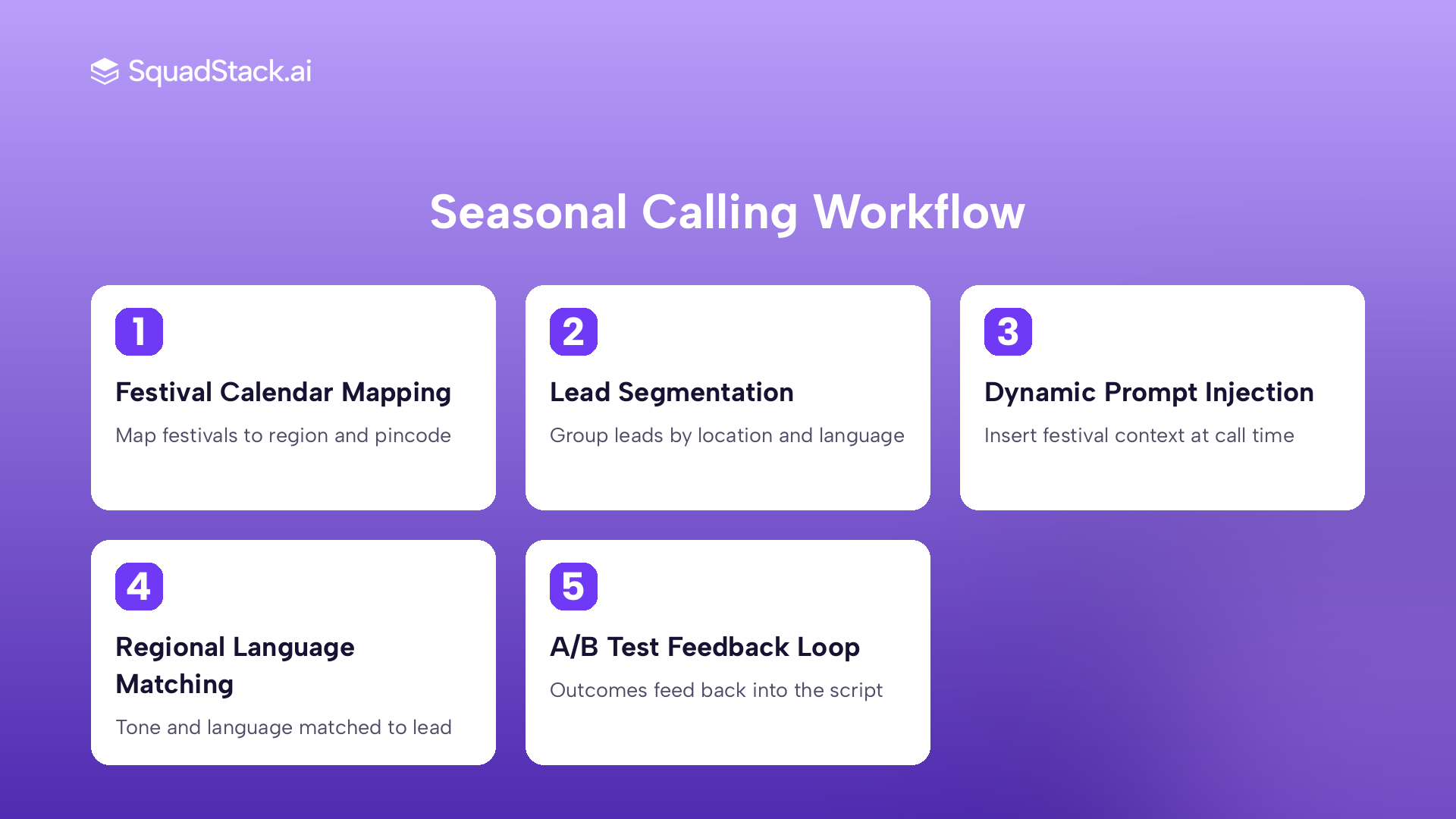
The process has five connected steps. Each builds on the one before it.
1. Festival calendar mapping. The campaign is configured with a seasonal calendar: a list of festivals, their dates, and the regions or pincodes where each is culturally significant. Diwali is national but Pongal is predominantly Tamil Nadu and parts of Andhra. Onam is Kerala. Chhath Puja matters most in Bihar and eastern UP. The calendar ties each festival to a lead segment.
2. Dynamic prompt injection. When a call is triggered, the platform reads the lead's location and the current date, then pulls the right festival context into the agent's prompt before the call begins. The agent does not need a separate script for each festival. A base campaign script carries slots that get filled at call time with the appropriate greeting, seasonal offer framing, and any culturally relevant language cues.
3. Language and tone matching. A Tamil Nadu lead on Pongal day gets a Tamil-language call. A Gujarati customer during Navratri gets a Gujarati-speaking agent. The tone adjusts too: festive calls tend to open warmer and more celebratory, while post-harvest agricultural season calls in rural markets lean on financial relief framing. SquadStack's voice agents cover 9 live Indian languages including Hindi, Tamil, Telugu, Kannada, Marathi, Malayalam, Bengali, and Gujarati, with native code-switching when a customer shifts mid-conversation.
4. Locally timed call windows. A call placed during a Diwali puja window, or at 6am during Chhath, will not be received well regardless of the script. The platform's calling window defaults to 9:30 AM to 8:30 PM and is configurable per campaign. Seasonal campaigns can further restrict or shift windows by region for specific festival days.
5. Continuous learning. Every call outcome, whether the customer engaged, asked about the offer, objected, or disconnected early, feeds back into the ROI Optimizer. The platform's A/B testing engine runs variants of greetings, offer angles, and call timings against each other on live traffic. Winners scale automatically. This means by week three of a Diwali campaign, the agent is running the version of the script that actually converted in week one, not the version the team guessed would work before launch.
For a closer look at how intent signals drive personalisation decisions, see SquadStack's AI intent layer.
Seasonal voice AI personalisation is not limited to retail. It works across any category where purchase behaviour shifts around cultural or agricultural moments.
Lending and BFSI. Pre-Diwali is a high-intent window for personal loans, gold loans, and credit card activations. A customer in a Hindi-belt city who has already been browsing pre-approved loan offers responds very differently to a Diwali-framed call ("त्योहार के लिए तैयार हैं?") than to a generic eligibility pitch. PhonePe, KreditBee, and IIFL are among the lending brands that run outbound voice campaigns at scale through SquadStack.
E-commerce and D2C. Abandoned cart recovery spikes around festivals because customers browse but delay purchase decisions. A voice call the evening before Dhanteras, in the customer's language, referencing the product they left behind and a limited festive offer, changes the conversion math significantly. For a detailed look at D2C results, see how a leading D2C personal care brand drove 8x ROI with Voice AI.
Insurance renewals. Many Indian households align major financial decisions with auspicious dates. An insurance renewal call timed to Akshaya Tritiya or the start of a new financial year, framed around protecting the family through the coming year, lands differently than a generic renewal reminder.
Education. Admission cycles follow academic calendars, but regional peaks matter too. Post-Dussehra in October is a strong re-engagement window for students who deferred decisions through the festive season.
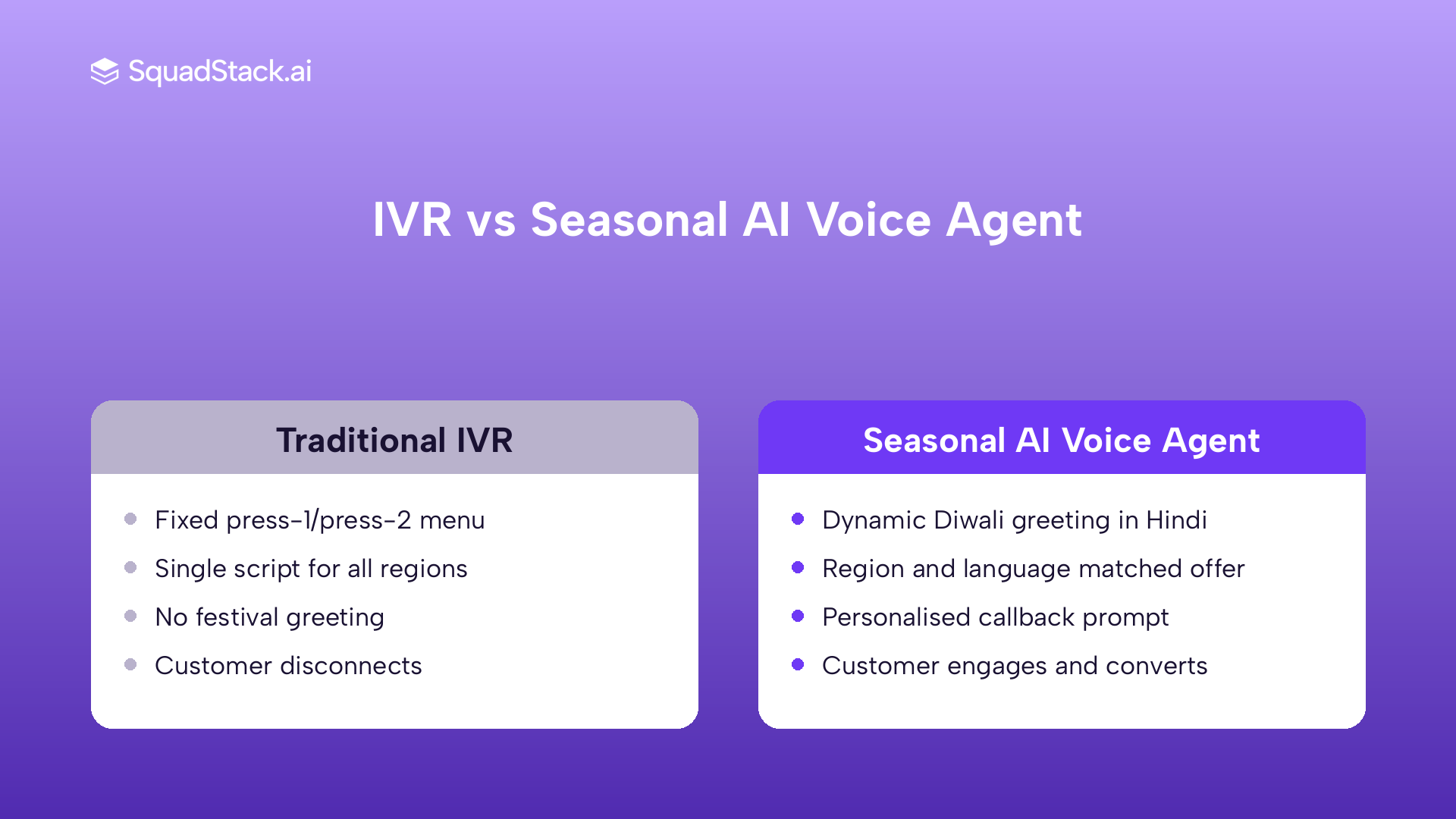
Generic IVR blasts cannot adapt to seasonal moments. Here is what that looks like in practice.
| Dimension | Traditional IVR | Seasonal AI Voice Agent |
|---|---|---|
| Script adaptation | A single fixed script plays to all callers. Pongal or Diwali context cannot be injected without a full rebuild. | Festival greeting and offer framing are injected dynamically per call based on the lead's region and date. |
| Language handling | A menu asks the caller to "press 1 for Hindi, press 2 for Tamil." The IVR cannot code-switch. | The agent speaks in the lead's language from the first word and shifts if the customer responds in another language. |
| Cultural timing | Calls go out on a fixed schedule regardless of festival day or regional puja window. | Call windows are configured per region to avoid sensitive times and to catch high-intent post-puja windows. |
| Objection handling | A caller who says "I'll think about it after Diwali" gets a menu it cannot understand. The call drops. | The agent acknowledges the timing, books a callback for the right post-festival day, and stores the reason. |
| Learning across the season | The IVR runs the same script on day 1 and day 30 of a Diwali campaign. | A/B test results from early in the season update the script. The agent on day 20 is better than the one on day 1. |
Before evaluating vendors, buyers should check for these specific capabilities.
Regional language depth, not just language count. Listing "Tamil" as a supported language is easy. The real question is whether the agent sounds native to a Tamil speaker in Madurai, not like a newsreader or a translation engine. This requires training data from actual telephonic conversations, not public text corpora.
Dynamic content injection. Can the platform update greeting text, offer framing, and call timing without a full script rebuild for every peak? If the answer is "raise a support ticket," the campaign will always be behind the calendar.
Configurable call windows. Festival timing varies by region and community. A platform that enforces a single national calling schedule will create problems on specific days.
A/B testing built into the workflow. Seasonal peaks are short windows. A platform where A/B testing is a reporting add-on, not a live optimization loop, cannot improve fast enough to make a difference within a two-week Diwali campaign.
TRAI compliance. All outbound calling must comply with DND registry rules. This is non-negotiable for any Indian campaign, seasonal or not.
For a full view of what an AI voice agent can do across the sales funnel, the AI voice agent for sales automation overview covers the platform end to end.
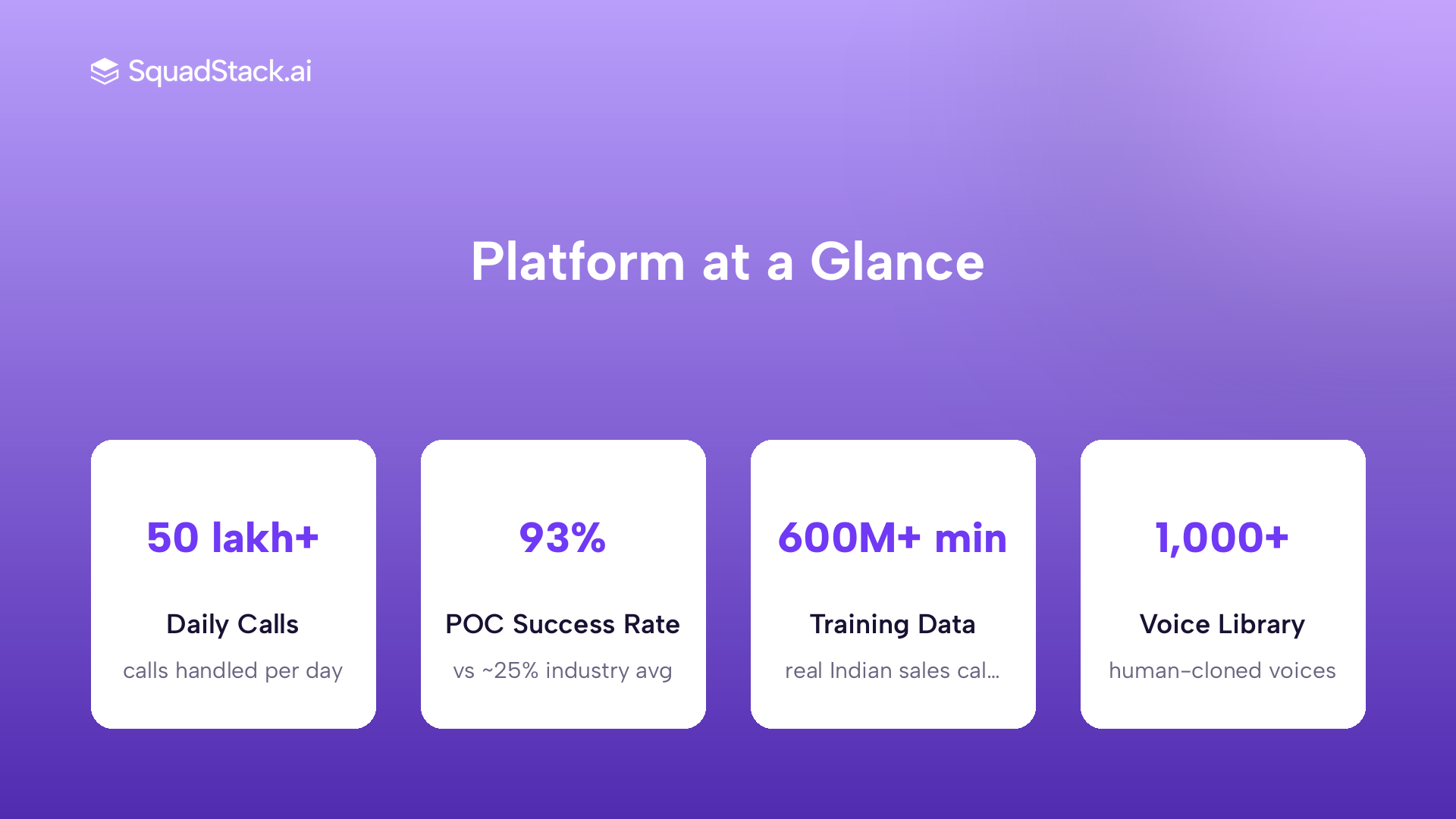
SquadStack's starting advantage is the data it has trained on. Arth, the in-house speech recognition model, was built on 600M+ minutes of real Indian telephony conversations, including noisy, code-switched calls from actual contact centers. That training data spans 85%+ of Indian pincodes, which means the accent and vocabulary patterns from Tier 2 and Tier 3 markets are in the model, not just metro speech.
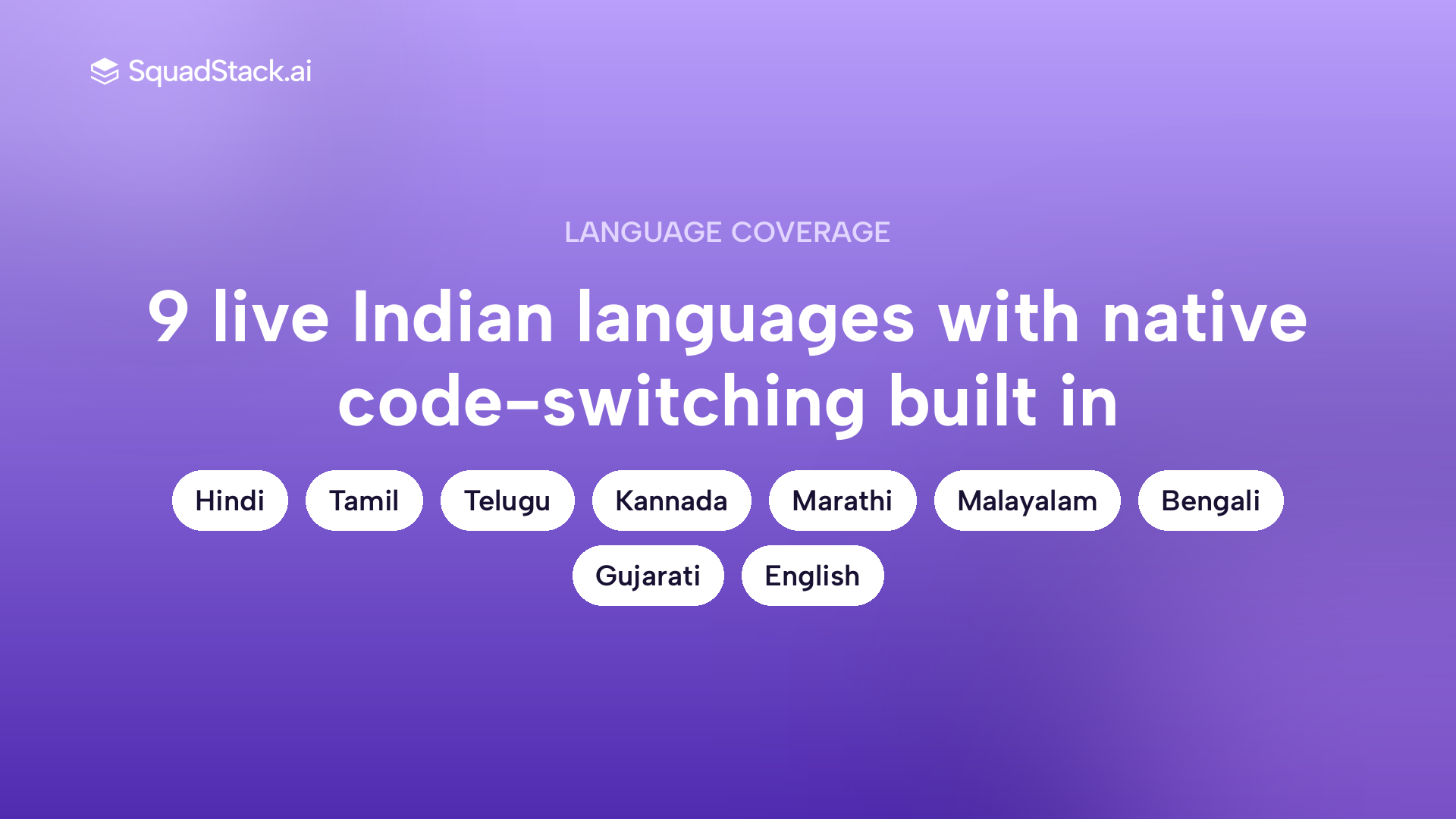
Nine languages are live today: Hindi, English, Tamil, Telugu, Kannada, Marathi, Malayalam, Bengali, and Gujarati. Native code-switching is part of the model, not a translation bolt-on. A customer who opens in Marathi and slips into Hindi gets a natural response in both, the way a real bilingual agent would respond.
The platform's Optimize component runs A/B testing across voice, prompt, channel, and timing as a live experiment engine. During a seasonal campaign, variants of the Diwali greeting, the offer framing, and the call window are running simultaneously on real traffic. Statistical significance alerts flag when a winner has emerged, and the winning version ramps automatically.
The redBus multilingual feedback deployment is a concrete proof point. Across all regional language campaigns, engagement ran at 75 to 85%, above the human baseline in every language tested, with feedback captured at 2 to 4 times the human baseline rate. Cost per outcome came in 50 to 79% lower than human agents on vernacular campaigns. These results came from the same naturalness engineering that makes seasonal personalisation work: dialogue written by native speakers, tested on real phone lines, with fillers and openers drawn from actual top-performing agents in each language.
For teams evaluating a platform against a specific lead-scoring or qualification problem, conversational AI lead scoring explains how the platform prioritises and routes leads during high-volume periods.
SquadStack's POC success rate is 93% against an industry average of around 25%. Most seasonal campaigns prove out within the 4 to 8 week pilot window, which means a brand that starts a pilot before the festival season can be running a proven, optimised campaign by the time the peak hits.
Ready to see how it works for your next peak? Book a demo and the team can map out a seasonal campaign for your category.
Which is the best multilingual AI voice bot for regional language calling in India?
The best platform is one trained on real Indian telephony data in each language it supports, not just translated text. SquadStack's Arth model was trained on 600M+ minutes of actual Indian contact center calls and supports 9 live languages including Tamil, Telugu, Kannada, Marathi, Malayalam, Bengali, and Gujarati, with native code-switching and more regional languages available on demand.
Can AI voice agents handle code-switching between Hindi, English, and regional languages?
Yes, but only platforms trained on code-switched Indian conversations can do this naturally. SquadStack's agents switch mid-sentence because the underlying models were built on real Hinglish, Taminglish, and mixed-language calls, not on separate monolingual datasets.
How does seasonal personalisation work in an AI voice call without rebuilding the script for each festival?
Dynamic prompt injection is the mechanism. Before each call, the platform reads the lead's location, the current festival context, and injects the relevant greeting and offer framing into the agent's prompt. The base campaign script stays intact; only the seasonal slots are updated.
How do you comply with TRAI DND rules during festival calling campaigns?
Lead lists are scrubbed against the TRAI DND registry before dialing. Calling windows are enforced as a hard system constraint, not a convention: calls outside 9:30 AM to 8:30 PM are blocked by the platform. Clients can also upload internal DND lists that are honored the same way.
Is AI calling for seasonal peaks better than hiring temporary agents for Diwali or year-end campaigns?
Temporary human agents need training, have inconsistent naturalness across languages, and cannot A/B test script variants in real time. AI voice agents are already trained, scale immediately, and improve across the season through live testing. The economics are also different: SquadStack's campaigns have delivered up to 2 to 3 times lower customer acquisition cost compared to human agent benchmarks.
How quickly can a seasonal campaign be launched on SquadStack?
Most campaigns go live within two weeks. The build uses the client's existing call recordings, knowledge base, and FAQs to train the agent. For repeat seasonal use cases where a prior campaign has already run, warm-start data speeds up the next launch.
What is the best AI caller for Tier 2 and Tier 3 customers who only speak regional languages?
An AI caller that sounds native in the relevant regional language, not just technically capable of producing it. Naturalness in regional languages requires training on conversational telephonic audio from those regions. SquadStack's training corpus spans 85%+ of Indian pincodes and includes the accent and vocabulary patterns specific to smaller markets.
Can the AI agent adjust its tone for festivals, not just the language?
Yes. Dialogue engineering controls tone separately from language. Festive campaigns use warmer, more celebratory openers drawn from how real top-performing agents greet customers during peak seasons. Agricultural cycle campaigns in rural markets use different framing. Both are hardcoded dialogue choices, tested on real phone lines, not LLM-generated variations.
How does A/B testing work during a short festival window like Diwali?
Multiple variants of the greeting, offer framing, and call timing run simultaneously from campaign launch. The platform monitors conversion rate and connect rate in real time and flags when a variant reaches statistical significance. The winning version ramps to a larger share of traffic while the losing variant is cut, all within the live campaign window.
Does SquadStack's platform support hyper-personalisation beyond seasonal calling?
Yes. The hyper-personalisation approach extends to voice, channel, timing, and script framing per individual lead, not just per festival. Every lever of a sales conversation is programmable and optimised per lead through the platform's Sales Decision System.