

Top AI Outbound Calling Tools in India: Features Compared
October 23, 2026
|

13 min read
See how text-based recruitment chatbots and voice AI compare across candidate reach, language support, and cost-per-hire in India's high-volume hiring market.
Most recruitment chatbot examples you'll find online are text-based tools designed for desktop-first, smartphone-savvy candidates. In India's high-volume hiring market, especially for frontline roles in BFSI and logistics, voice AI alternatives reach more candidates faster, with far less drop-off. This post breaks down both approaches, shows where each one works, and explains why the choice matters more in India than anywhere else.
High-volume hiring in India is a numbers game with a reach problem. A logistics company needs 500 delivery riders this month. A gold loan NBFC is expanding into 30 new districts. A consumer electronics brand is hiring field sales agents across six states. The candidates exist. Getting them through a screening funnel before they ghost or take another offer is the hard part.
Recruitment chatbots became the go-to answer for this problem. But most of the chatbot examples you see documented online were built for a different context: English-speaking, app-comfortable, white-collar applicants in urban markets. Applied to India's frontline hiring reality, many of them fail quietly, through drop-off rates that nobody publicises.
Voice AI is the alternative that fits better here. This post compares both approaches directly, using real recruitment chatbot examples and deployment data, so you can make the right call for your hiring context.
A recruitment chatbot is an automated system that handles candidate conversations at scale, typically covering job qualification, screening questions, and next-step scheduling, without a human recruiter on the other side of every exchange.
The "chatbot" label covers a wide range of tools. At the basic end, you have rule-based bots that walk candidates through a fixed question tree on WhatsApp or a careers page. At the more capable end, you have AI-driven agents that can handle objections, switch languages, and update your ATS in real time. Most recruitment chatbot examples in blog posts sit somewhere in the middle.
Voice AI is a subset of this category where the interaction happens over a phone call rather than a text interface. The candidate picks up the phone, hears a human-like voice, answers screening questions out loud, and gets a result within minutes. No form. No app. No WhatsApp thread to abandon halfway through.
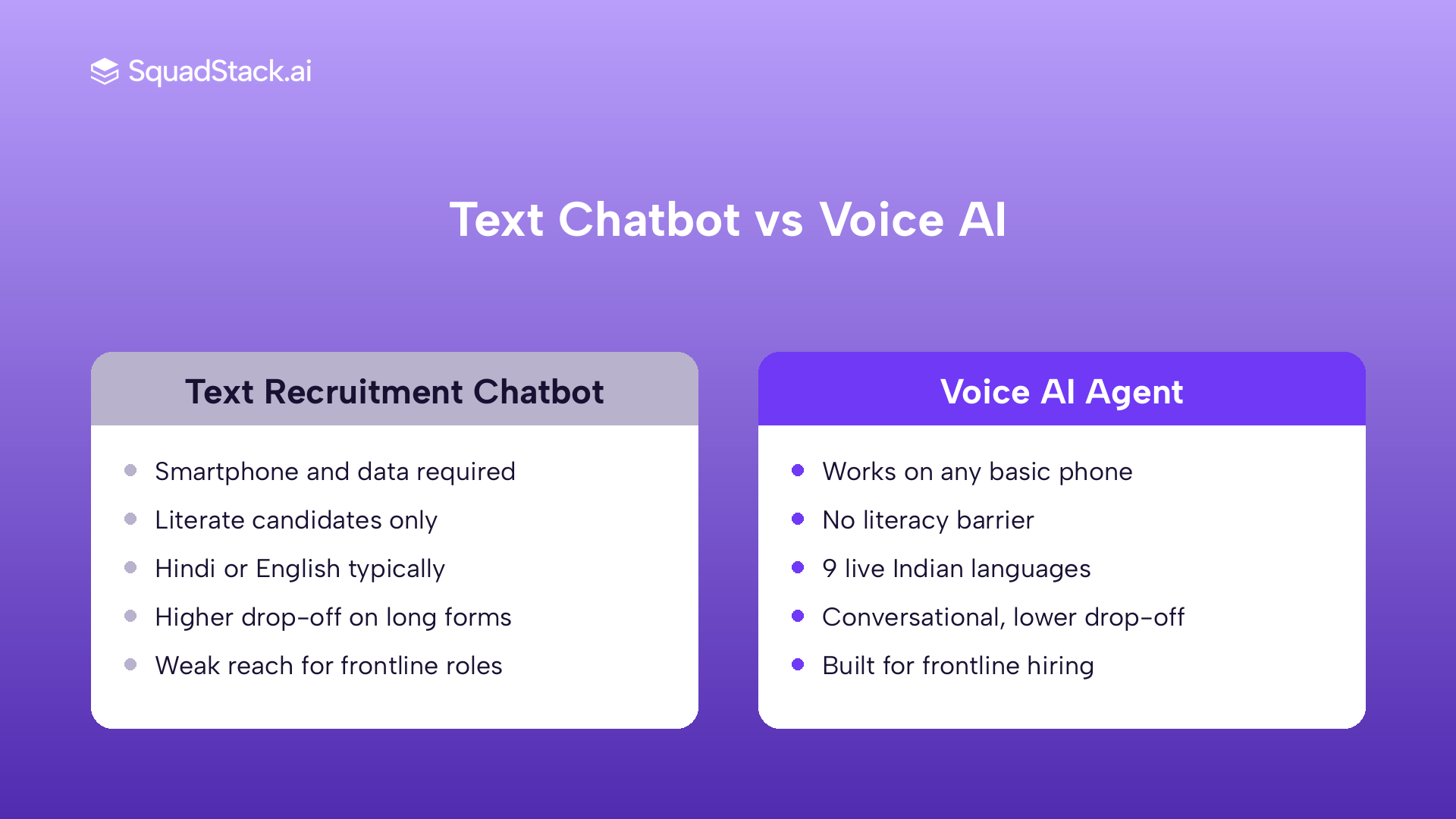
A typical text chatbot flow for hiring looks like this:
1. Candidate applies via job board or sees a WhatsApp broadcast. 2. Bot sends a structured message: "Hi, you applied for the Delivery Executive role. Reply 1 to continue." 3. Candidate answers qualification questions over text. 4. Bot scores the responses and either books an interview slot or sends a rejection. 5. Recruiter reviews shortlisted candidates in the ATS.
This works when candidates are comfortable with text, own a smartphone, and have a stable internet connection. For hiring in metro cities, for tech roles, or for graduate-level positions, it holds up reasonably well.
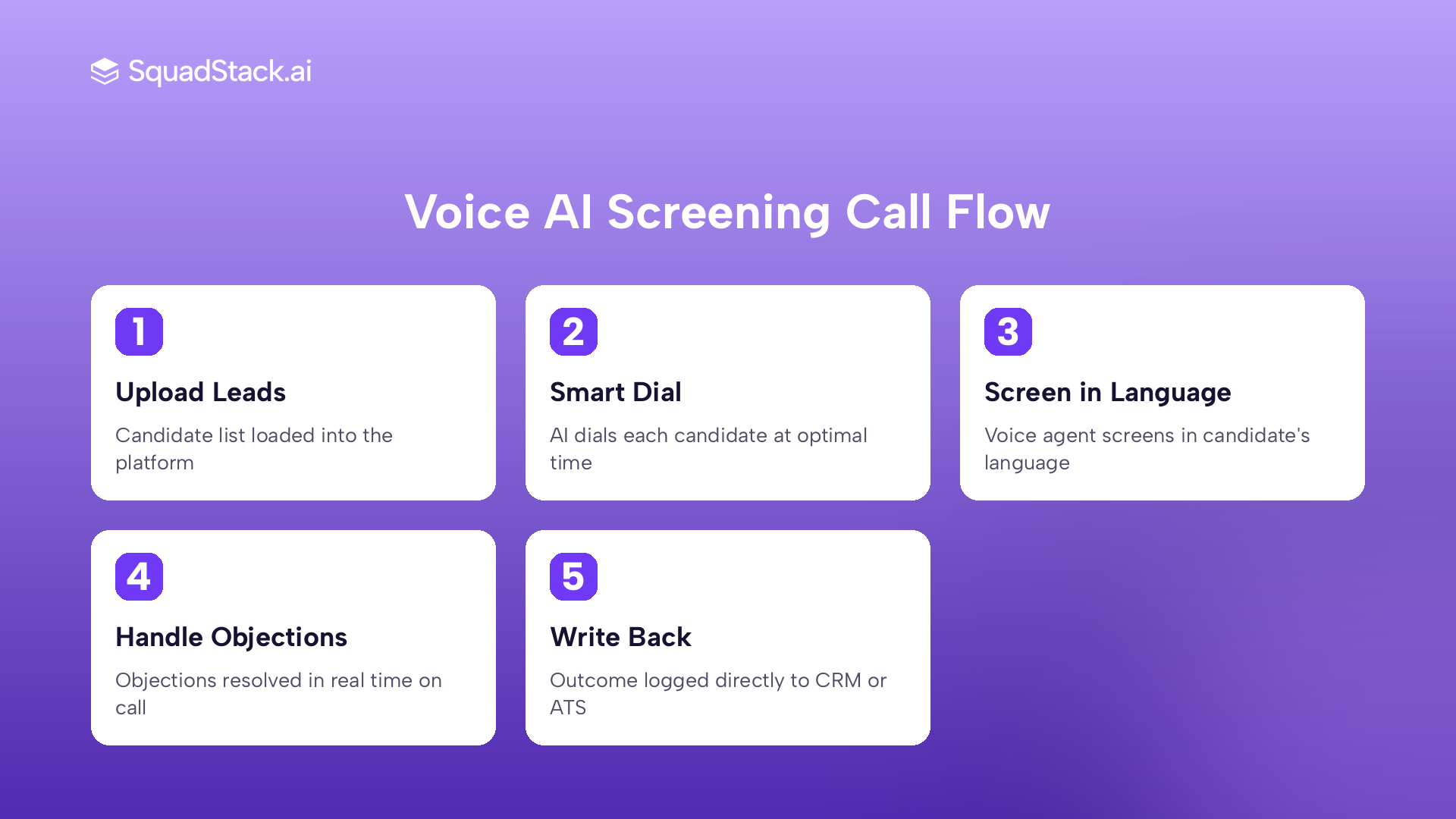
A voice AI recruitment flow works differently:
1. Candidate applies, or a sourced lead is uploaded to the platform. 2. The AI Lead Manager decides the best time to call and dials the candidate. 3. A voice AI agent opens in the candidate's language, explains the role, and runs through screening questions in natural conversation. 4. The agent handles common objections ("Is this work from home?", "What's the salary?"), captures structured data, and books the next step. 5. Outcome and candidate data are written back to the CRM or ATS automatically.
No candidate needs a smartphone. No form needs to be filled. A candidate in a district town with a basic phone and patchy 4G can complete a full screening call in under five minutes.
Text-based recruitment chatbots work best in these scenarios:
Campus and graduate hiring. Students applying via LinkedIn or Naukri are comfortable with chat interfaces and have the attention span to work through a multi-step WhatsApp flow.
IT and tech recruitment. Candidates are on laptops, expect a digital-first process, and low drop-off is achievable because the interface matches their daily behaviour.
Naukri's candidate profile completion is a real example from SquadStack's own customer base: the platform uses AI-assisted outreach to help candidates complete incomplete profiles, a task where a structured follow-up sequence makes sense.
Text chatbots can also handle pre-screening questions at volume for roles where candidates apply online and expect an async, text-based process.
The drop-off risk for text-based chatbots in India's frontline hiring is real and underreported. Three failure modes come up repeatedly:
Language mismatch. A Hindi-speaking rider candidate in Jaipur receiving a WhatsApp form in English will either guess or abandon it. Most text chatbots support English and maybe Hindi. Running the same form in Bhojpuri, Haryanvi, or Gujarati code-switched with English is not something most platforms handle natively.
Low smartphone literacy. Tapping through a multi-step WhatsApp conversation, typing responses, and staying engaged until the end requires a level of smartphone fluency that many Tier-2/3 candidates, especially in logistics and field sales, do not have.
Form fatigue. Even candidates who start a text flow often drop off at the fourth or fifth question. A voice call is a different experience: it feels like talking to someone, not filling out a government form.
Voice AI fits high-volume frontline hiring better than any other channel for the Indian market. The use cases SquadStack runs cover several relevant examples:
Rider hiring and onboarding for logistics and quick commerce platforms. Candidates get a call, hear the role explained clearly in their language, answer screening questions, and book a slot, all in one call. A leading quick commerce platform running this use case through SquadStack saw 90% candidate connectivity and 40% lower cost-per-hire.
Candidate screening for staffing platforms. Awign and WorkIndia, both SquadStack customers, use voice AI for candidate screening and re-engagement. At the volumes these platforms operate, calling every candidate manually is not feasible. Voice AI handles the first cut.
Gold loan NBFC field sales hiring. Expanding a field sales team across rural and semi-urban India means reaching candidates who may never open a WhatsApp business message. A voice call in their language clears that barrier. The SquadStack gold loan NBFC voice AI case study shows how this plays out in a BFSI expansion context.
For a broader view of how AI voice agents work across sales and hiring workflows, that pillar page covers the full capability set.
Text chatbots and voice AI are not interchangeable. For white-collar, digital-native hiring, text works. For high-volume, multilingual, frontline hiring in India, voice AI reaches more candidates and completes more screenings.
| Dimension | Text Recruitment Chatbot | Voice AI Agent |
|---|---|---|
| Candidate reach | Requires smartphone + data + app literacy | Works on any phone, no data or app needed |
| Language coverage | Usually English, sometimes Hindi | 9+ Indian languages with native code-switching |
| Drop-off risk | High in Tier-2/3 and for low-literacy candidates | Lower: a call feels like a conversation |
| Response rate | Lower for blue-collar roles | Higher for frontline and field roles |
| Screening depth | Good for structured, form-style Q&A | Handles multi-turn objection handling and follow-ups |
| Setup complexity | Moderate: flow + WhatsApp/web integration | Moderate to high: telephony + language configuration |
| CRM integration | Standard | Standard, with real-time write-back |
| Best fit | Campus, tech, and graduate hiring | Rider, field sales, BFSI, and logistics hiring |
| Compliance | Varies by vendor | TRAI, DPDP, ISO 27001, SOC 2 Type II |
If your candidates are college graduates applying online, a text chatbot is probably fine. If your candidates are delivery riders, field sales executives, or rural loan agents, voice AI is likely the right fit. The question is not which technology is better in the abstract. It is which channel your candidates actually respond to.
India's hiring market is more multilingual than most companies plan for. A candidate screening workflow that only works in English and Hindi will lose a meaningful share of candidates in Tamil Nadu, Gujarat, West Bengal, and Kerala. Voice AI platforms that handle code-switching natively, where the agent moves between Hindi and English mid-sentence without breaking the flow, serve this population better than a text bot that forces one language.
Simple qualification (Do you have a driving licence? Are you available full-time?) works on text. But if your screening includes salary negotiation, role clarification, or handling common objections about commute or shift timing, a conversational voice interaction handles it better than a rigid text flow.
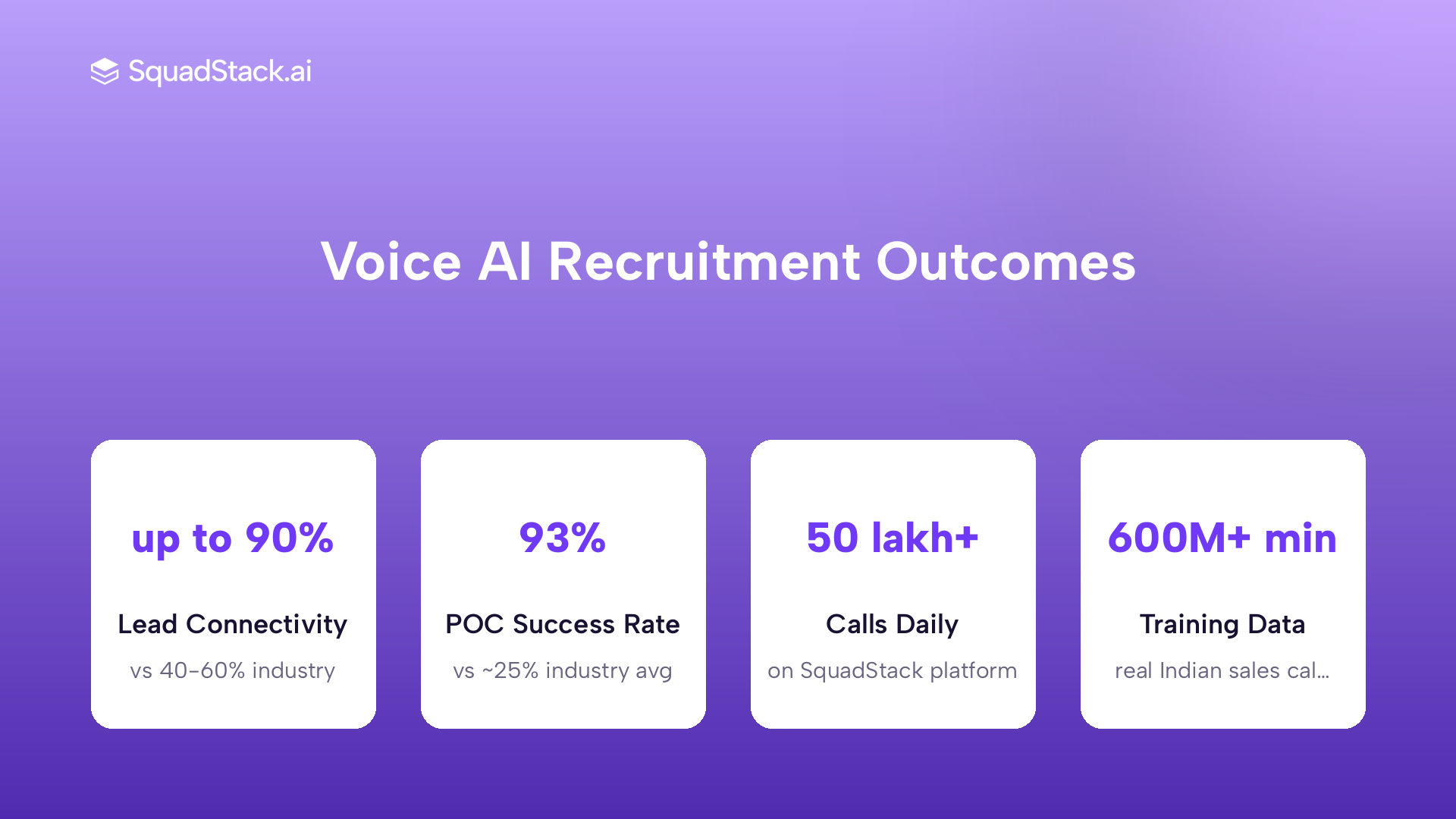
Industry norms for lead or candidate connectivity in outbound recruitment sit at 40 to 60%. Voice AI platforms that optimise call timing, rotate numbers to avoid spam flags, and retry on the right schedule can reach up to 90% lead connectivity. That gap matters significantly when you are trying to hire 500 people in six weeks.
For a comparison of the broader contact center software category, this roundup of AI call center software covers the main platforms.
SquadStack's voice AI was built on 600M+ minutes of real Indian sales and contact-center conversations, spanning more than 85% of Indian pincodes. That training corpus includes the kind of noisy, code-switched, low-bandwidth telephony audio you get when calling a candidate in a district town on a Tuesday morning. Most voice AI platforms train on read-speech datasets or YouTube audio. Production-quality telephonic audio in Hindi, Tamil, Telugu, or Marathi does not exist publicly, which is why owning that data matters.
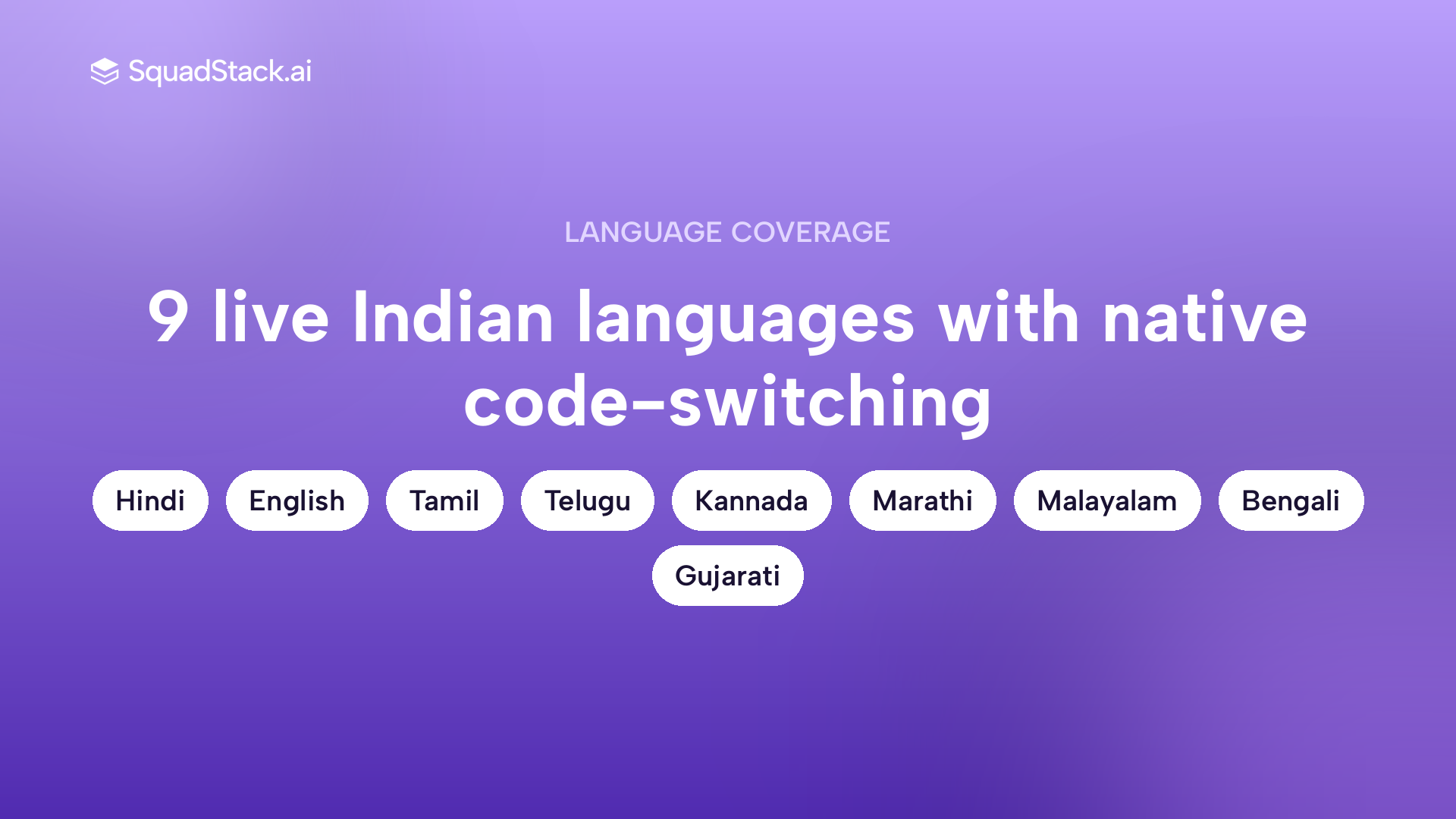
The platform supports 9 live Indian languages: Hindi, English, Tamil, Telugu, Kannada, Marathi, Malayalam, Bengali, and Gujarati, with native code-switching and additional regional languages available on demand. Agents do not just switch languages between calls. They switch mid-sentence, the way a real bilingual recruiter does.
On the hiring use case specifically, SquadStack runs candidate screening and re-engagement for Awign, Naukri, and WorkIndia. For logistics, Delhivery and Everest Fleet use the platform for rider hiring and onboarding. Delhivery's deployment produced 4x lower cost-per-hire compared to their previous approach.
The POC process starts in roughly two weeks and follows a live production test on real candidates, not a sandbox demo. SquadStack's POC success rate is 93%, against an industry average of around 25%. That gap reflects what happens when you test against real conditions rather than controlled demos.
Every engagement includes dual-layer quality assurance through the Eval System, which scores every call on Outcome, Sentiment, and Execution. Calls are not just logged: they are audited so the agent improves on the next batch.
For recruitment teams evaluating AI tools for contact center and outbound operations, SquadStack sits at the high-volume, outcome-optimised end of that market.
Book a demo to see voice AI recruitment screening in action.
Which is the best voice AI recruitment tool for high-volume hiring in India?
SquadStack is built specifically for high-volume Indian consumer market hiring, with 9 live languages, native code-switching, and a training corpus of 600M+ minutes of real Indian telephony audio. It supports candidate screening, re-engagement, and onboarding at scale, with verified deployments across logistics, staffing platforms, and BFSI.
Can a recruitment chatbot handle multilingual candidates in India?
Text-based chatbots typically handle one or two languages and require candidates to read and type responses. Voice AI agents with native code-switching can hold a complete screening conversation that moves between Hindi and English, or Tamil and English, mid-sentence, without the candidate needing to select a language preference first.
What is the difference between a recruitment chatbot and a voice AI agent?
A recruitment chatbot communicates through text (WhatsApp, web forms, or chat). A voice AI agent calls the candidate and holds a spoken conversation. For candidates without strong smartphone literacy or in areas with patchy data, a phone call reaches people that a text chatbot cannot.
How do recruitment chatbots handle candidate drop-off?
Text chatbots see higher drop-off when the interface is unfamiliar or the language does not match. Voice AI reduces drop-off because the interaction is a phone call, not a form. Optimised calling schedules and spam-aware number rotation also improve the share of candidates who are actually reached.
Are voice AI recruitment agents compliant with TRAI rules in India?
SquadStack's platform is TRAI-compliant. Calling hours are hard-enforced by the system (9:30 AM to 8:30 PM), DND lists are scrubbed before dialing, and only 140-series numbers are used for outbound cold calling. Compliance controls are built into the platform, not applied manually.
Can a voice AI agent screen candidates for field sales roles in BFSI?
Yes. BFSI field sales hiring is one of SquadStack's active use cases. The gold loan NBFC deployment linked in this post is a direct example of voice AI used to screen and qualify candidates for field expansion in semi-urban and rural India.
How long does it take to deploy a voice AI recruitment agent?
SquadStack typically goes live in roughly two weeks. Setup includes a kickoff, conversation design, agent build, integration with your CRM or ATS, and testing. The longer lead time on most deployments comes from client-side data feeds and compliance approvals, not the build itself.
What happens when a candidate wants to talk to a real person?
SquadStack supports warm transfer to a human recruiter. The candidate is handed off with full context, including what was discussed and what screening steps were completed, so the human does not start the conversation from scratch.
How does a voice AI agent handle objections during a screening call?
The agent detects objections in real time, such as salary concerns or role confusion, and responds across multiple turns rather than firing a single scripted answer. Common objections are mapped and handled during the conversation design phase before the campaign goes live.
Do recruitment chatbots work for Tier-2 and Tier-3 hiring in India?
Text-based chatbots face real limitations in Tier-2/3 India due to lower smartphone literacy and language coverage gaps. Voice AI works on any phone, including basic feature phones, and reaches candidates who would never complete a WhatsApp form. This makes it the more practical option for high-volume frontline hiring outside metros.