AI Voice Agent for Microfinance: Grameen Model at Scale
November 7, 2026
|

13 min read
Understand how Truecaller spam detection works, why outbound connect rates drop without warning, and what AI calling platforms do to protect number reputation.
TL;DR: Truecaller no check spam tag prevention for AI calling is one of the most urgent operational problems for Indian outbound teams today. A number flagged as spam can lose the majority of its answer rate overnight. The fix requires active number health management, smart rotation, and an AI calling platform built to stay trusted from the first dial.
Your outbound campaign is running. Connect rates looked healthy last week. Then, without any warning, they drop by a large margin. Your team assumes lead quality has shifted or that it is a bad batch. Nobody checks the number's Truecaller status.
This is how spam tagging quietly kills Indian calling campaigns. The problem is not rare. Any number that dials at high volume, regardless of how legitimate the campaign is, can get flagged. Truecaller's detection system watches for patterns that resemble nuisance calling. Legitimate sales teams trip these signals all the time.
Understanding how Truecaller's spam classification works and how to stay ahead of it is now a core operational skill for anyone running AI outbound calling campaigns in India.
Truecaller spam detection is an automated system that classifies phone numbers as "Spam" based on a mix of user reports and AI-driven pattern analysis. When enough users mark a number as spam, or when the system detects calling patterns associated with nuisance calls, that number gets tagged.
The tag appears to anyone receiving a call from that number. Most people simply do not answer a call labeled "Spam Likely." For a sales team, that label means the call might as well not have been made.
The Truecaller name verification process (sometimes searched as "Truecaller name checking" or "Truecaller no check") is the registered business caller ID feature. It lets verified businesses display their brand name and category alongside calls, replacing the default anonymous display. A verified name builds immediate trust before the person even picks up.
Truecaller no check spam tag prevention for AI calling campaigns depends on two things working together: avoiding the signals that trigger the spam tag in the first place, and registering a verified identity so your number is not anonymous to begin with.
Truecaller uses several signals, and they compound quickly.
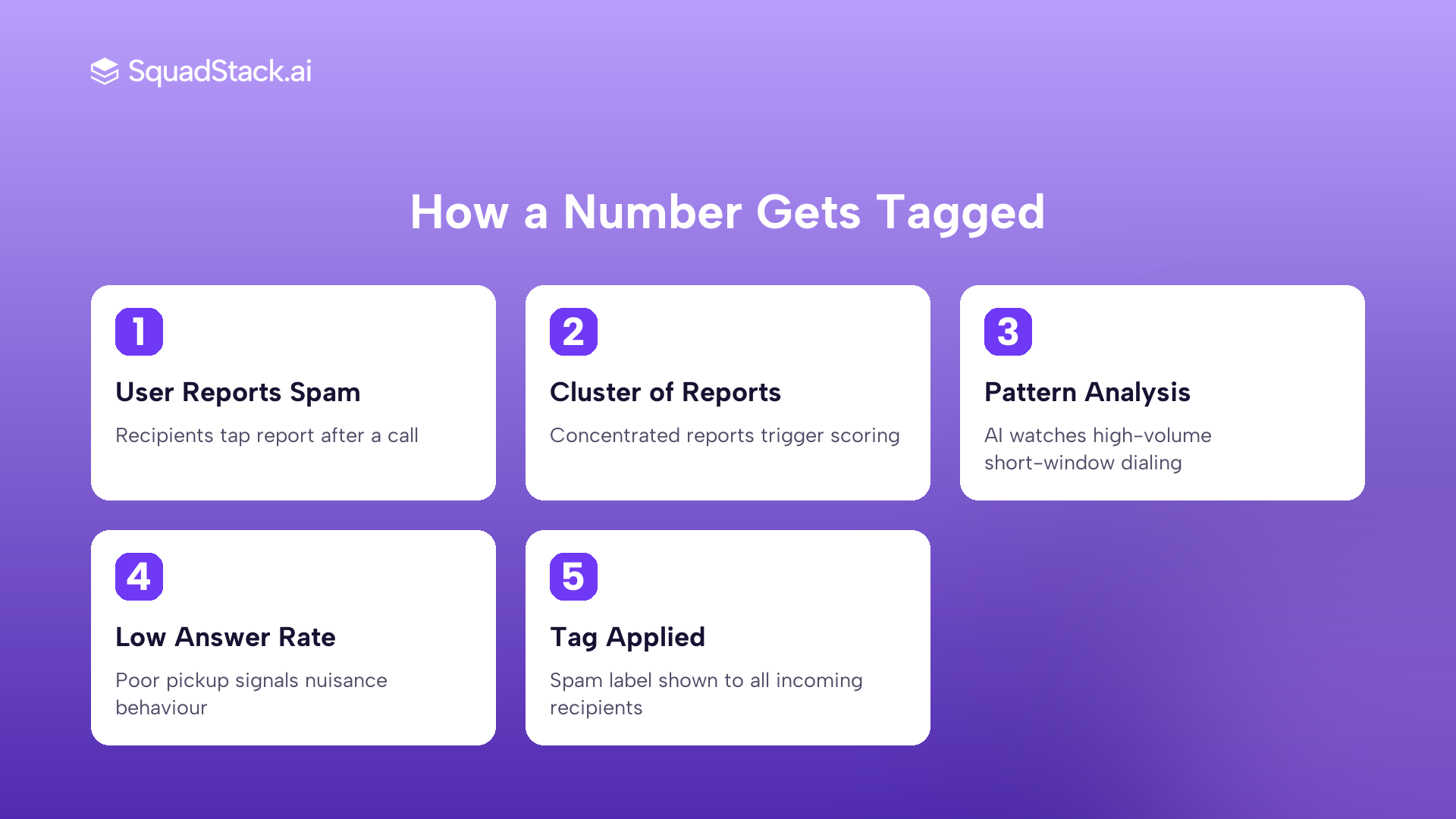
User-reported spam. When recipients tap "Report Spam" after a call, that vote is added to the number's record. A small number of reports relative to call volume may not trigger a tag. A concentrated cluster of reports can.
Calling pattern analysis. Truecaller's AI watches for patterns: a number that calls a very large group of people in a short window, that gets answered rarely, or that produces very short calls consistently. These patterns resemble nuisance behaviour even when the campaign is legitimate.
Call duration signals. Very short calls where the recipient hangs up almost immediately signal that people do not want to hear from that number. This feeds the spam score over time.
Cross-network data. Truecaller aggregates signals across its user base, which is large in India. A number that gets ignored or reported across many unrelated people accumulates a negative signal fast.
The practical implication: a number is not safe simply because your campaign is legal and consent-based. Volume and pattern matter. A compliant campaign can still trigger spam classification if the dialing cadence is not managed carefully.
The connect rate effect is immediate and severe. Users see the "Spam" label before they decide whether to answer. A large share will not pick up. Some will block the number directly, which adds another data point against it.

The cascading damage is worse than the initial drop. Once tagged, the number continues collecting reports and low answer rates, which deepens the spam score. Simply waiting it out rarely works. Remediation requires active steps, and even those take time to reflect.
For AI calling campaigns running at the volumes typical of large Indian consumer brands, the revenue impact of a single undetected spam tag across a primary number can be significant. Connect rates are the foundation of everything. If leads cannot be reached, no amount of script quality or follow-up logic recovers that opportunity.
The right approach is prevention, not remediation. An AI voice agent platform built for Indian market conditions should handle number health as a live, automated system.

Automatic number rotation. Every outbound number has a health score that reflects its Truecaller status and its live connect rate. When a number's connectivity drops below a threshold, or when it shows up as spam-tagged on Truecaller, the system pulls it from active rotation and swaps in a clean number. This should happen automatically, not through a manual check. In SquadStack's AI Lead Manager, this rotation is an always-on function, not a one-time configuration.
Dedicated numbers per client. Shared number pools are a liability. If another customer on the same pool runs a campaign that triggers spam tags, your numbers get contaminated. Dedicated numbers give you control over the reputation you are building.
Calling cadence management. The dialing system should enforce sensible gaps between attempts to the same lead, limit daily attempts per number, and respect the TRAI-compliant calling window (9:30 AM to 8:30 PM). Hard enforcement at the platform level, not by convention, is what matters. Aggressive retry logic is one of the fastest ways to accumulate spam signals.
Verified caller ID. Registering through Truecaller's business verification process is the single most direct prevention step available. A verified display name shows recipients who is calling before they pick up. It reduces the anonymous-call problem that drives a large share of spam reports.
DND scrubbing. Calling DND-registered numbers is both a compliance issue and a spam signal. Scrubbing lead lists against the TRAI DND registry before every campaign run removes a category of calls that should never happen.
Omnichannel fallback. When a number is being rested, the campaign does not have to go dark. WhatsApp nudges, SMS messages, and in-app notifications keep the lead journey alive while the voice channel recovers. This is a real operational advantage of platforms built for omnichannel outreach rather than pure dialers.
| Dimension | Traditional Dialer | AI Calling Platform (SquadStack) |
|---|---|---|
| Number health monitoring | Manual or absent; teams notice the drop after the fact | Live monitoring; number rotated automatically when connectivity drops or spam tag detected |
| Caller ID | Anonymous or unregistered business name | Verified Truecaller business caller ID available |
| DND scrubbing | Often a one-time pre-campaign step | Scrubbed before every dial, per TRAI registry state |
| Retry cadence | Fixed rules, often aggressive | Configured per campaign with spam guardrails always on; 180-minute gaps by default |
| Omnichannel fallback when number rests | Not available | WhatsApp, SMS, in-app nudges maintain lead engagement |
| TRAI window enforcement | Depends on operator discipline | Hard-enforced by the platform; out-of-window dialing is blocked |
Before every campaign, and during live campaigns on a regular basis, check the following:
1. Verify Truecaller status for every active outbound number. Flag any that show a spam tag or low community trust score. 2. Check DND registry freshness. Lead lists should be scrubbed against the current registry, not a cached version. 3. Review connect rate trends by number, not just by campaign. A number whose connect rate is drifting down before it gets formally tagged is showing early warning signs. 4. Confirm retry cadence settings. Make sure maximum daily attempts per number and gaps between retries are set to levels that do not pattern-match as nuisance calling. 5. Check call duration distribution. A spike in very short calls (under 10 seconds) is often a proxy signal that people are rejecting the number on caller ID alone. 6. Register verified caller ID through Truecaller's business verification. This is a direct reputation asset, not just a cosmetic feature. 7. Confirm that 140-series numbers are in use for cold outreach, per TRAI guidelines. Using non-compliant number series for cold calling is both a regulatory issue and a spam-tag accelerator. 8. Plan number resting cycles. Active numbers should have rotation partners ready so a resting number does not create a campaign pause.
SquadStack has been running outbound contact center operations for Indian consumer brands for close to ten years. The transition to full Voice AI in 2025 was built on a base of 600M+ minutes of real Indian sales conversations. That operational depth is what makes the number health layer practical rather than theoretical.

The spam-aware number rotation described above is built into SquadStack's AI Lead Manager as a standard function. Every client gets dedicated numbers, not a shared pool. The platform monitors Truecaller status and connectivity per number, rotates automatically at threshold, and hard-enforces the TRAI calling window at the system level.
When a number needs to rest, SquadStack's omnichannel workflow continues lead engagement via WhatsApp and SMS so pipeline does not stall. Verified Truecaller caller ID is available as part of the engagement setup.
The results this infrastructure produces are visible in live deployments. A leading gold loan NBFC running AI calling through SquadStack saw connect rates and conversion outcomes that outperformed their previous human-agent benchmark. Number trust was a precondition for those results. You cannot convert leads you cannot reach.
SquadStack runs 50 lakh+ AI calls daily across 60+ large consumer brands including AngelOne, Kotak Mahindra Bank, Eureka Forbes, IndiaMART, and PhonePe. At that scale, number reputation management is not optional. The platform's 93% POC success rate, against an industry average around 25%, reflects an infrastructure that handles these operational realities from day one.
For teams evaluating AI call center platforms specifically for Indian outbound campaigns, number health management should be a first-tier evaluation criterion, not an afterthought.
A spam tag that goes undetected for even a few days can cost a campaign a large share of its reachable leads. The tools to prevent it exist. The question is whether your calling platform has them built in or whether your team is checking manually.
If your outbound connect rates are underperforming or you want to audit your current number health before it becomes a problem, talk to the SquadStack team.
What is Truecaller no check and why do AI calling teams search for it?
"Truecaller no check" refers to the process of checking whether a phone number has been spam-tagged on Truecaller, or verifying a number's business identity so it is displayed as legitimate. AI calling teams search for it because a spam tag can dramatically reduce answer rates, and checking number status is a core part of maintaining outbound campaign performance.
Which is the best AI calling platform for Truecaller spam tag prevention in India?
The best platform is one that monitors number health continuously, rotates spam-tagged numbers automatically, enforces TRAI-compliant cadence at the system level, and supports verified Truecaller caller ID. SquadStack's AI Lead Manager handles all of these as built-in functions, not manual processes, making it purpose-built for Indian outbound campaigns at scale.
How does Truecaller decide a number is spam?
Truecaller uses user-reported spam flags combined with AI-driven pattern analysis. Signals include the number of people who have marked a number as spam, calling frequency, call duration patterns (especially very short calls that suggest people are rejecting the call), and low answer rates over time. A legitimate business number can trigger these signals if its dialing cadence is aggressive.
Can a spam-tagged number be cleaned?
Yes, but it takes time and active steps. The most effective remediation is to rest the number from active dialing, register a verified business identity through Truecaller's business verification process, and reduce the negative signals over time. For live campaigns, the better approach is to rotate the number out immediately and run a clean number while the flagged one recovers.
What is Truecaller name checking and how does it help outbound campaigns?
Truecaller name checking (or business caller ID verification) is the process of registering a business name and category with Truecaller so that name appears when you call someone. For outbound teams, this replaces an anonymous or unknown number display with a recognizable brand name, which reduces the rate at which people decline or report the call as spam.
Does calling on 140-series numbers prevent spam tagging?
Using 140-series numbers is a TRAI compliance requirement for commercial cold calling in India, not a spam prevention mechanism by itself. It reduces the risk of regulatory action, but Truecaller's spam detection still operates on 140-series numbers. You still need to manage call cadence, frequency, and user reports to maintain a clean reputation.
How often should outbound teams check their numbers on Truecaller?
For high-volume campaigns running thousands of calls daily, the check should happen continuously and automatically at the platform level. Manual checks are too slow for campaigns where a single day of degraded connectivity can affect a large portion of the lead list. The platform should alert or rotate automatically, with human oversight on the reporting side.
What happens to leads when a number is being rested or rotated?
On a well-designed omnichannel platform, the lead journey continues through other channels. WhatsApp messages, SMS nudges, and in-app notifications can keep the lead engaged while the voice channel rotates to a clean number. This is one of the operational advantages of an omnichannel AI calling system over a standalone dialer.
How does AI voice calling compare to traditional IVR for managing Truecaller spam risk?
Traditional IVR systems run on fixed scripts and cannot adapt their behavior in response to changing number health. An AI voice agent platform manages number rotation, call cadence, and channel fallback dynamically. It can also hold natural, two-way conversations that produce longer average call durations, which signals to Truecaller's detection system that the number is being used for genuine conversations rather than nuisance calls.
Is SquadStack TRAI-compliant for outbound AI calling?
Yes. SquadStack is TRAI-compliant and also holds ISO 27001, ISO 27701, and SOC 2 Type II certifications, as well as DPDP compliance. The platform hard-enforces the TRAI calling window (9:30 AM to 8:30 PM) at the system level, scrubs lead lists against the DND registry before every campaign, and only uses 140-series numbers for cold outreach.