.svg)





Hyper-Personalised Outbound Call Scripts Using Customer Lifecycle Data
October 6, 2026
|

13 min read
A voice AI platform is software that holds real conversations with leads and customers over the phone, replacing or augmenting human agents. Not all...
A voice AI platform is software that holds real conversations with leads and customers over the phone, replacing or augmenting human agents. Not all platforms are equal: Indian enterprises evaluating options should score vendors on seven criteria, latency, language depth, CRM connectors, compliance tooling, analytics, escalation logic, and pricing model, before signing. This guide covers each one and shows what good looks like.
Most voice AI evaluations start with a product demo. The agent sounds human, answers a few sample questions smoothly, and the team is impressed. Three months later, connectivity is low, regional-language calls sound robotic, and the CRM is full of missed dispositions.
The demo was fine. The evaluation was not.
Buying a voice AI platform for Indian consumer sales is a technical and commercial decision that involves telephony, language models, compliance, and ongoing optimization. This guide gives CXOs and RevOps leaders a structured framework for getting it right.
A voice AI platform is a software system that conducts spoken conversations with leads or customers autonomously, using AI to understand what the person says and respond in natural language, in real time. It is not an IVR. It does not play recordings or route callers through a numbered menu. It listens, understands intent, asks follow-up questions, handles objections, and takes actions mid-call such as booking a callback or sending a WhatsApp link.
The platform handles high-volume, repeatable conversations: loan qualification, demat account opening, AMC renewal, lead follow-up, rider onboarding. Done well, it reaches more people faster, at lower cost, with consistent quality across every call.
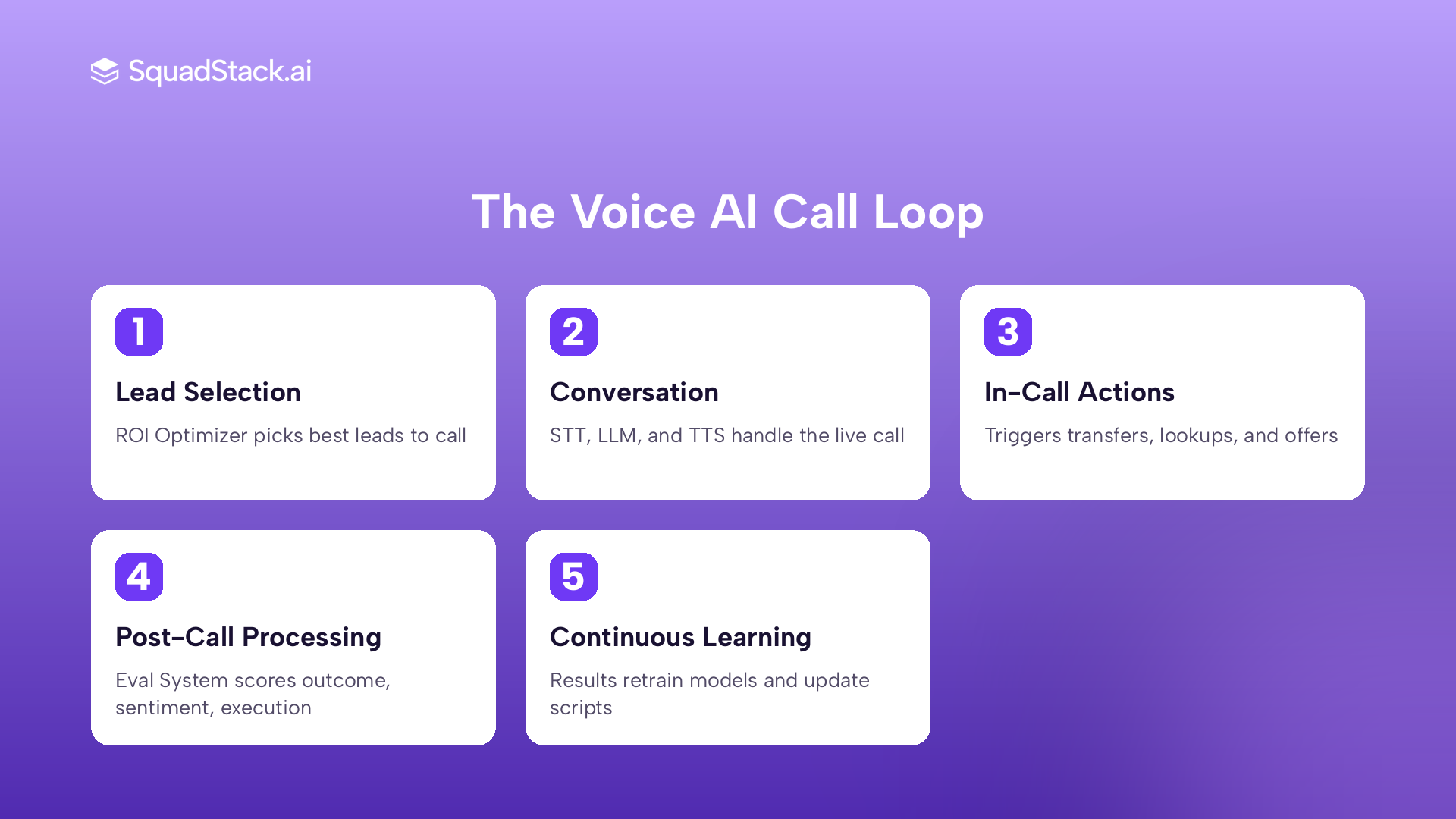
The core loop has five steps.
1. Lead selection. A scoring engine ranks the lead list, checks DND registry status, applies cadence rules, and rotates numbers flagged as spam.
2. The conversation. The platform dials the lead. A speech recognition model (STT) converts spoken audio to text. A language model (LLM) decides what to say next. A text-to-speech engine (TTS) converts the response to audio. This loop runs in under a second on a well-built platform.
3. In-call actions. While the call is live, the agent can send a WhatsApp message, book a follow-up, confirm entity data, or route the call to a human if a configured trigger fires.
4. Post-call processing. Transcripts are generated, dispositions are classified, and structured data points are written back to the CRM. A QA layer scores the call on outcome, sentiment, and execution.
5. Continuous learning. Every outcome feeds back into the system. The ROI optimizer reads which scripts, voices, timings, and channel sequences converted and which did not. A self-improvement layer proposes precise edits backed by live A/B evidence. Each cycle leaves the agent slightly sharper than the last.
This last step is the one most vendors skip. A platform without a built-in optimization loop requires manual tuning after every campaign change, and that is where most deployments stall.
For a deeper look at how agentic calling stacks are structured, see the agentic AI contact center overview.
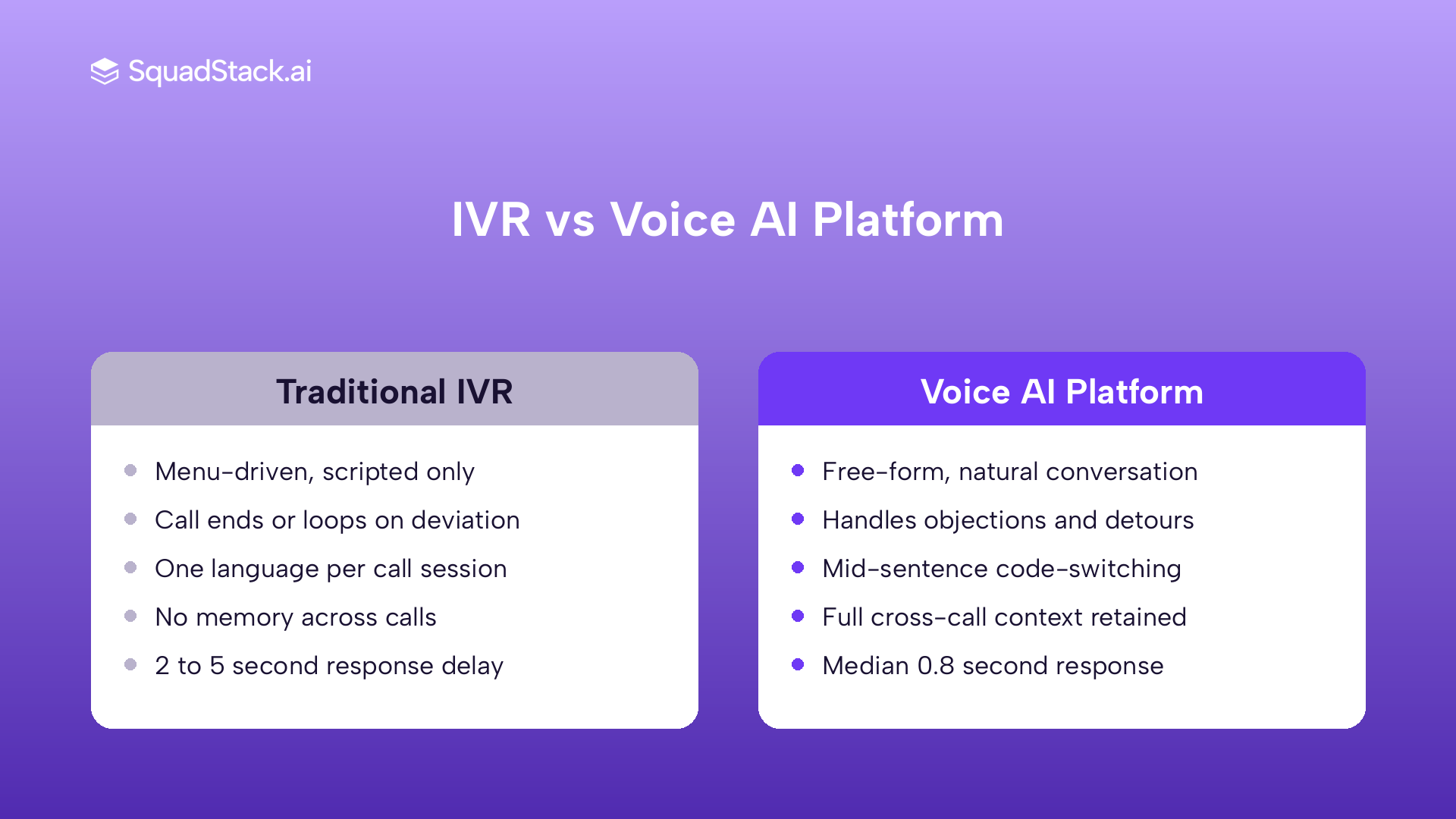
| Dimension | Traditional IVR | Voice AI Platform |
|---|---|---|
| Conversation style | Press 1 for X, Press 2 for Y | Speaks and listens naturally, both ways |
| Handling an off-script response | Fails, loops, or drops the call | Understands and adapts in real time |
| Language switching | Fixed to one language per call | Switches mid-sentence (Hinglish, Taminglish) as the lead speaks |
| Memory across calls | None. Every call starts cold | Persistent memory: agent knows the lead's history before dialing |
| Objection handling | Cannot handle it | Multi-step live objection handling, built into the conversation |
| Response speed | Instant playback (pre-recorded) | Sub-0.8 second AI response; natural conversational rhythm |
A typical IVR failure: a personal loan lead calls back a second time, gets asked the same income question they already answered, and hangs up. A voice AI platform with persistent memory opens that second call from where the last one stopped.
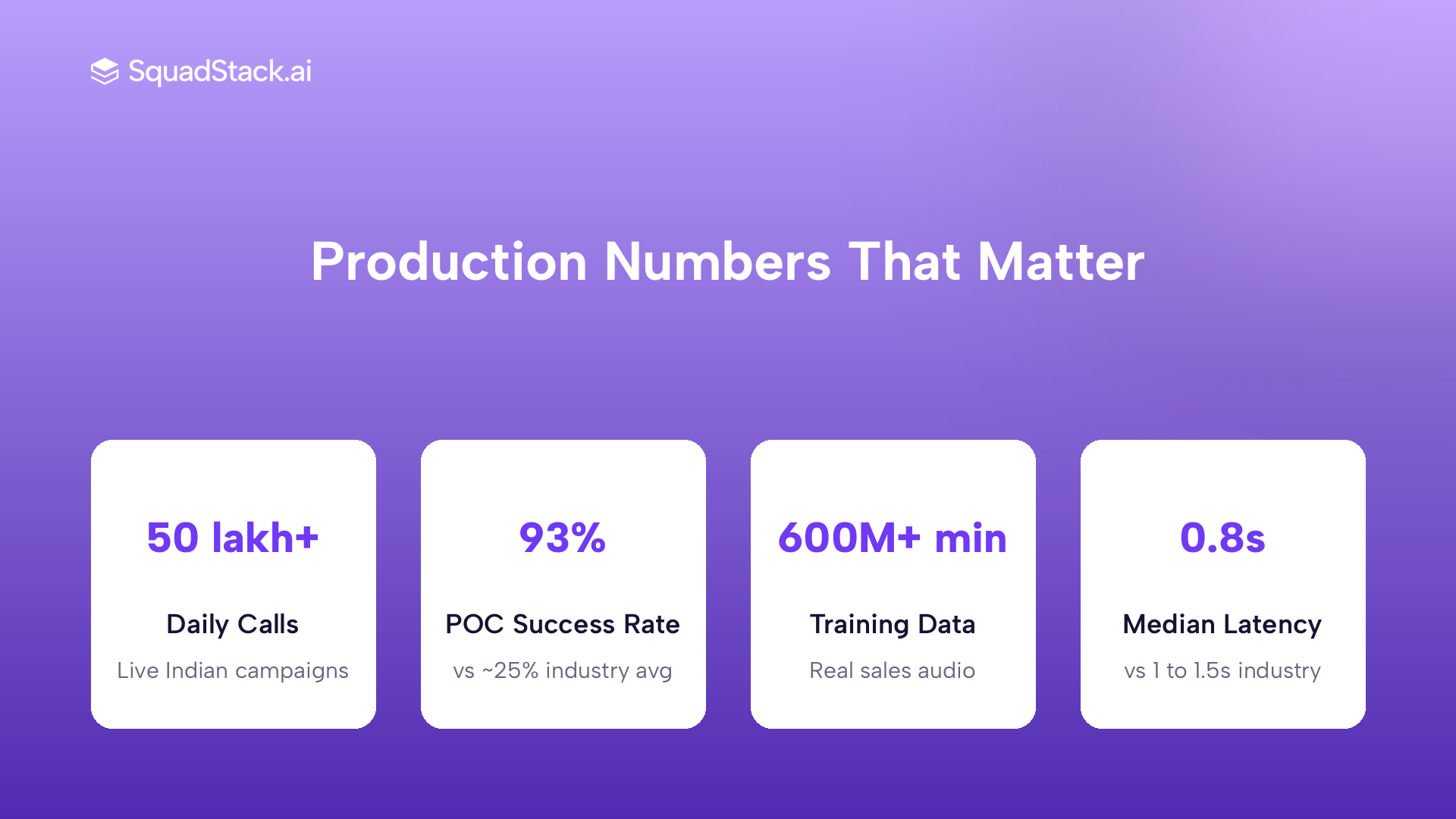
Response latency is the gap between the lead finishing a sentence and the agent beginning its reply. The target is 0.8 seconds or less. Above 1.5 seconds, conversations feel broken and leads hang up early.
Red flag: the vendor quotes latency on clean audio in a controlled environment but cannot show production numbers on live 8kHz telephony lines with background noise.
For India, listing nine languages on a feature page is not the same as sounding native in all nine. A model trained on YouTube transcripts sounds like a newsreader in Tamil or Bengali. A model trained on millions of real telephony conversations, including code-switched speech like Hinglish and Taminglish, sounds like a person.
Ask for a live demo in your target vernacular language on a phone call, not a web player. Web audio hides artifacts that 8kHz telephony exposes.
Red flag: the vendor sources their speech model from a public dataset. Production quality on noisy phone lines will disappoint.
The platform must write dispositions, extracted entities, and follow-up bookings back to your CRM automatically after every call. Check whether the integration is two-way and whether callbacks sync in real time.
Red flag: the vendor offers a bulk CSV export rather than a live API or webhook-based write-back.
Three compliance layers must be hard-enforced by the platform, not left as configuration options.
TRAI calling hours: outbound calls are only permitted between 9:30 AM and 8:30 PM. This must be a system-level block, not a setting a campaign manager can accidentally override.
DNC/DND scrubbing: lead lists must be scrubbed against the TRAI DND registry before dialing.
DPDP data residency: for BFSI and healthcare clients, all models and data must be hosted in India.
Red flag: the vendor's compliance answer is "we have a compliance module" without specifying hard blocks on calling hours or in-country hosting.
Surface-level dashboards show connect rate and call count. The analytics layer should give you per-turn latency breakdown, disposition accuracy, entity extraction quality per campaign, and a direct path from a metric that moves to the underlying calls behind it.
Red flag: the only path from "conversions dropped 10% this week" to an answer is a support ticket.
High-intent leads should route to a human agent with full context already passed: what the lead said, what was confirmed, where in the funnel they are. A cold handover that starts with "how can I help you today?" erases the value of the AI conversation that just happened.
Check how transfer triggers are configured, what context is passed, and what happens when no human is available.
Red flag: the platform supports transfer but the human receiving the call sees only a phone number and a name.
For outbound sales, per-outcome pricing aligns incentives with your goals. Per-minute pricing penalizes longer conversations, which are often the more valuable ones. Also ask whether telephony, QA, and analytics are included or billed separately.
Red flag: pricing is only available after a multi-week scoping exercise. Transparent vendors can give a ballpark early.
For a broader comparison of platforms, this overview of AI call center solutions and this comparison of AI tools for contact centers are useful references.
SquadStack built its speech model, Arth, on 600M+ minutes of real Indian sales conversations recorded in live telephony conditions, code-switched, noisy, 8kHz. That training corpus is the foundation behind every claim below.
Latency. Median response latency of 0.8 seconds or less across all nine supported languages, staying flat on long calls through a context management layer that keeps the per-turn payload constant.
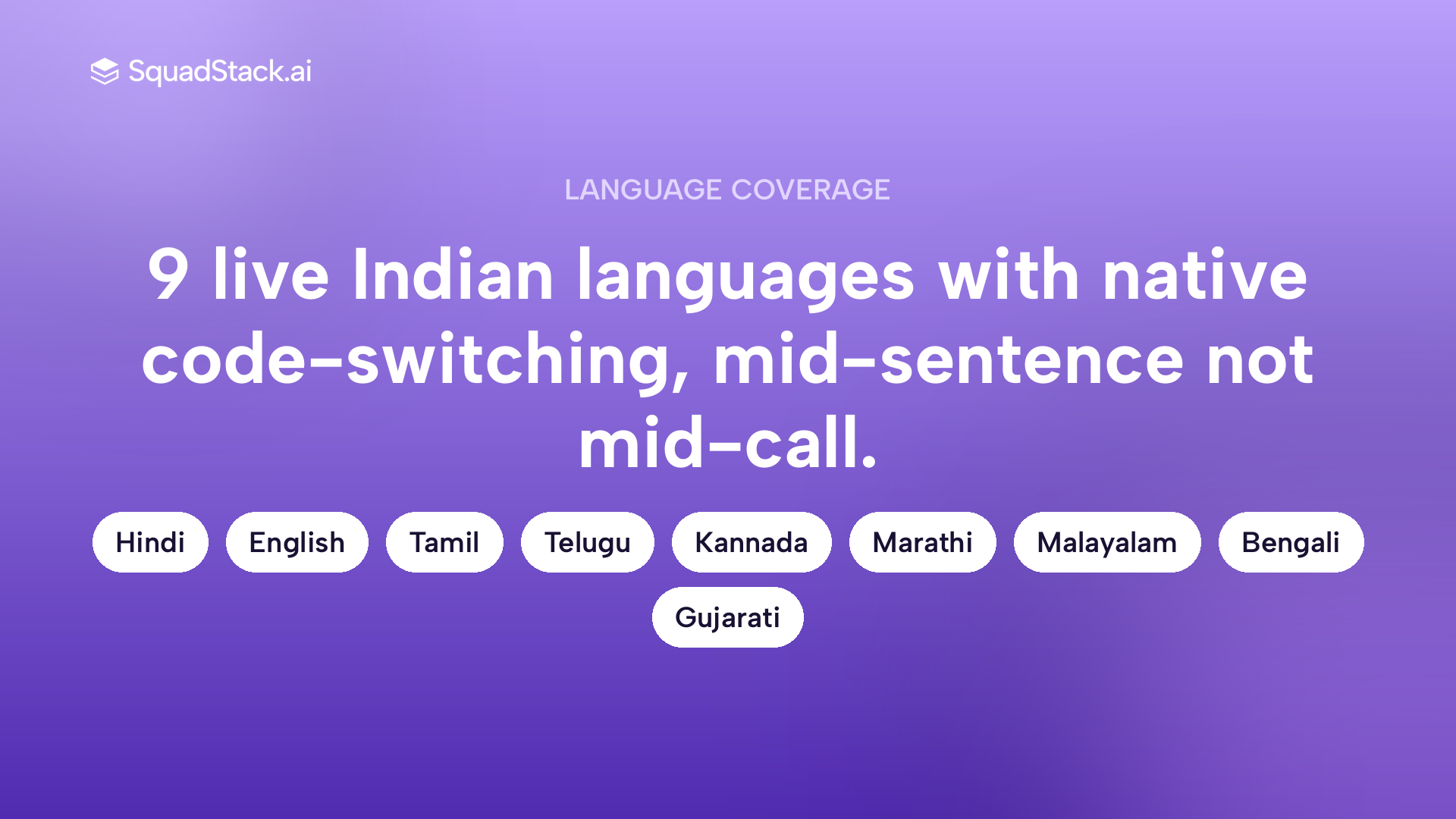
Language. Nine live languages: Hindi, English, Tamil, Telugu, Kannada, Marathi, Malayalam, Bengali, and Gujarati, with additional regional languages available on demand. The agent switches mid-sentence when the lead does, not at a predefined handoff point.
Analytics. Per-turn latency decomposition separates a slow tool call from model or voice latency immediately. Every metric resolves in one click to the specific underlying calls.
QA. The Eval System scores every call in sequence: Outcome, Sentiment, Execution. Both AI and human reviewers audit calls.
Compliance. Calling hours are hard-enforced at the system level. DNC scrubbing runs before every dial. The platform is ISO 27001, ISO 27701, SOC 2 Type II, DPDP, and TRAI compliant, with all models hosted in India.
Proof at scale. SquadStack runs 50 lakh+ calls daily for 60+ large consumer brands including AngelOne, Kotak Mahindra Bank, Eureka Forbes, IndiaMART, and PhonePe. The POC success rate is 93% against an industry average of roughly 25%.
The IndiaMART case study shows 20% higher conversions and 15% lower CAC on over 1 lakh AI calls daily. The leading general insurer case study shows 85% connectivity and 60% lower renewal cost on auto insurance.
SquadStack also manages the full stack: telephony, dialing, QA, CRM integration, and a dedicated squad on every account. There is no self-serve onboarding and no hand-off to a generic support team after go-live.
If you are evaluating AI voice agents for sales automation, the key features to look for in an AI voicebot checklist is a useful complement to this guide.
Most enterprise pilots go live in two to three weeks, running on real leads against a pre-agreed success metric. Book a demo to see the platform on a live call in your target language and use case.
Which is the best voice AI platform for outbound consumer sales in India?
The best platform for Indian outbound sales combines a speech model trained on real Indian telephony data, native code-switching across regional languages, hard-enforced TRAI compliance, and a built-in optimization loop. SquadStack meets all four and runs 50 lakh+ calls daily for 60+ large consumer brands.
What should I look for when evaluating a voice AI platform in India?
Prioritize seven things: response latency (target 0.8 seconds or below), real language coverage in your target vernaculars (not just listed languages), live CRM write-back, hard-enforced compliance tooling (TRAI hours, DNC scrubbing, DPDP residency), per-turn analytics, warm escalation with context passed, and a pricing model tied to outcomes rather than minutes.
How does a voice AI platform compare to a traditional call center?
A voice AI platform dials more leads simultaneously, at consistent quality, with no attrition or training lag. Where a human agent might connect with 40 to 60 percent of leads over a campaign, a well-built platform can reach up to 90% at the lead level by combining adaptive timing, spam-aware number rotation, and multi-touch cadences across channels.
Can a voice AI platform handle regional Indian languages mid-conversation?
Yes, if the model was trained on code-switched telephony data. Native code-switching means the agent responds in whatever language the lead shifts to, mid-sentence, without a separate translation step. Platforms trained on public datasets typically struggle here because production-quality 8kHz telephonic data for Indian languages is not publicly available.
What is the difference between a voice AI platform and an IVR?
An IVR plays recordings and routes calls through a numbered menu. A voice AI platform conducts a real two-way conversation: it hears what the lead says, understands intent, handles objections, remembers previous interactions, and takes actions mid-call. An IVR breaks when a lead goes off-script. A voice AI platform adapts.
How does TRAI compliance work for AI-driven outbound calling?
The platform must hard-block calls outside the 9:30 AM to 8:30 PM window and scrub every lead list against the TRAI DND registry before dialing. Only 140-series numbers may be used for cold outbound. These controls must sit in the platform's telephony layer, not rely on a campaign manager to configure them correctly.
How long does it take to go live with a voice AI platform?
Most enterprise deployments go live in two to three weeks. The build phase trains the agent on the client's own call recordings, knowledge base, and FAQs, so it performs like the client's best agent from day one. The long pole is usually the client's telephony approvals and data feeds, not the platform build itself.
What is a realistic POC success rate for a voice AI platform?
Industry-wide, roughly one in four voice AI pilots converts to a successful production deployment. SquadStack's POC success rate is 93%, which reflects a combination of deep Indian-market training data, a managed-service model, and a pre-agreed success metric for every pilot.
Should I build a voice AI platform in-house or buy one?
Building in-house looks straightforward until you hit the real constraints: an Indian-language speech model tuned for 8kHz telephony, sub-800ms latency at scale, QA infrastructure for thousands of concurrent calls, and a continuous optimization loop each require a specialist team. The speech model is roughly 10% of the problem. The other 90% is the sales decision system, telephony stack, and ongoing optimization. Most consumer brands do not have those teams, and by the time an in-house build reaches production quality, a vendor with 600M+ minutes of training data and 50 lakh+ daily calls has already delivered the outcome.
Does a voice AI platform integrate with existing CRM systems?
Yes. A good platform writes dispositions, extracted entities, and callback bookings to the CRM in real time via API or webhook after every call. It also reads inbound lead metadata so the agent starts every call with the lead's profile, not a blank slate. If a vendor can only offer bulk CSV exports, that is a sign the integration layer is not production-grade.