.svg)





Hyper-Personalised Outbound Call Scripts Using Customer Lifecycle Data
October 6, 2026
|

13 min read
A voice agent is an AI-powered software that holds real, two-way spoken conversations, understands natural language, and takes action, without a human on...
A voice agent is an AI-powered software that holds real, two-way spoken conversations, understands natural language, and takes action, without a human on the other end. Unlike a phone menu or a keyword-spotting bot, it listens, responds in context, and adapts mid-call. Businesses across sales, support, and collections use voice agents to reach more customers, in their language, at scale.
Sales and support teams in India have a reach problem. A lead list arrives, human agents dial through it, and a large share of leads are never spoken to. Calls go unanswered, numbers get flagged as spam, timing is wrong, and no one has the bandwidth to retry intelligently. Voice agents exist to solve exactly that. But not all voice agents are equal, and knowing the difference matters before you commit to one.
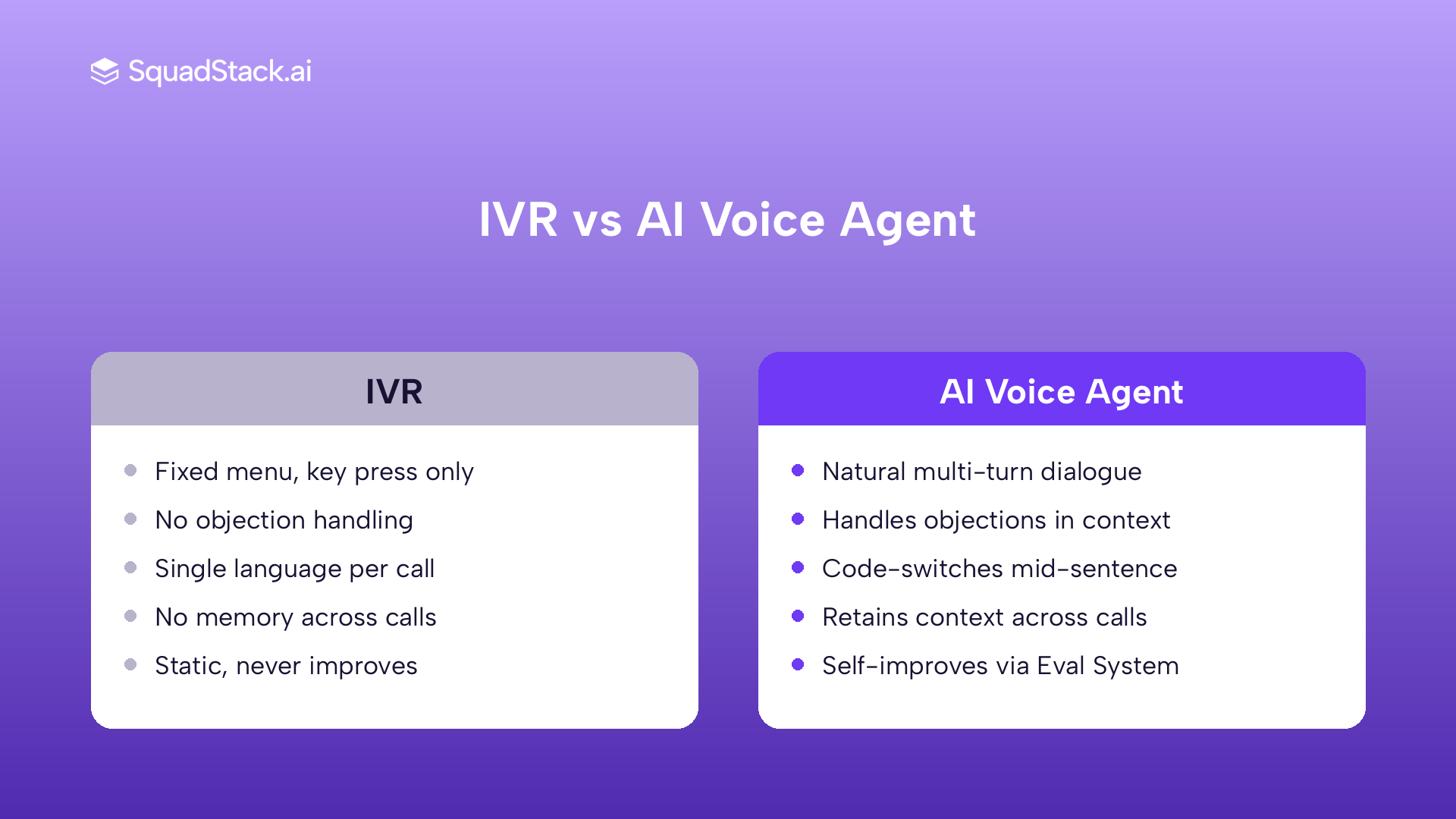
A voice agent is an AI system that conducts spoken conversations autonomously. It listens to what a person says, understands the intent behind it, and speaks back with a contextually appropriate response, in real time, without a human agent on the line.
A voice agent is not a phone menu asking you to press 1, and not a voice recorder that transcribes your words and routes you somewhere. It understands what you actually mean, even if you say it in Hinglish, interrupt it, or ask something off the expected script.
The category has evolved through three generations, and the differences are significant:
| Type | How it works | What breaks it |
|---|---|---|
| Rule-based IVR | Fixed menus, DTMF tones, pre-recorded prompts | Any deviation from the menu: a question, a regional accent, a sentence instead of a key press |
| Keyword-spotting bot | Detects specific trigger words and plays a mapped response | Synonyms, context, or any phrasing it was not trained to recognize |
| LLM-powered voice agent | Understands full natural language, holds multi-turn dialogue, adapts to conversation context | Very little, when built on the right data |
Most of what gets called a "voice bot" today sits in the second category: it recognizes a phrase like "not interested" and plays a retention message. A true LLM-powered voice agent understands that "I'm a bit busy right now" and "can you call me after 6?" both require a callback, even though neither phrase contains a keyword.
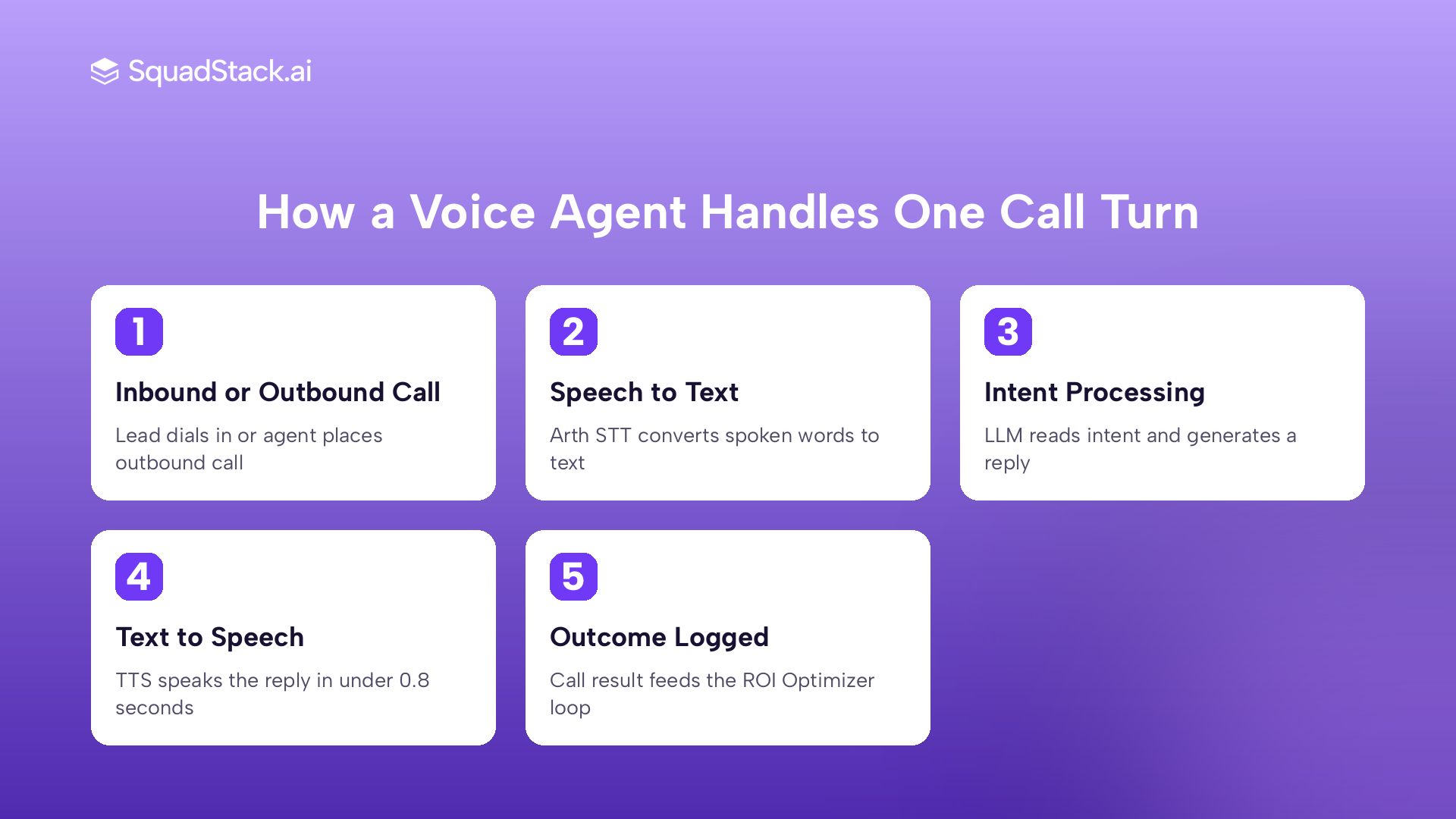
A modern voice agent runs a cascaded architecture across four components, all completing in well under a second per turn.
Step 1: Speech recognition (STT). The caller speaks and the system converts audio to text. In practice, this is the hardest step: Indian phone calls are noisy, code-switched between Hindi and English, compressed to 8kHz, and full of entity names (PAN numbers, city names, product codes) that generic models misread.
Step 2: Language understanding (LLM). The text goes into a language model fine-tuned for the use case. The model reads the full conversation context, decides what the caller means, and generates a response.
Step 3: Speech synthesis (TTS). The response text is converted to speech. Quality depends on whether the voice was cloned from real conversational audio or trained on read-speech, which sounds formal and unnatural on the phone.
Step 4: Turn-taking and action. The system detects when the caller has finished speaking, handles interruptions naturally, and executes mid-call actions: booking a callback, sending a WhatsApp link, or transferring to a human agent with full context passed.
The continuous learning loop. After every call, outcomes feed back into the system. Which calls converted? Where did leads drop off? What objections came up? The ROI Optimizer uses this data to refine scripts, adjust timing, test new voices, and improve the next batch of calls. This is what separates a static bot from an agent that actually improves over time.
For a deeper look at how this connects to the full outbound workflow, see SquadStack's AI voice agent platform overview.
Voice agents attach to the moments where fast, personalized outreach drives revenue but human bandwidth runs out. Here are the most common applications in the Indian market:
Outbound sales and lead qualification. A lending company generates thousands of pre-approved loan leads daily. Calling each manually means missing the conversion window. A voice agent calls every lead within minutes, qualifies income and intent, and passes warm prospects to closers. IndiaMART uses this approach for buyer-seller matching, achieving 20% higher conversions and over 1 lakh AI calls daily.
Demat account opening and financial product activation. Brokerage and fintech companies need to guide users through multi-step onboarding before they drop off. Voice agents handle the qualification conversation, confirm details, and prompt the next step. AngelOne uses SquadStack for demat account opening, customer support, and fraud detection.
Collections and repayment reminders. A voice agent can call every overdue borrower before a human team could reach a fraction of them, explain the situation clearly, and arrange payment. PhonePe and Moneyview both use voice AI for collections alongside personal loan sales.
AMC and product renewals. Eureka Forbes uses voice agents for AMC sales, reaching customers whose contracts are due for renewal at scale and lower cost than a field or phone team.
Rider hiring and onboarding. High-volume hiring campaigns need to screen hundreds of candidates a day. Delhivery cut cost-per-hire by 4x using voice AI for rider hiring and onboarding.
Feedback and NPS. Short, conversational post-purchase surveys get better response rates than SMS forms. redBus uses voice AI for review and rating collection. A leading general insurer achieved 85% connectivity and 60% lower renewal cost on auto insurance renewals.
Voice agents also handle education lead qualification, healthcare appointment booking, e-commerce abandoned cart recovery, and seller onboarding. The full range is covered in SquadStack's AI voice agent for sales automation resource.
Many teams still deploy IVR for outbound or inbound flows and call it a voice solution. The gap is significant.
| Dimension | IVR | LLM-powered voice agent |
|---|---|---|
| Conversation style | One-way: plays a prompt, waits for a key press or a programmed word | Two-way: listens to anything the caller says and responds in context |
| Handling a mid-call objection | Cannot process "the EMI seems high, can you check if I get a better rate?" so it repeats the menu or disconnects | Catches the objection, addresses it across multiple turns, and continues the conversation |
| Language and code-switching | Usually one language, breaks on Hinglish or mixed-sentence responses | Native code-switching mid-sentence, trained on real bilingual conversations |
| Memory across calls | Every call starts cold | Persistent memory: follow-up calls resume from exactly where the previous one left off |
| Learning and improvement | Static; someone must manually rewrite the script to change behavior | Every call's outcome feeds back into continuous optimization of script, timing, and voice |
A practical example: a personal loan applicant says "I already uploaded my PAN last week, do I need to do it again?" An IVR loops back to the main menu. A voice agent with persistent memory confirms PAN was received and moves directly to the next pending step.
Most voice AI platforms were built for English-speaking markets and adapted for India later. That shows up in three places: language quality, compliance readiness, and performance on real Indian phone calls.
Language depth, not language count. Any platform can list languages. What matters is whether the speech model was trained on real Indian telephony audio, including code-switched speech like Hinglish and Taminglish. A model trained on YouTube videos or read-speech will sound like a newsreader, and callers hang up.
TRAI compliance out of the box. Outbound calling in India requires 140-series numbers for cold calling, DND registry scrubbing, and hard calling-window limits (9:30 AM to 8:30 PM). These must be enforced at the platform level. Ask to see how it is enforced, not just whether it is supported.
Performance on real sales metrics. Connectivity rate, conversion rate, and cost per outcome are the numbers that matter. Ask for benchmarks from live campaigns, not lab demos.
A managed service, not just a tool. Building a voice agent that works on demo is easy. Making it handle objections across 10+ turns and improve week over week requires dialogue engineering, QA, and a continuous optimization loop. That is not something most teams can run in-house.
For a structured evaluation framework, see how to evaluate a voice agent.
SquadStack spent roughly 10 years running AI-assisted contact centers for large Indian consumer brands before going fully Voice AI in 2025. That history produced 600M+ minutes of real, outcome-labelled Indian sales conversations used to train Arth, SquadStack's proprietary speech recognition model.
Arth is tuned for Indian telephony: noisy 8kHz lines, code-switched speech, regional accents, and Indian entity names. In SquadStack's own benchmark on real telesales audio, Arth v1 sits within 0.9 WER points of the best commercial streaming STT, ahead of Deepgram and Sarvam. It is owned, fine-tunable on outcome data, and hosted in India for DPDP compliance.
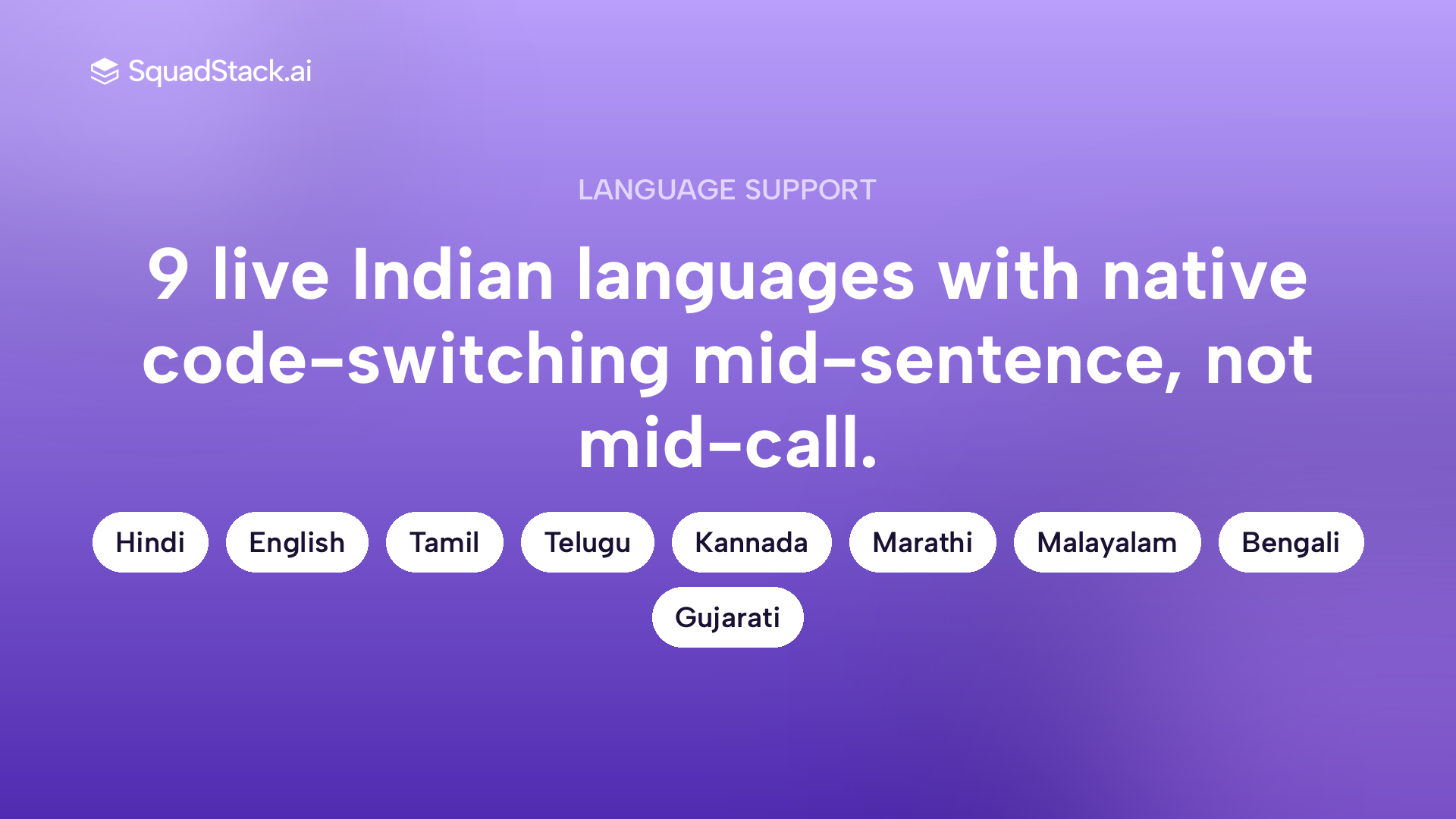
The platform supports 9 live Indian languages, including Hindi, English, Tamil, Telugu, Kannada, Marathi, Malayalam, Bengali, and Gujarati, with native code-switching and more regional languages available on demand. Callers do not need to choose a language at the start. The agent switches mid-sentence, the way a bilingual human agent does.
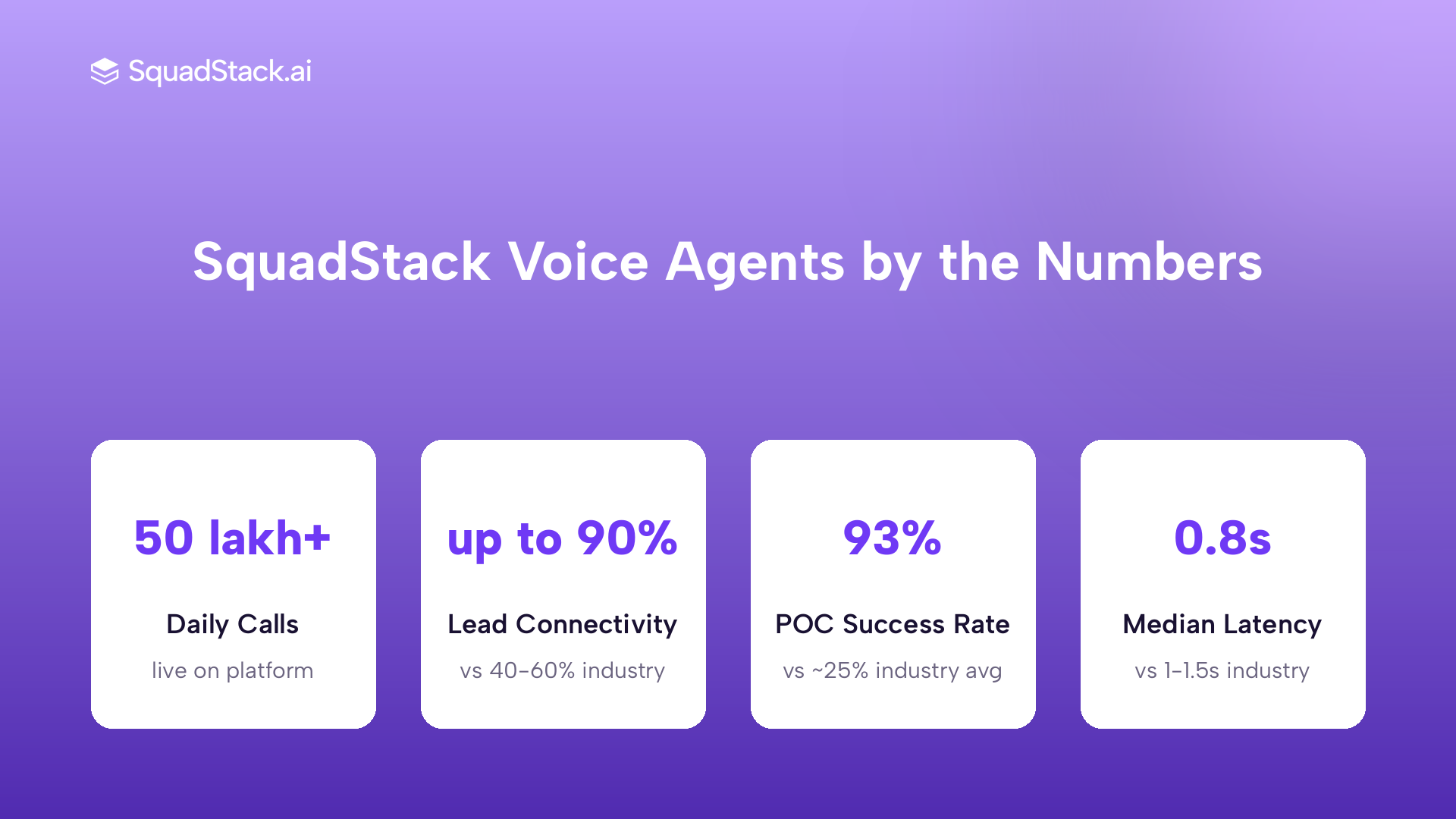
At scale, SquadStack runs 50 lakh+ calls daily across 60+ large consumer brands. Median response latency is 0.8 seconds or less. A pilot typically goes live within 2 weeks, and SquadStack's POC success rate is 93%, against roughly 25% for the industry.
Named customers include Kotak Mahindra Bank (personal loan sales), AngelOne (demat account opening, customer support, and fraud detection), Eureka Forbes (AMC and product sales), IndiaMART (buyer-seller matching), and PhonePe (merchant and personal loan sales, collections).
For teams in lending or brokerage, the bank-linked brokerage case study shows 3x higher conversions on account opening. Explore the full platform for AI sales or see how it applies to lead qualification specifically.
If you are evaluating voice agents for your sales or support team, schedule a demo to see a live call in your industry and language.
Which is the best voice agent platform for consumer sales in India?
The best platform for Indian consumer sales combines a speech model trained on real Indian telephony (not generic data), native multilingual support with code-switching, TRAI-compliant dialing, and a continuous optimization loop. SquadStack is purpose-built for this context, running 50 lakh+ calls daily across BFSI, e-commerce, education, and logistics brands.
Can a voice agent handle outbound sales calls automatically in India?
Yes. A modern LLM-powered voice agent can dial outbound, conduct a full qualification or sales conversation, handle objections, and pass warm leads to human closers, all without a human on the line. SquadStack's voice agents handle the entire call, including multi-turn objection handling, in 9+ Indian languages.
What is the difference between a voice agent and a voicebot?
The terms are often used interchangeably, but "voice agent" typically refers to the more capable, LLM-powered generation that understands natural language and holds open-ended conversations. A "voicebot" or "voice bot" often describes an older keyword-spotting or IVR system. The distinction matters: only a true voice agent can handle the variability of real Indian sales calls.
How does a voice agent compare to a human agent on sales performance?
In controlled campaigns, SquadStack's voice agents have matched or beaten human agents on conversion rate, handle time, and cost per outcome. Connectivity, reaching up to 90% of leads against a 40 to 60% industry norm, is the biggest structural advantage: the AI never fatigues, does not miss a retry, and does not get flagged as spam when number health is managed.
What languages does a voice agent need to support for India?
At minimum, Hindi and English, along with Hinglish code-switching. For national scale, Tamil, Telugu, Kannada, Marathi, Malayalam, Bengali, and Gujarati are important. The harder requirement is not language count but native fluency: the speech model must have been trained on real spoken audio in each language, not just translated scripts.
Is a voice agent TRAI-compliant for outbound calling in India?
TRAI compliance requires 140-series numbers for cold calling, DND registry scrubbing, and a hard calling window (9:30 AM to 8:30 PM). SquadStack enforces these at the platform level, not as optional settings. The platform is also ISO 27001, ISO 27701, SOC 2 Type II, and DPDP compliant.
How long does it take to deploy a voice agent?
A typical SquadStack engagement goes live in roughly 2 weeks, covering agent build, workflow setup, integrations, and UAT. The agent trains on the client's own call recordings, knowledge base, and FAQs before going live. Simpler, well-scoped campaigns can be prototyped faster; the main delay is usually client-side approvals and data feeds.
What happens when a voice agent cannot answer a caller's question?
There are two mechanisms. RAG (retrieval-augmented generation) lets the agent query a product knowledge base mid-call for specific policy, pricing, or product questions, with retrieval latency under 100 milliseconds. For situations that genuinely require a human, warm transfer passes the caller with full context already surfaced, so the human agent does not start the conversation from scratch.
Can a voice agent remember what a customer said on a previous call?
Yes, if the platform supports persistent memory. SquadStack's agents carry context across calls and channels: if a borrower confirmed their loan amount on Monday and stalled at document upload, the Wednesday follow-up call opens from that exact point. Without persistent memory, every call starts cold and leads repeat themselves, which drives drop-off.
How do voice agents handle Indian accents and background noise?
This is a speech model problem, not a features problem. Arth, SquadStack's proprietary STT, was trained on 600M+ minutes of real Indian telephony audio, including noisy, code-switched calls at 8kHz. It handles regional accents, crosstalk, and packet loss because it was trained on production call conditions, not clean studio audio. Generic models trained on public datasets consistently underperform on Indian telephony.