.svg)






Subscriber Churn Prediction Calls: AI Voice for OTT and Streaming
October 10, 2026
|

12 min read
.png)
Should enterprises build or buy Voice AI? This guide breaks down hidden complexity, revenue impact, and the smarter path to faster outcomes.
Every CXO and product leader eventually faces the same question:
Should we build Voice AI in-house or buy it?
On paper, building feels like the smarter, more strategic choice.
You control the stack. You customize for your use case. You own the IP.
And with today’s APIs and LLMs, it looks deceptively easy to get started.
But here is the reality most leadership teams only realize much later: Building a Voice AI agent that works in real customer conversations at scale is one of the fastest ways to burn time, money, and internal credibility.
Not because teams are incompetent.
But because Voice AI is far more complex than it appears in early demos.
This article is written for CXOs, product leaders, and business heads who are either:
We see this exact situation play out repeatedly. Let’s walk through what actually happens.
The initiative starts with optimism.
Early demos look encouraging.
Leadership feels validated.
The decision feels future-proof.
Once the system meets real customers, things start to feel off.
Engineering leaders notice:
Business leaders start feeling it elsewhere:
At this stage, no one calls it a failure.
It is framed as “early iteration pain.”
But the unease begins.
This is the phase most teams underestimate.
To move from a demo to a production-grade Voice AI system, teams realize they are not just building a bot. They are building an entire system.
.png)
Core AI Components You Must Get Right
Most teams initially rely on global cloud APIs here and then discover how limited control they actually have.
The Orchestration Layer Most Teams Miss
This is where many in-house efforts stall.
A working Voice AI also requires:
This orchestration layer often ends up being larger and more expensive than the AI itself.
And it is rarely part of the original plan.
By months six to nine, leadership starts hearing familiar updates:
Meanwhile:
No one announces failure.
It just never becomes critical to the business.
The obvious costs are easy to estimate:
The higher cost is an opportunity.
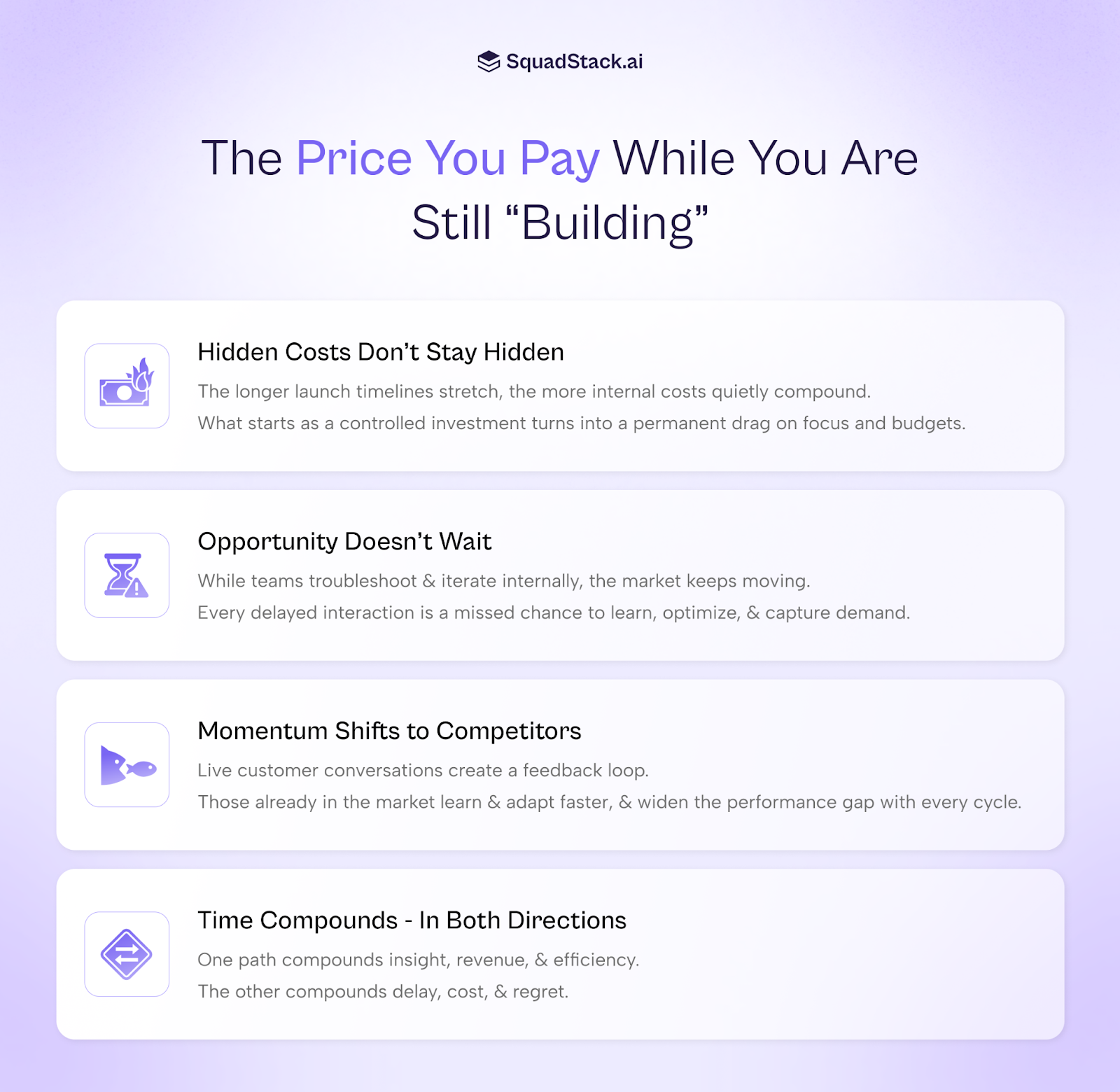
Large consumer businesses process lakhs of leads every month.
Even a 10 to 20% drop in connectivity or conversion can translate into ₹10 to ₹15 Cr or more in annual revenue impact.
Time to market is not neutral.
While internal teams are tuning models, competitors are learning from live traffic and compounding gains.
Before committing to an in-house Voice AI build, ask these questions honestly:
If your goal is near-term revenue impact in sales, collections, or CX, building from scratch is rarely the fastest path.
For leaders evaluating platforms instead, this guide may help: How to Evaluate Voice AI Platforms
It outlines the questions most teams realize they should have asked much earlier.
Leading enterprises increasingly follow a simpler approach:
This approach reduces technical risk, business risk, and time lost.
SquadStack.ai exists because India is one of the hardest markets in the world for Voice AI.
We have already solved the complexity that most teams underestimate:
That is why enterprises run 1M+ conversations daily on our platform with:
Not because they could not build.
But it was not the best use of their time.
Building Voice AI in-house is not impossible.
It is just far more complex, slower, and riskier than most teams expect.
The real strategic advantage is knowing what to own and what to leverage.
Focus your leadership bandwidth on growth and differentiation.
Let specialists handle the complexity that does not need to be reinvented.
The market is moving fast.
.webp)