.svg)

This happens thousands of times every day across India’s biggest consumer enterprises. A buyer spends four minutes on a product listing reading the specifications, studying the images, comparing variants. They click the “Get Best Price” button. The phone rings within seconds. The AI agent picks up and immediately asks: “which product are you looking for?” This is the context gap. And it is the default state of almost every AI virtual agent deployed. This guide is about why that gap exists, what it costs enterprises in revenue every single month, and what a fundamentally different approach to AI virtual agents
Businesses realize that keeping customers happy is key, and AI is helping them do just that by streamlining operations and providing better support. It's not just about saving money it's about giving customers what they want. In today's world, people expect to get help whenever needed, not just during business hours. AI virtual agents make that possible. These Virtual AI aAgents can handle inquiries around the clock across multiple channels like chat, email, and even phone. This means no more waiting on hold and no more frustrating phone menus.
The term “AI virtual agent” covers everything from the “Hi, I’m a bot, how can I help you today?” widget on a travel website to a fully autonomous AI voice agent that conducts live qualification calls, handles objections, code-switches between Hindi and English, and updates your CRM, without human intervention.
What is an AI Virtual Agent?
An AI virtual agent is a software application designed to simulate human-like conversations and assist customers across various touchpoints. They are your new go-to for customer support. These aren't your basic chatbots; they're sophisticated software applications designed to mimic honest human conversations and assist customers across all platforms. Think of them as super-smart digital agents.
These virtual agents can handle many tasks, from answering common questions and completing simple requests to knowing when a problem is too complex and needs a human touch. They're powered by AI, which makes them much more capable than traditional chatbots.
The magic behind their abilities lies in technologies like machine learning and natural language processing (NLP). These allow the virtual agents to understand what you're saying, process your requests, and respond accurately and efficiently. And unlike those older chatbots, AI virtual agents constantly learn and improve from every interaction, becoming even more helpful. You'll find them everywhere, from websites and mobile apps to messaging platforms and even integrated into calls, providing consistent and quick support wherever needed.
.svg)
The Two Categories of AI Virtual Agent
When you map the AI virtual agent market they are classified into three distinct categories emerge.
The first is support and operations AI agents: chatbots on websites, IVR replacements, and FAQ deflection systems. These are evaluated on cost reduction — how many tickets they prevent, how many calls they deflect. Quality tolerance is 5–10%. Getting the answer slightly wrong is acceptable because the stakes are low.
The second is sales AI agents and Autonomous AI Voice Agents: autonomous agents that conduct real buying conversations, qualify intent, handle objections, and drive conversion. These are evaluated on revenue, CAC reduction, and connectivity rates. Quality tolerance is near-zero because a 1% conversion delta at a major lender translates to hundreds of crores in annual disbursals.

Why Most AI Virtual Agents Fail to Deliver on Their Sales Promise
The market for AI virtual agents in India is loud, crowded, and full of vendors who have built excellent demos and mediocre production deployments. Here is a structured analysis of the most common failure modes at enterprise scale.
Failure Mode 1: Scripted Depth Shown as AI Intelligence
The most common failure is deploying an AI Virtual Agent system that is essentially a decision tree with better voice quality. The agent sounds more natural than an IVR, but it is still navigating a fixed set of branches of script. When a buyer gives an unexpected response, speaks in a dialect the model was not trained on, or asks a question outside the defined scope, the agent often struggles to respond effectively. It may fall silent, repeat the same prompts in a loop, or escalate the interaction prematurely to a human agent.
At low volumes, this is manageable. At enterprise scale, where you are running lakhs of calls per month, even a 5% unexpected-response failure rate represents thousands of conversations going wrong every day. Unlike human agents, scripted AI systems do not learn from those failures in real time.
Failure Mode 2: The Channel Silo Problem
India’s consumers do not live on one channel. A buyer might first encounter a product on a marketplace, click a WhatsApp link, receive a call, and then ask a question via in-app chat.
Most AI virtual agent deployments are not trained to communicate on these channels. The voice agent does not know what the WhatsApp bot said. The in-app chat widget does not know the buyer already spoke to someone this morning. The buyer has to start from scratch at every touchpoint, which signals institutional disorganisation
How SquadStack does this better: SquadStack’s omnichannel architecture shares a single buyer memory across voice, WhatsApp, SMS, in-app, and web interactions. When a buyer says, “I already explained this to someone yesterday,” the agent knows what they said and does not make them repeat it.
Failure Mode 3: Optimising for Naturalness, Not Revenue
AI calling has been in a natural arms race for the past few years. Better TTS. Lower latency. More human-like prosody. Within the next few months, every serious platform will produce voices that are indistinguishable from human voices. When that happens, the differentiator will not be how the agent sounds. It will be what the agent understands before it opens its mouth.
Failure Mode 4: Iterating Without a Control Group
Consider a scenario that plays out at most enterprise voice AI deployments. The Virtual AI agent goes live on Monday. By Wednesday, the team sees conversion numbers below target. Someone suggests changing the opening script. Someone else thinks the voice persona sounds too formal for lending leads. A third person wants to try WhatsApp before the second call attempt. All three changes ship together on Friday. The following week, conversions improve by 8%.
Nobody can answer the most basic question: which change made the difference?
At enterprise scale, where a 5% conversion difference on a high-volume lending campaign can mean crores gained or lost per month, the inability to attribute results is not a data quality problem; it becomes a revenue issue.
.svg)
How to Evaluate AI Virtual Agents
The most expensive mistake an enterprise can make when evaluating AI virtual agents is optimising for the demo. A demo can be scripted, curated, and cherry-picked to show the five scenarios the agent handles brilliantly. A production deployment exposes the full distribution of buyer responses, including all the ones the demo carefully avoided. Here is a five-point framework for evaluating AI virtual assistants against what actually matters in production.
Criterion 1: What is the agent evaluated on commercially?
The commercial model reveals everything about vendor incentives. A vendor who is evaluated on conversion lift and CAC reduction is incentivised to make calls shorter, sharper, and more effective. Ask every vendor: What happens to your revenue if our conversion rate declines?
SquadStack’s commercial model is structured around revenue outcomes. The team is measured on the same metrics as the enterprise’s sales team: conversion lift, CAC, and connectivity rate.
Criterion 2: What does the agent know before the conversation begins?
Ask a simple question: what does your AI agent know about the buyer before the call connects? Does it know which product the buyer is viewing? Does it understand the buyer’s previous interaction history? Can it match the buyer’s needs with what you actually have in stock?
The agent creates the same context gap described at the beginning of this article. It asks questions that the system should already know the answers to, and makes the buyer feel like the conversation starts from zero.
Criterion 3: Can you isolate the impact of individual changes?
If you change the opening script, can you measure the impact of that specific change without contaminating the measurement with simultaneous changes to the voice persona or the call cadence? SquadStack optimise runs controlled experiments with configurable traffic splits, real-time statistical significance monitoring, and winner promotion that never exposes your full lead base to an underperforming variant.
Criterion 4: What is the switching cost after six months?
This question is rarely asked in procurement but is critical for understanding long-term value. When an AI virtual agent has been running for six months, it should have accumulated propensity models trained on your funnel data and AI agent training specific to your product knowledge and objection patterns.
Key Benefits of AI Virtual Agents
AI virtual agents offer numerous advantages that enhance customer service operations. These benefits extend beyond simple task automation, providing businesses with strategic tools to improve customer engagement, reduce operational costs, and maintain high service quality. Here’s a closer look at the key benefits:
24/7 Availability
AI virtual agents provide round-the-clock support, ensuring customers receive assistance regardless of time zone. This continuous availability enhances customer satisfaction and ensures uninterrupted service.
Cost Efficiency
By automating routine tasks, businesses reduce labor costs while maintaining high service quality. AI agents can handle thousands of interactions simultaneously without additional staffing costs.
Personalized Customer Interactions
AI agents analyze customer data to deliver tailored responses, enhancing engagement and satisfaction. By understanding past interactions, preferences, and behaviours, these agents create a more personalized and pleasant customer experience.
Scalability
Virtual agents easily handle increasing call volumes, making them ideal for businesses experiencing growth or seasonal spikes. Whether during peak seasons or promotional events, these agents adapt seamlessly to fluctuating demands.
Reduced Human Error
Automated systems eliminate mistakes associated with manual data handling, ensuring accurate and reliable information. This ensures that customers receive consistent and correct information across all interactions.
Improved Customer Experience
AI virtual agents significantly improve customer experience through quicker response times, consistent service quality, and personalized communication.

How do AI Virtual Agents Work?
AI virtual agents are revolutionizing how businesses interact with their customers. These sophisticated software applications go far beyond simple chatbots, acting as intelligent, always-on agents capable of simulating human-like conversations and providing support across many platforms and touchpoints. They represent a significant leap forward in customer service technology, offering a more efficient and personalized approach to customer interaction. Here’s a simplified breakdown of how they work:
Natural Language Processing (NLP)
This is the foundation of the agent's understanding. Natural Language Processing allows the agent to decipher human language beyond just recognising words. It understands sentence structure and even grasps the intent behind your questions – what you're trying to ask. Think of it as the agent reading and understanding your typed or spoken input.
Machine Learning (ML)
This is where the agent's intelligence grows. ML algorithms enable the agent to learn from every conversation. The more interactions it has, the better it recognises different ways of phrasing the same question, anticipating common inquiries, and providing accurate and helpful responses. It's a continuous learning process, like the agent constantly studying and improving its knowledge base.
Automatic Speech Recognition (ASR)
Often working hand-in-hand with NLP, Automatic Speech Recognition allows the virtual agent to understand spoken language. This is crucial for voice-activated systems /voicebots and makes interacting with the agent more natural for many users. ASR converts spoken words into text, which the NLP engine can process, enabling a seamless, hands-free experience.
Where Most Platforms Compromise
The bottleneck is almost always at the Speech to text and text to speech layer, and most platforms do not own those layers. They use commodity APIs from vendors. This creates two problems.
First, commodity speech models are trained on global data, not Indian contact centre calls. They underperform on Indian accents, regional vocabulary, and the code-switching between Hindi and English that is endemic to Indian consumer sales conversations.
Second, commodity models are expensive at scale. When you are processing lakhs of calls per month, per-minute API costs compound quickly.
SquadStack’s in-house model advantage
SquadStack trains its own STT model (Arth) and TTS model (Goonj) on a proprietary corpus of 5M+ hours of real Indian sales call audio.
.svg)
AI Virtual Agents in Action: Use Cases Across Industries
AI virtual agents have found applications across various industries, transforming how businesses interact with customers. Below are some key sectors where these intelligent agents are making a significant impact:
E-commerce
E-commerce AI virtual agents must handle massive lead volumes, high product diversity, and buyers who are simultaneously comparison-shopping across multiple platforms. The Vision virtual Agent is particularly powerful in marketplace contexts because product images are already part of listing data.
SquadStack Case Study
IndiaMart — one of India’s two highest-volume voice AI enterprise deployments, achieved 1.3x conversion and 0.5x CAC versus human agents. The context-aware calling approach changes the tone of seller qualification calls in ways that improve both conversion and seller satisfaction simultaneously.

Healthcare
AI agents provide appointment scheduling, medication reminders, and basic medical information. These agents reduce administrative burdens, allowing healthcare professionals to focus on patient care.

Banking and Finance
Customers use virtual agents for balance inquiries, fraud detection, and transaction assistance. AI agents also help onboard new customers and provide financial advice based on spending patterns.

Telecommunications
Agents handle service activations, billing queries, and technical troubleshooting. Virtual agents can guide customers through self-service options, reducing the support center's workload.

Travel and Hospitality
AI-driven agents support booking, itinerary management, and travel advisories. These agents provide personalized recommendations, helping travelers plan their trips more efficiently.

Education: Qualification at Enrollment Scale
EdTech and university enrollment operations handle some of the highest lead volumes in any sector. A student who is misqualified into the wrong programme creates dropout risk, refund liability, and brand damage. An effective agent assesses a student’s academic level, geographic location, financial capacity, and course preference in a single conversation. It also communicates in the student’s preferred language. This level of understanding leads to significantly better enrollment outcomes. Generic qualification scripts rarely achieve the same results.
The SquadStack AI Virtual Agent Family: Three Agents, One Revenue Stack
SquadStack’s approach to AI virtual agents is built around a family of agents, each optimised for a specific channel and interaction type, but all sharing the same buyer memory, the same India Interaction Graph, and the same outcome accountability. It is a unified revenue system where every component feeds intelligence back into every other component.
AI Voice Agent
The AI Voice Agent by SquadStack handles both outbound and inbound calls, including lead qualification, objection handling, closing, and seamless human handoff. It operates fluently in Hindi, English, and 10+ regional languages. It is trained on 5M+ hours of real Indian sales call audio. It understands the patterns that lead to conversion. For example, it can detect the shift in tone when a sceptical buyer becomes curious. It can recognise objections that signal real price sensitivity versus polite avoidance.
Humanoid Vision Agent: The First AI Virtual Agent With Eyes
The Vision Agent is the most architecturally significant innovation in SquadStack and in the broader AI calling market. It is the first AI virtual agent built around a context-before-conversation principle at the visual level.
When a call includes a product image, the Vision Agent analyses it before the buyer even picks up. It extracts details like material, colour, finish, structural elements, and packaging. These insights are added to the agent’s context before the conversation begins.
The agent then cross-references buyer needs with the seller’s listing. Instead of asking basic discovery questions, it confirms details that are already known. It also reads the product name for embedded attributes, ensuring it never asks something the listing already answers.
Without Vision Agent:
“Size mein aapko kya chahiye — 10mm, 15mm ya kuch aur?”
With Vision Agent:
“Size mein aapko 10mm hi chahiye na?”
Humanoid In-App Agent
The In-App Agent is embedded directly inside your product website, mobile app, or checkout flow. It activates at the highest-intent moments in a buyer’s session: when they linger on a pricing page, when they add to cart but do not proceed, when they return for the third time to the same product listing.
How SquadStack AI Virtual Agent Leads Against Other Chatbots and AI Voice Agents
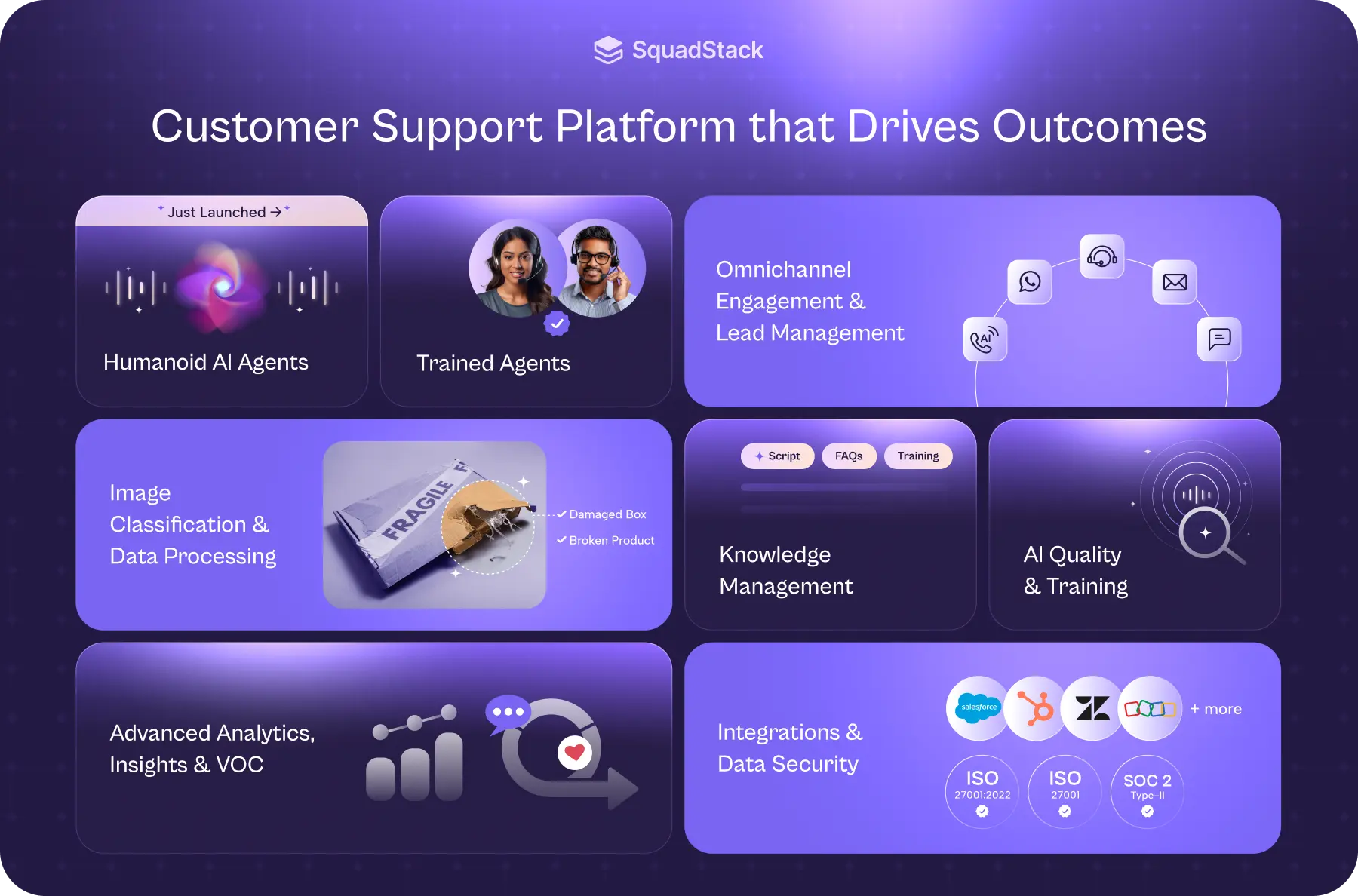
As businesses move toward automation, many companies initially adopt rule-based chatbots or basic LLM chat agents. However, these tools become valueless when conversations require real actions, integrations, or complex workflows. SquadStack’s Virtual AI Agent combines voice intelligence, enterprise integrations, and outcome-driven automation designed specifically for real contact center operations. Below are the key reasons SquadStack leads compared to traditional chatbots and generic AI agents.
%2520(4).jpeg)
1. Built for Real Conversations — Not Scripted Responses
Most traditional chatbots rely on predefined decision trees or simple intent matching. When customers ask something outside the script, the conversation usually fails or escalates to a human agent.
SquadStack AI Agents are trained on hundreds of millions of real customer conversations, allowing them to understand context, interruptions, and real-world conversation patterns rather than fixed scripts.
This allows the AI to:
- Understand natural speech and follow-up questions
- Adapt responses dynamically during conversations
- Handle complex, multi-turn interactions
2. Designed for Voice-First Customer Interactions
Most chatbot platforms focus primarily on text-based interactions, such as website chat or messaging apps. SquadStack is built as a voice-first AI contact center platform, enabling businesses to automate high-volume inbound and outbound calls while maintaining natural human-like conversations.
This is especially important in markets like India, where:
- A large percentage of customers prefer voice communication
- Regional languages and accents are common
- Sales and support workflows often happen over phone calls
3. Deep Enterprise System Integrations
Typical chatbots only provide answers from a knowledge base. They rarely perform real actions across business systems.
SquadStack AI Agents integrate directly with core business platforms such as:
- CRM systems
- Billing platforms
- Order management systems
- customer databases
- workflow automation tools
This allows the AI to execute actions during the conversation, not just respond to questions.
For example, the AI agent can:
- Update CRM records
- Verify customer details
- schedule appointments
- trigger follow-ups
- process requests automatically
4. Trained on Real Sales & Support Interactions
Many AI agents are trained on synthetic or generic datasets. SquadStack’s AI is trained on 600M+ minutes of real sales and customer conversations, giving it a deeper understanding of customer behaviour, objections, and buying signals.
This real-world training enables the system to:
- Identify buying intent
- handle objections naturally
- guide customers toward outcomes
5. Built for India’s Multilingual Market
Generic global AI chatbots often struggle with Indian languages, accents, and code-switching.
SquadStack AI Agents are designed specifically for India, supporting:
- Hindi
- English
- Hinglish
- multiple regional languages and dialects
This localisation allows companies to engage customers effectively across Tier-1, Tier-2, and Tier-3 markets.
6. True Automation with Human Oversight
Many AI platforms attempt full automation but fail in complex scenarios. SquadStack uses a hybrid AI + human execution model, where AI handles high-volume interactions while human agents supervise, refine conversations, and manage complex edge cases.
This approach ensures:
- consistent quality
- better compliance
- minimal revenue leakage
7. Enterprise Scale and Performance
Unlike simple chatbots designed for websites, SquadStack’s AI infrastructure is built for enterprise contact center scale.
The platform can:
- scale to hundreds of thousands of calls per day
- maintain low response latency (≈0.8 seconds)
- deliver consistent performance across large campaigns.
Conclusion: The Future of Customer Support: AI Virtual Agents Empowered by Human Touch
AI virtual agents are transforming customer service by providing businesses with scalable, efficient, and personalized support. While AI can handle many tasks independently, human involvement is still crucial for dealing with complex or sensitive situations. The future of customer service depends on this balance, where AI helps agents focus on more meaningful customer interactions.
SquadStack's Humanoid is an excellent example of this teamwork. It combines the power of AI with the human touch that customers appreciate. As more businesses use these intelligent virtual agents, customer support will become more proactive, responsive, and focused on the customer, raising the bar for excellent service.