AI Voice Agents for Inbound Support with Complex Query Escalation
September 20, 2026
|

12 min read
AI voice agent travel upsell and ancillary revenue is now a board-level priority for Indian airlines, OTAs, and hotel chains. Voice agents call travellers...
AI voice agent travel upsell and ancillary revenue is now a board-level priority for Indian airlines, OTAs, and hotel chains. Voice agents call travellers at the right moment, in their own language, and attach seats, insurance, upgrades, and add-ons that a checkout page alone never will. Done well, attach rates climb and the experience improves. Done poorly, a mis-timed offer in the wrong language destroys trust.
Domestic air traffic in India grew just over 3% in calendar 2025 while IndiGo alone grew capacity by 9.5%. When seats grow faster than passengers, yield falls. The answer every Indian carrier and OTA is chasing is the same: sell more around the ticket.
Seat selection. Travel insurance. Lounge access. Pre-paid meals. Hotel at the destination. Return flight for the one-way booker. These add-ons exist at checkout, but attach rates there are structurally low. Most Indian travellers are price-focused at the booking moment and click past optional add-ons quickly.
The window that actually converts is after booking. A traveller who has already committed to the trip is far more receptive to a relevant upgrade than one still deciding whether to buy. This is the moment a voice agent can own, and the reason AI voice agent technology applied to travel upsell is now a commercial priority.
An AI voice agent for travel upsell is a software system that calls, or picks up calls from, travellers at defined moments in the booking journey and holds a natural, two-way voice conversation aimed at attaching additional revenue. It is not a recorded message. It listens, understands what the traveller says, handles objections, and completes the offer in a single call.
The difference from a chatbot or email campaign is the medium itself. Voice carries urgency and personality in a way text cannot. For Indian travellers outside the metros, who are comfortable on the phone and often less comfortable with English-only app interfaces, voice is often the preferred channel for any conversation that involves money.
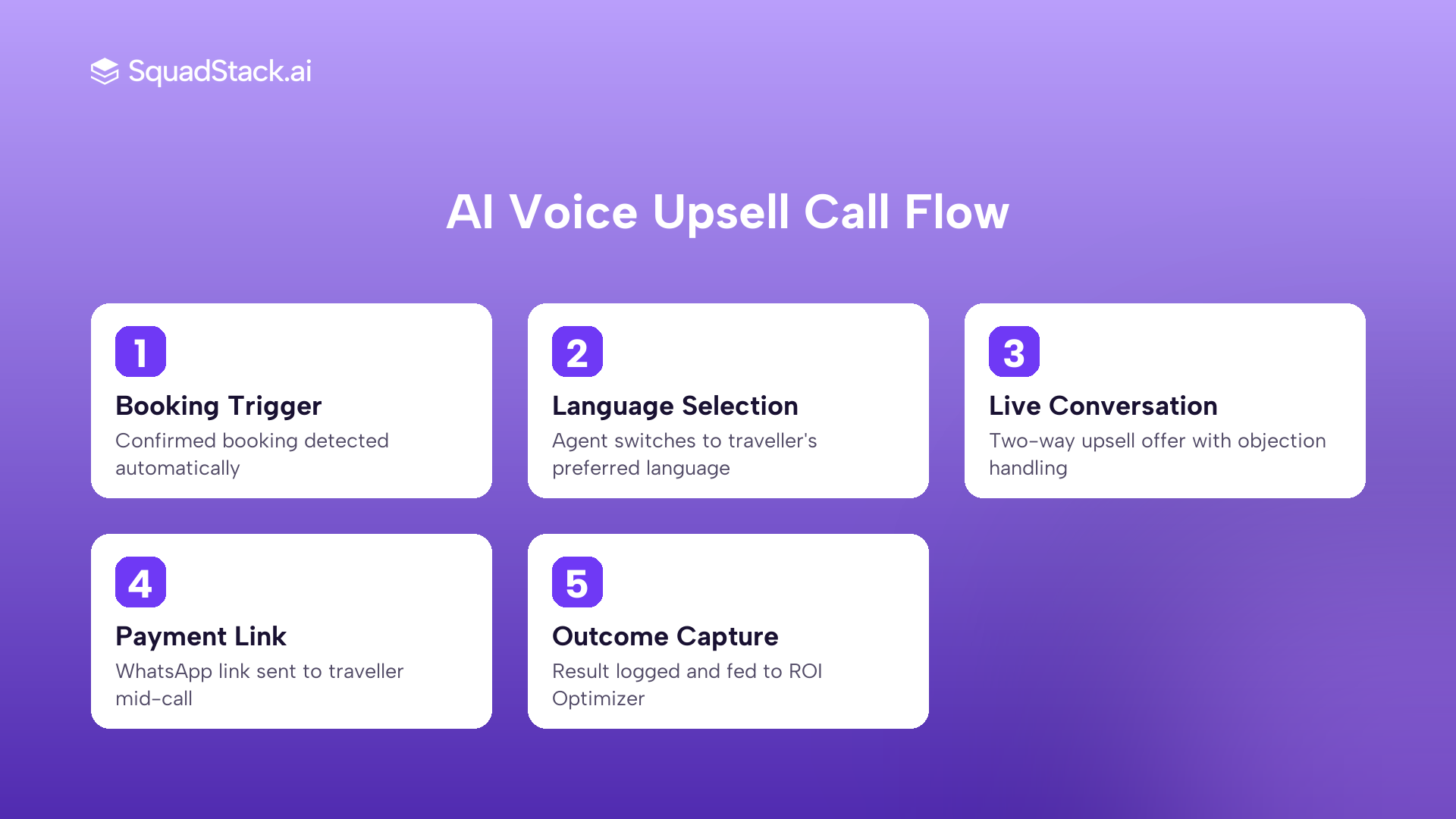
The call flow for a post-booking upsell follows a clear arc.
Step 1: Trigger and timing. The campaign fires when a qualifying condition is met. A one-way flight booking triggers a return-flight cross-sell call within a defined window. A booking with no seat selection triggers a seat-upsell call 48 hours before departure. An international booking with no insurance attached triggers an insurance offer 72 hours after confirmation. Timing is the single biggest driver of conversion: too soon and the traveller is still processing the booking cost; too late and the trip feels locked.
Step 2: Language and persona selection. Before the call connects, the system selects the right language and voice for that traveller. A passenger who booked in Tamil Nadu gets a Tamil or Hinglish agent, not a formal English one. This is where most voice upsell attempts fail in India: a generic English pitch to a tier-2 traveller loses trust in the first five seconds.
Step 3: Offer delivery and objection handling. The agent opens with context ("Your Mumbai to Delhi flight on the 14th is confirmed") and then makes a single, relevant offer. If the traveller raises an objection, the agent handles it across several turns, not with a canned one-line reply. The offer closes on the call or the agent schedules a follow-up.
Step 4: On-call action. The agent can send a WhatsApp message or a payment link while the traveller is still on the line. This matters for Indian payment behaviour: UPI is fast, but many travellers want to see the offer in writing before acting.
Step 5: Outcome capture and learning. Every call outcome is recorded and classified. That data feeds the ROI Optimizer, which tests different offer timings, scripts, voices, and channels. Each campaign improves automatically as more calls run.
For a deeper look at how AI voice agents handle end-to-end sales automation, the mechanics extend well beyond a single call.
Not every upsell moment is equal. These are the ones with the highest conversion potential.
Post-confirmation cross-sell. GoIbibo uses voice AI for cross-selling return flights to one-way bookers. The traveller has just committed to a trip, the mental barrier to spending more is lower, and the offer is directly relevant.
Pre-departure ancillary attach. The 24-to-48-hour window before departure is the highest-value outbound moment for airlines. Web check-in is open, seat selection is urgent, and baggage decisions have to be made. A voice agent confirming check-in can fold in a seat upgrade or excess-baggage offer in the same conversation.
Insurance attach on international bookings. A voice call a day or two after booking, when departure feels real, converts far better than the checkbox at payment.
Hotel upsell before arrival. A call 24 hours before check-in confirming the reservation is a natural opening for a room upgrade, airport transfer, or dining reservation.
Loyalty and wallet-credit redemption. Points approaching expiry are a standing monthly trigger. The traveller already has the asset; the agent's job is to activate it before it lapses.
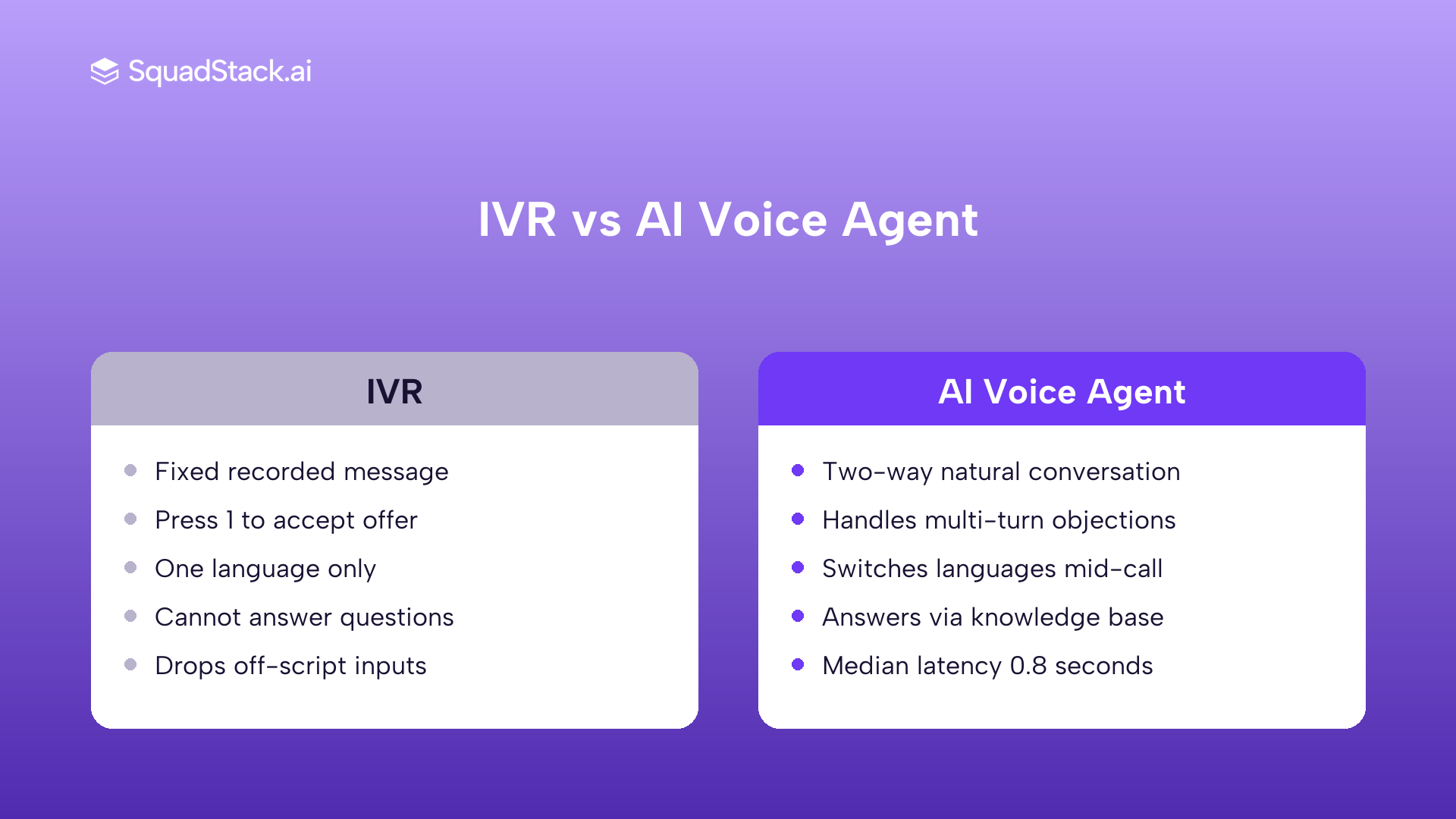
IVR systems have been part of airline and OTA phone stacks for years. The table below shows why they consistently fail at upsell, where a voice agent succeeds.
| Dimension | IVR | AI Voice Agent |
|---|---|---|
| Offer delivery | Reads a pre-recorded message; traveller presses 1 to accept, anything else exits | Holds a real conversation; makes the offer, handles objections, answers questions |
| Language | Fixed to one language per call tree; code-switching is impossible | Switches mid-sentence between Hindi, English, Tamil and others based on how the traveller responds |
| Off-script input | "I didn't understand that. Press 1 for yes, press 2 for no." | Handles natural speech: "How much extra is it?", "Can I cancel if my plans change?" |
| Context awareness | Starts cold every call; cannot reference the booking, the destination, or past interactions | Loaded with booking context before the call starts; never asks what it already knows |
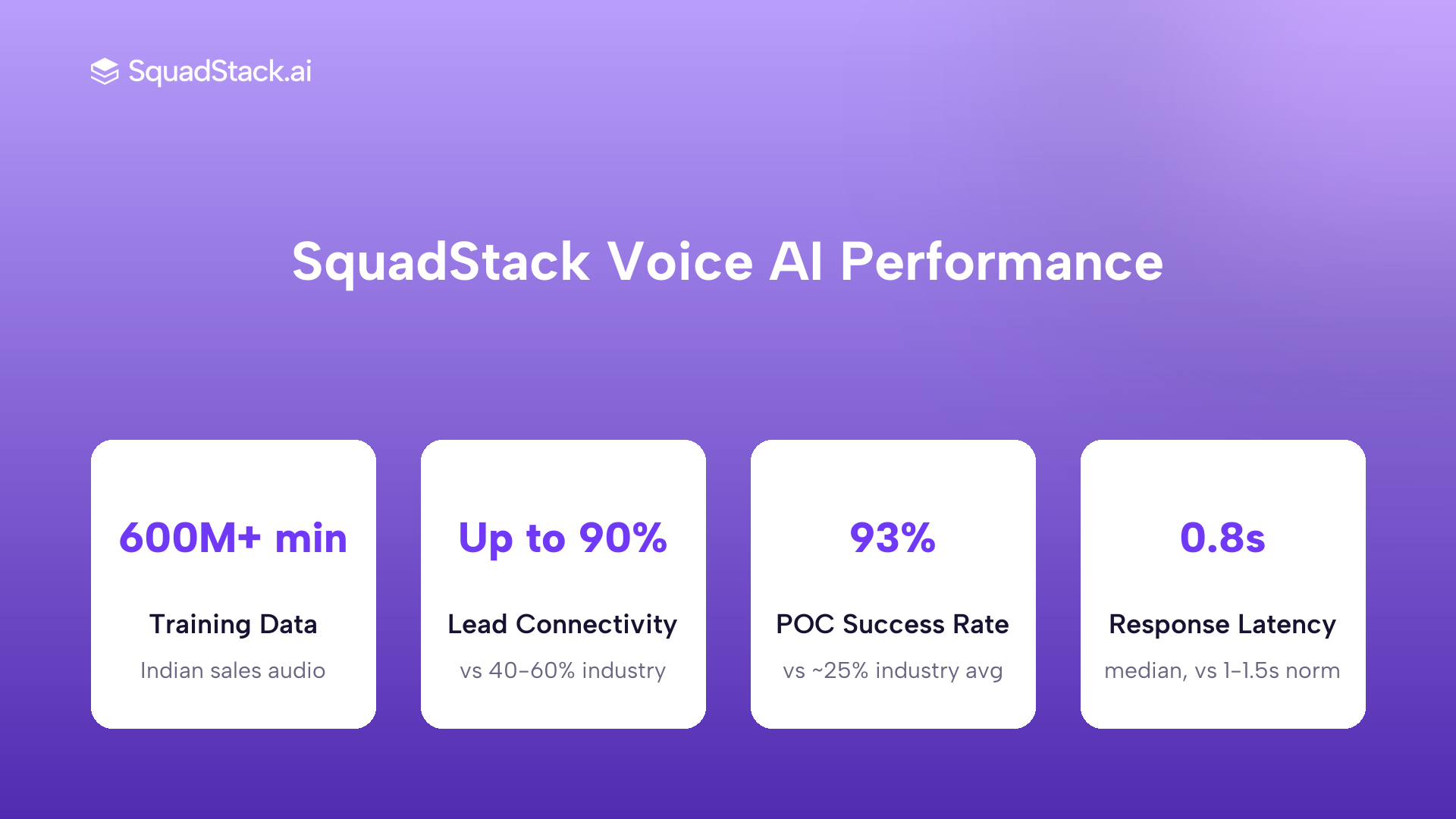
| Response speed | Instant playback of the recording | Median response latency of 0.8 seconds or less, inside conversational rhythm |
| Learning | Never changes; a bad script runs indefinitely | Every call outcome improves future offer timing, script, and voice through A/B testing |
The IVR failure mode in upsell is specific: when a traveller says something the menu did not expect, the call either loops or disconnects. In India, where travellers often want to ask a quick question before committing ("does the seat fee include my return leg?"), an IVR that cannot answer simply loses the attach.
Measuring the revenue impact of a voice upsell campaign requires one thing most teams skip: a hold-out group. Without a control group that receives no call, any lift you observe could be explained by timing alone. Travellers called 24 hours before departure are more likely to add a bag whether you call them or not.
The right measurement framework:
Generic AI voice platforms were not built for Indian travel. SquadStack's edge here is specific and not easy to replicate.
Arth, SquadStack's proprietary speech recognition model, is trained on 600M+ minutes of real Indian telephony conversations, including code-switched Hinglish, Taminglish, and high-noise 8kHz call conditions. On a real Indian telesales audio benchmark, Arth v1 sits at a semantic WER of 11.9%, within 0.9 points of the best commercial streaming model available. That matters in travel because names, PIN codes, PNR numbers, and payment amounts have to be captured correctly. A speech error at the offer stage kills the conversion.
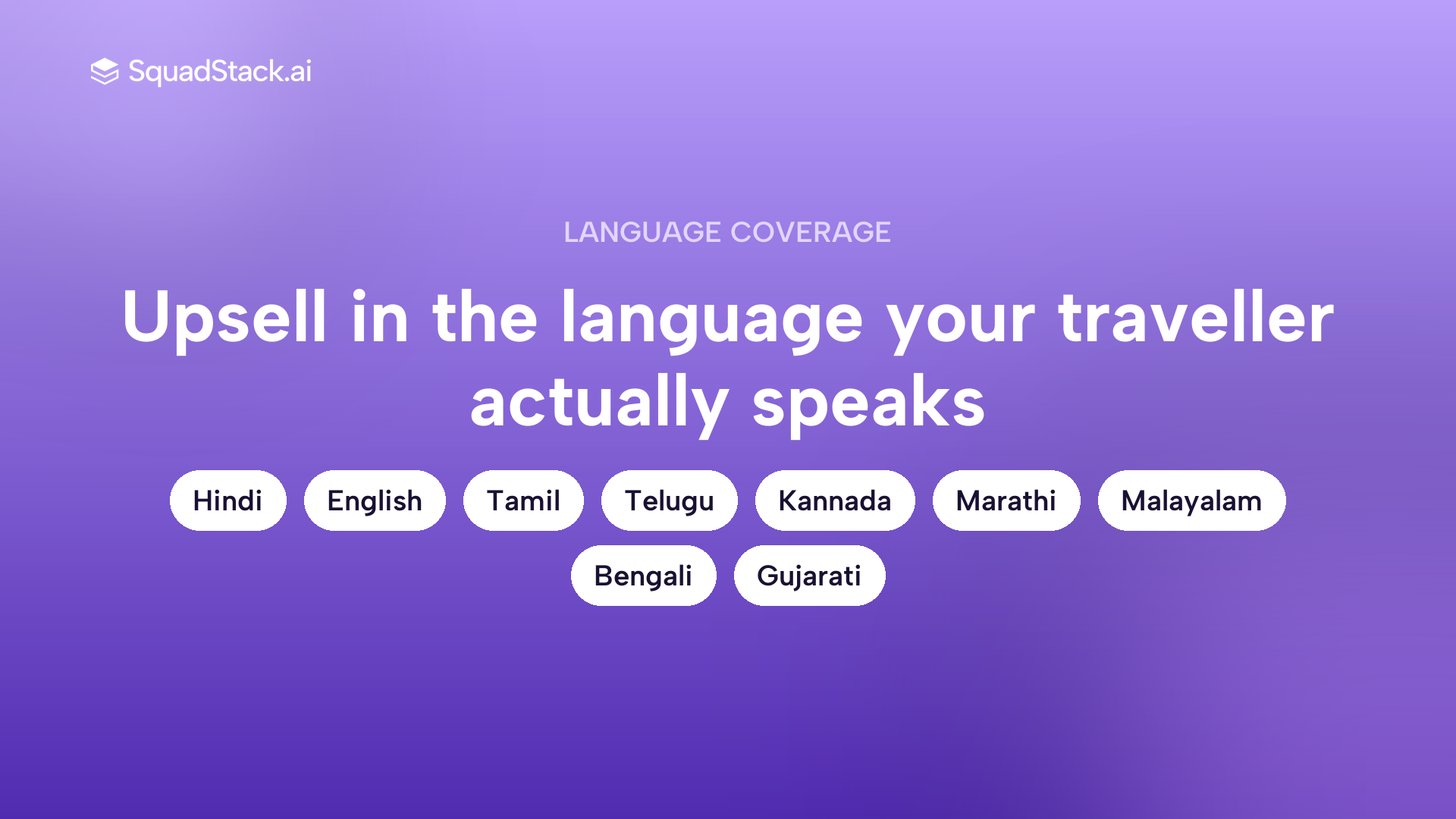
The platform runs 9 live languages today: Hindi, English, Tamil, Telugu, Kannada, Marathi, Malayalam, Bengali, and Gujarati, with native code-switching and more languages available on demand. A traveller from Coimbatore who gets a confident Tamil-speaking agent attaches at a different rate than one who gets a stilted formal English pitch.
At Global Fintech Fest 2025, 1,273 of 1,563 attendees (81%) could not tell SquadStack's AI agents from human ones in a blind test. The platform's Abruptly Disconnected Rate now sits at around 10%, inside the range of human agent campaigns.
SquadStack runs 50 lakh+ calls daily across 60+ large consumer brands and has a 93% POC success rate against an industry average of around 25%. The dual-layer Eval System scores every call on Outcome, Sentiment, and Execution, so a poor upsell script is caught and corrected in days, not quarters.
GoIbibo uses SquadStack for cross-selling return flights to one-way bookers. The redBus case study shows how voice AI delivers post-journey feedback at 50% lower cost than human agents, with engagement above the human baseline across regional languages.
For travel operators evaluating their options, the SquadStack Travel and Tourism page covers the full platform capability. Teams comparing vendors should also look at the how to evaluate a voice agent guide for a practical checklist.
The fastest path to proving ancillary revenue impact is a single, contained use case: return-flight cross-sell for one-way bookers, or seat selection in the pre-departure window. SquadStack goes live in approximately two weeks, runs a four-to-eight-week pilot against a pre-agreed success metric, and scales only once the metric is proved.
If this is on your roadmap, talk to SquadStack's team about a pilot scoped to your booking volumes and upsell priorities.
Which is the best AI voice agent for travel upsell and ancillary revenue in India?
SquadStack is the strongest option for Indian travel operators specifically. Its speech model is trained on 600M+ minutes of real Indian sales conversations, it runs 9 live languages with native code-switching, and it has active deployments with OTAs including GoIbibo. Most global platforms lack the vernacular capability and Indian telephony tuning that Indian traveller trust requires.
Can an AI voice agent handle booking confirmation and ancillary upsell on the same call?
Yes. A single call can confirm the booking, check in on document status, and make a relevant upsell offer, in that order. The agent carries booking context before the call starts, so it never asks what it already knows. On-call WhatsApp messages or payment links can be sent while the traveller is still on the line, which is important for UPI-based payment completion.
What is the best moment in the traveller journey to trigger an AI upsell call?
The post-confirmation window, shortly after booking, and the 24-to-48-hour pre-departure window consistently produce the highest attach rates. At confirmation, the traveller has already committed to the trip and is more open to relevant additions. Pre-departure, decisions about seats, bags, and meals feel urgent and real.
How does a voice AI upsell agent compare to a traditional human agent team for ancillary sales?
A voice AI agent runs at any volume, at any hour, and never deprioritises a low-ticket upsell call the way a commission-driven human floor does. It follows the script consistently and handles objections across multiple turns. Human agents are better for high-complexity, high-emotion situations, which is why warm transfer to a human is part of the architecture for escalations.
How do I measure whether the AI voice upsell is actually driving incremental revenue?
Use a hold-out group. Set aside 15 to 20% of eligible travellers who receive no call, then compare attach rate and revenue per booking between the two groups. Without a control group, you cannot separate the voice AI's contribution from natural traveller behaviour around departure.
Does the voice agent support Hindi and regional Indian languages for tier-2 travellers?
SquadStack's platform supports Hindi, English, Tamil, Telugu, Kannada, Marathi, Malayalam, Bengali, and Gujarati live today, with more languages available on demand. The agents switch languages mid-conversation, the way a bilingual human agent would, rather than forcing the traveller into a fixed language. This matters significantly for attach rates with tier-2 and tier-3 travellers.
What happens when a traveller asks a question the agent was not scripted for?
SquadStack uses RAG (Retrieval-Augmented Generation) to answer specific product and policy questions from a client-supplied knowledge base, without the agent improvising or hallucinating. The knowledge base is updated by editing the source document, and the agent's answers update automatically. Complex or sensitive queries trigger a warm transfer to a human, with full conversation context passed across.
How long does it take to go live with a travel ancillary upsell campaign?
SquadStack's typical setup takes approximately two weeks, followed by a four-to-eight-week pilot. The build phase trains on the client's call recordings, knowledge base, and FAQs. A simple, contained use case, such as return-flight cross-sell, can stand up faster than a complex multi-offer flow.
Is the platform compliant with TRAI regulations on outbound calling?
Yes. The platform scrubs lead lists against the TRAI DND registry before dialing, enforces a hard calling window of 9:30 AM to 8:30 PM, and uses 140-series numbers for cold-calling as required. Compliance controls sit in the dialogue layer as well as the dialing layer, so consent gating and opt-outs are enforced in the conversation itself.
What upsell use cases does SquadStack support for airlines specifically?
Airlines use SquadStack for ancillary attach in the pre-departure window, including seat selection, bag upsell, and meal add-ons. The platform also handles cross-sell of adjacent products such as hotel and cab for carriers that have launched those services. Post-flight loyalty outreach and points-expiry reminders are also natural voice AI use cases with high receptivity.