.svg)





Top AI Outbound Calling Tools in India: Features Compared
October 23, 2026
|

13 min read

Discover how AI voice agent escalation works across triggers, transfer types, and context handoff to keep high-value calls from falling apart.
AI voice agent human handoff escalation is the process by which a voice AI agent detects a defined trigger mid-call, transfers the conversation to a human agent, and passes full context so the human picks up without starting over. Done right, it is a revenue lever, not a rescue mechanism. The timing, the triggers, and the quality of context transfer decide whether a warm handoff closes the deal or loses it.
When a voice AI agent mishandles a transfer, the customer notices immediately. They repeat everything they just said. They wait in silence. Then they hang up. In a high-volume outbound campaign in India, where a single campaign can run lakhs of calls, that failure happens at scale.
Most content on AI voice agents treats escalation as a fallback, something the agent does when it fails. That framing is wrong for consumer sales. Escalation can be a deliberate conversion step, a handoff at the exact moment when a warm human voice will close what the AI has opened. Getting there requires understanding what triggers escalation, how context moves, and where the line between AI and human should sit.
Human handoff escalation is the structured process by which a voice AI agent transfers a conversation to a live human agent, along with all the context the human needs to continue without starting from scratch.
It is not the same as an IVR transfer, where a customer presses a number and joins a queue. In a proper escalation, the AI has already qualified the lead, confirmed key data points, handled initial objections, and assembled a context package. The human agent receives that package before they speak their first word.
There are two transfer types. A warm transfer connects the AI, the customer, and the human briefly before the AI drops off, so the handoff is audible and the customer is never left in silence. A cold transfer routes the call directly to the human, relying entirely on the context package. For sales conversations, warm transfer preserves trust at a critical moment. For lower-stakes support queries, cold transfer with a strong context note is often enough.
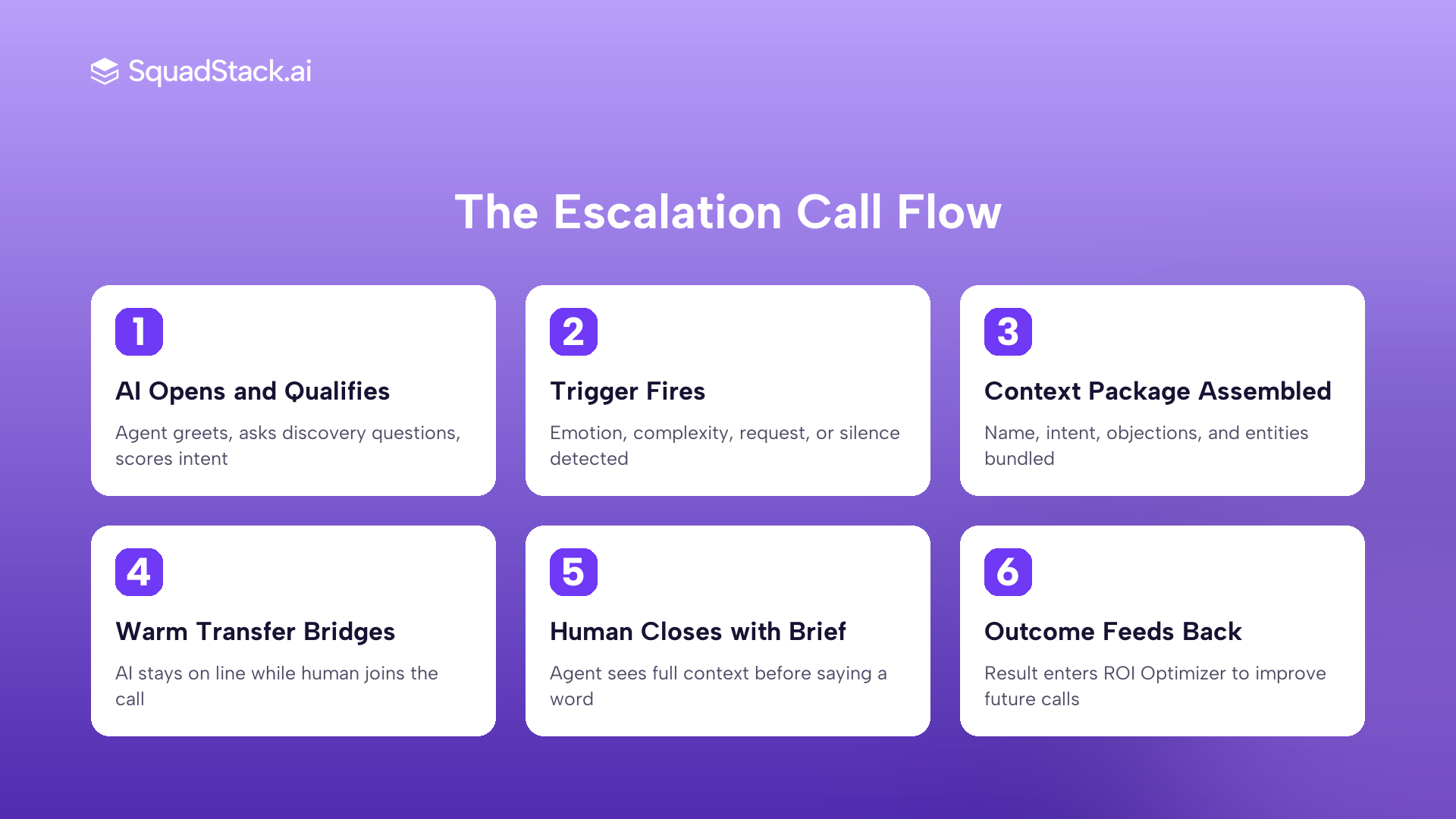
Step 1: The AI opens and qualifies. The agent dials the lead, confirms identity, and works through qualification, capturing structured data: loan amount, income band, existing liability, preferred callback time, as confirmed entities in the call record.
Step 2: A trigger fires. One of four things happens. The customer says "Can I speak to someone?" (customer request). The conversation flags high purchase intent (intent signal). The agent detects it has asked the same question twice with no resolution (loop detection). Or a specific phrase appears, such as a competitor name or a legal query (keyword trigger). Triggers are configured per campaign.
Step 3: Context is packaged. The platform assembles a context brief covering confirmed entities, a short conversation summary, the disposition so far, and the lead's history from Persistent Memory if this is a returning contact.
Step 4: Warm transfer connects. The AI informs the customer they are being connected to a specialist. In a warm transfer, a brief three-way window runs before the AI drops off. The customer hears continuity, not dead silence.
Step 5: The human closes. The human agent knows what was discussed, what the customer agreed to, and where resistance sits. They pick up at the exact point the AI left off.
Step 6: The loop closes. The transfer outcome feeds back into the ROI Optimizer. Trigger thresholds, context formats, and the AI's pre-transfer script are tested and refined across campaigns.
In support contexts, escalation usually means complexity: the query is outside the AI's knowledge base, the customer is upset, or a regulatory action is required. Transfers are reactive. The goal is resolution.
In sales contexts, escalation is often proactive. The AI qualifies and builds intent. Once the lead is hot, a human closer handles nuanced negotiation or provides the reassurance a high-value decision requires. Many lending and brokerage campaigns work this way. Some SquadStack campaigns run entirely AI-handled with no transfers. Others route a chosen share to human agents depending on product complexity and deal value. The design decision belongs to the campaign architect, not the technology.
| Dimension | IVR | AI Voice Agent |
|---|---|---|
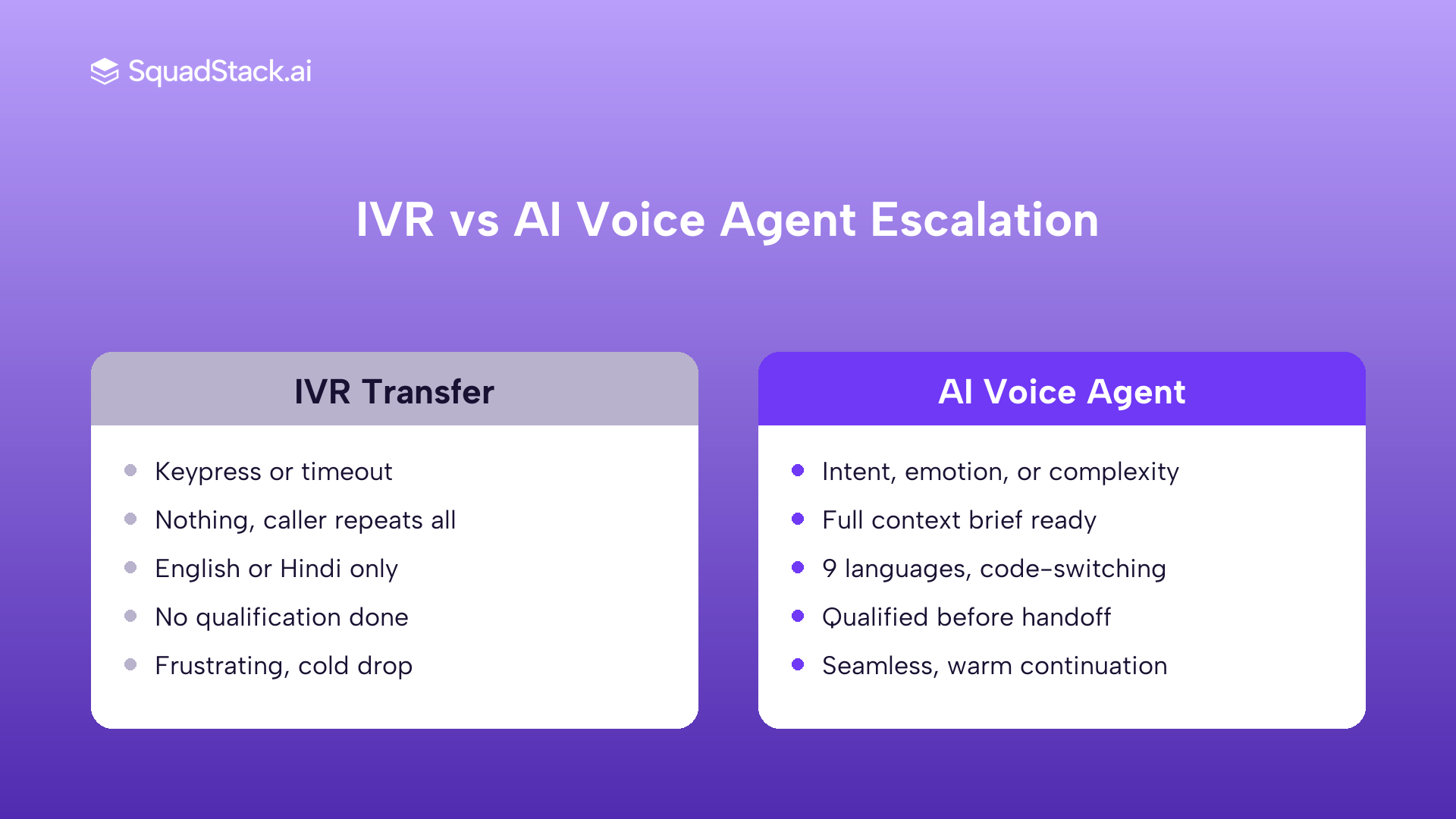
| Escalation trigger | Customer presses a menu key | Triggered by intent signal, loop detection, keyword, or customer request. No key press needed |
| Context at transfer | None. Human gets a queue entry and a caller ID | Full context package: confirmed entities, disposition, summary, prior call history |
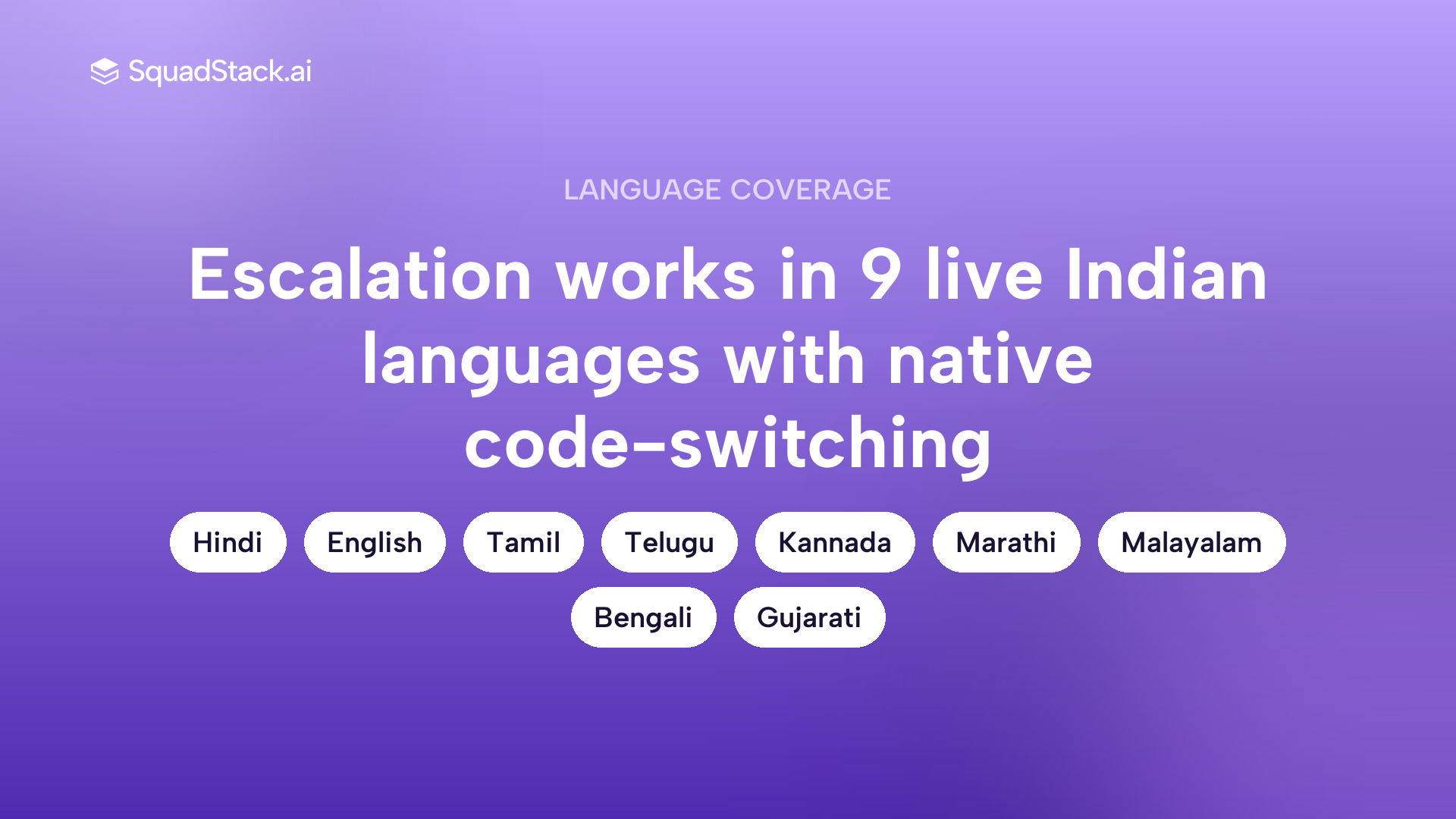
| Language handling | Fixed language | Native code-switching across Hindi, English, Tamil, Telugu, Kannada, Marathi, Malayalam, Bengali, Gujarati |
| Sales qualification before transfer | Cannot qualify. Human starts from zero | AI confirms income, eligibility, and stated intent before the human joins |
| Customer experience | Customer re-explains their situation after transfer | Human picks up mid-conversation, not at the start |
| Escalation rate control | No control | Configurable thresholds. Some campaigns run 0% transfers; others route 10 to 15% by design |
The context gap is the most expensive difference. A human on an IVR-transferred call spends the first two minutes gathering what the AI could have confirmed before the transfer. In a lending or brokerage campaign, those two minutes are where deals drop.
Trigger configurability. Can you define what fires an escalation per campaign? A personal loan flow has different trigger logic than a demat account opening. Platform-level triggers with no per-campaign override suggest the vendor has not run production campaigns at scale.
Context richness. What does the human receive at transfer? A transcript dump is not a context package. Look for confirmed entities, a structured summary, and disposition state. The human should be able to read it in under ten seconds.
Warm vs cold transfer choice. Both have their place. A platform that only supports one type limits your design options.
Availability fallback. When no human is available, the AI should book a callback with the same context attached, not drop the call.
Compliance behavior during transfer. TRAI rules, DNC registry status, and consent logging do not pause during a transfer. The platform must enforce compliance in the dialogue layer, not just at dial time.
The quality of escalation depends directly on what the AI understood before the transfer. That understanding comes from the speech model, the context layer, and the memory system.
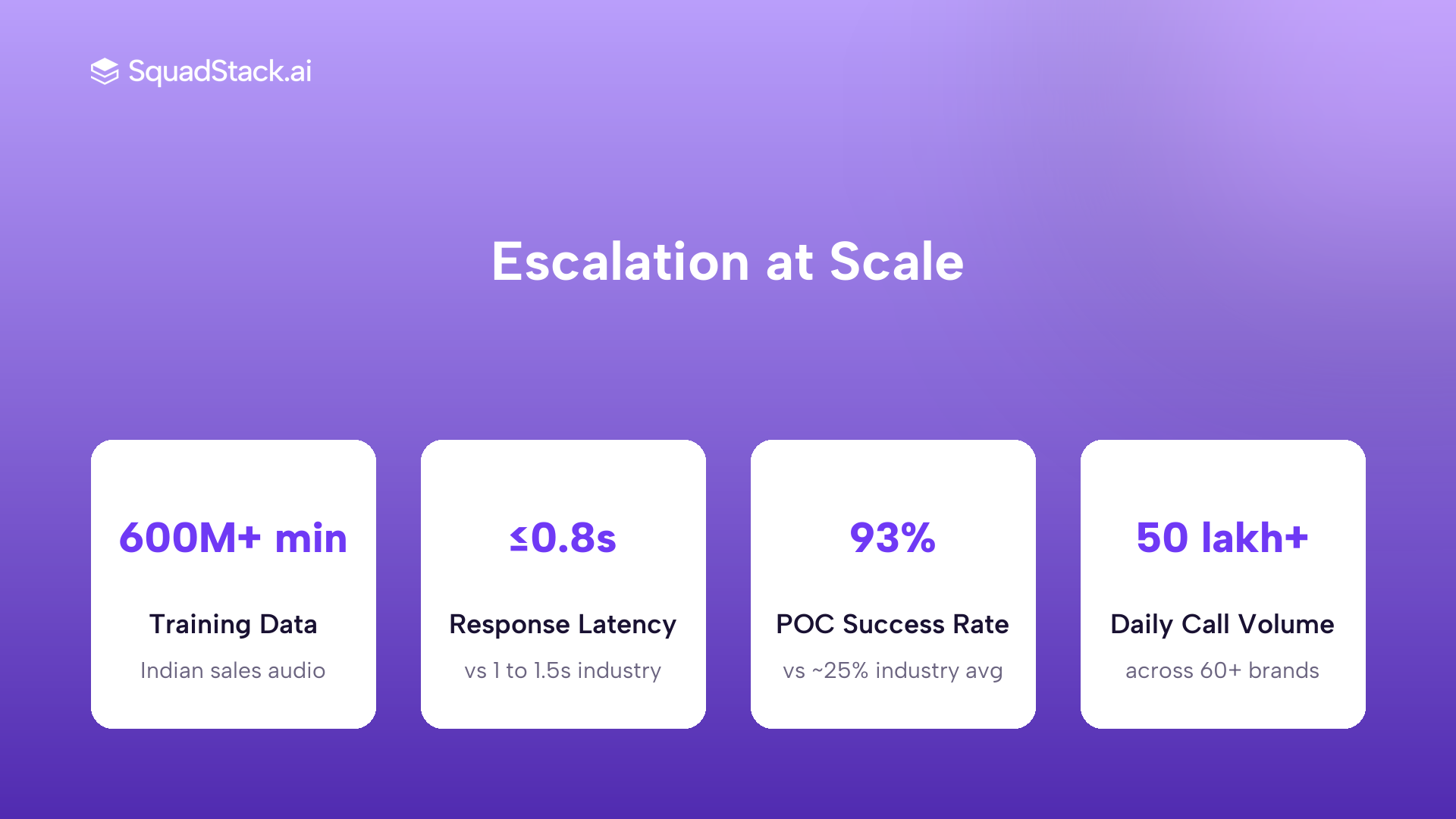
SquadStack's speech model, Arth, is trained on 600M+ minutes of real Indian sales conversations covering noisy telephone lines, code-switched Hinglish and Taminglish, and the specific cadences of Indian consumer sales. When a customer switches from Hindi to English mid-sentence, Arth does not miss it. Confirmed entities, the objection raised, and stated intent all land accurately in the context package before the transfer fires.
Persistent Memory means a returning customer is never treated as a new lead. If a customer confirmed their income three days ago and dropped off at bank statement upload, the next call opens with that context loaded.
The Eval System scores every call on Outcome, Sentiment, and Execution, with both AI and human review. Escalation quality is measured and improved, not assumed.
In a brokerage deployment, a leading bank-linked brokerage saw 3x higher conversions with SquadStack's voice AI approach.. Brands including AngelOne, Kotak Mahindra Bank, and PhonePe have deployed these workflows in production.
For teams thinking about how escalation fits into a broader agentic AI contact center stack, the escalation layer is not a standalone feature; it is embedded in the same system that manages leads, runs QA, and optimizes conversion across channels.
Escalation done well is invisible to the customer. They feel the conversation continue, not a break in the experience. Escalation done poorly costs conversions.
The design decisions that matter are trigger logic, context richness, warm vs cold transfer, and the fallback when no human is available. Get those four right and the handoff becomes a sales tool rather than a support fallback.
If your team is building or evaluating an escalation policy for a consumer sales campaign in India, book a demo with SquadStack to see how trigger design and context transfer work in live production campaigns. You can also explore the full AI voice agent platform or read how AI voice agents work in sales automation.
Which is the best AI voice agent with real-time human handoff for consumer sales in India?
The best platform for Indian consumer sales combines configurable escalation triggers, full context transfer at handoff, and a speech model that handles native code-switching across Indian languages. SquadStack's voice agents are trained on 600M+ minutes of real Indian sales conversations, run across 60+ large consumer brands, and support warm transfer with confirmed entity context passed to the human agent before the first word is spoken.
What triggers an AI voice agent to hand off to a human?
The four standard escalation triggers are: a direct customer request ("talk to a human"), a high-intent signal from the conversation (for example, a customer in a loan flow asking about disbursement), loop detection when the AI has been unable to resolve the same question after repeated attempts, and keyword triggers on specific phrases such as competitor names or legal terms. Each trigger type is configurable per campaign.
What is the difference between warm transfer and cold transfer in AI voice agent escalation?
In a warm transfer, the AI, the customer, and the human agent are briefly connected together before the AI drops off. The customer hears a continuous conversation and does not experience a gap. In a cold transfer, the call is routed directly to the human, who relies entirely on the context package. Warm transfer is better for high-value sales conversations where trust matters. Cold transfer with a rich context brief works well for support queues focused on speed.
What context does the human agent receive when an AI voice agent escalates a call?
A well-designed escalation package includes confirmed entities from the call (name, stated income, product interest, objection raised), a short summary of the conversation, the current disposition, and any prior interaction history from Persistent Memory. The human agent should be able to read this in under ten seconds and pick up the conversation from where the AI left off, not from the beginning.
How does AI voice agent escalation work in India specifically, given language switching?
Indian sales calls frequently involve mid-sentence switches between Hindi and English, or regional languages like Tamil and Telugu. An AI that cannot handle this accurately loses critical context before the transfer. SquadStack's Arth model is trained specifically on code-switched Indian telephony audio, so entities and intent are captured correctly even when a customer switches languages mid-call. The context package passed to the human reflects the actual conversation, not a garbled transcript.
How does escalation work for collections calls where tone and compliance rules are strict?
Collections campaigns require escalation logic that is tightly governed. The AI should honor TRAI calling windows, DNC registry status, and any consent flags before and during the call. When a customer raises a dispute or requests to speak to a manager, the trigger should fire immediately and the human should receive the full account context, including prior call history, payment status, and the specific point of dispute. Compliance-aware dialogue ensures no breach occurs during the transfer itself.
What happens if no human agent is available when the AI tries to escalate?
The AI should fall back to callback scheduling rather than dropping the call or leaving the customer in a queue. The booked callback carries the same context package as a live transfer, so the human returning the call knows exactly what was discussed and where the conversation should resume. This keeps the lead warm rather than forcing a cold re-engagement.
How is escalation performance measured and improved over time?
Every transferred call is scored on the same Eval System framework used for fully AI-handled calls: Outcome (was the transfer justified and did the human convert), Sentiment (how did the customer experience the handoff), and Execution (was the context complete and accurate). These scores feed back into trigger calibration and context formatting. Over time, the system learns which trigger thresholds produce the best downstream conversion.
Can AI voice agents handle real-time human handoff escalation in regulated industries like BFSI?
Yes. TRAI-compliant dialing windows, DNC scrubbing, consent gating, and AI disclosure are enforced in the dialogue layer, not just at dial time. These controls persist through a transfer. SquadStack holds ISO 27001, ISO 27701, SOC 2 Type II, DPDP, and TRAI compliance, which is relevant for banking and lending deployments where regulatory requirements apply at every stage of the call, including the moment of handoff.
How does AI voice agent escalation compare to a traditional IVR transfer?
An IVR transfer is menu-driven. The customer presses a key, the call routes, and the human starts from zero. An AI voice agent escalation is intent-driven. The AI has qualified the lead, confirmed data, and assembled a context package before the transfer fires. The human agent receives a briefing, not a cold call. For consumer sales campaigns, this difference in context quality directly affects close rates after transfer.

