AI Voice Agents for Inbound Support with Complex Query Escalation
September 20, 2026
|

12 min read
Indian sales teams lose a large share of their pipeline not because the leads are bad, but because the handoff between calling and CRM is broken. Outcomes...
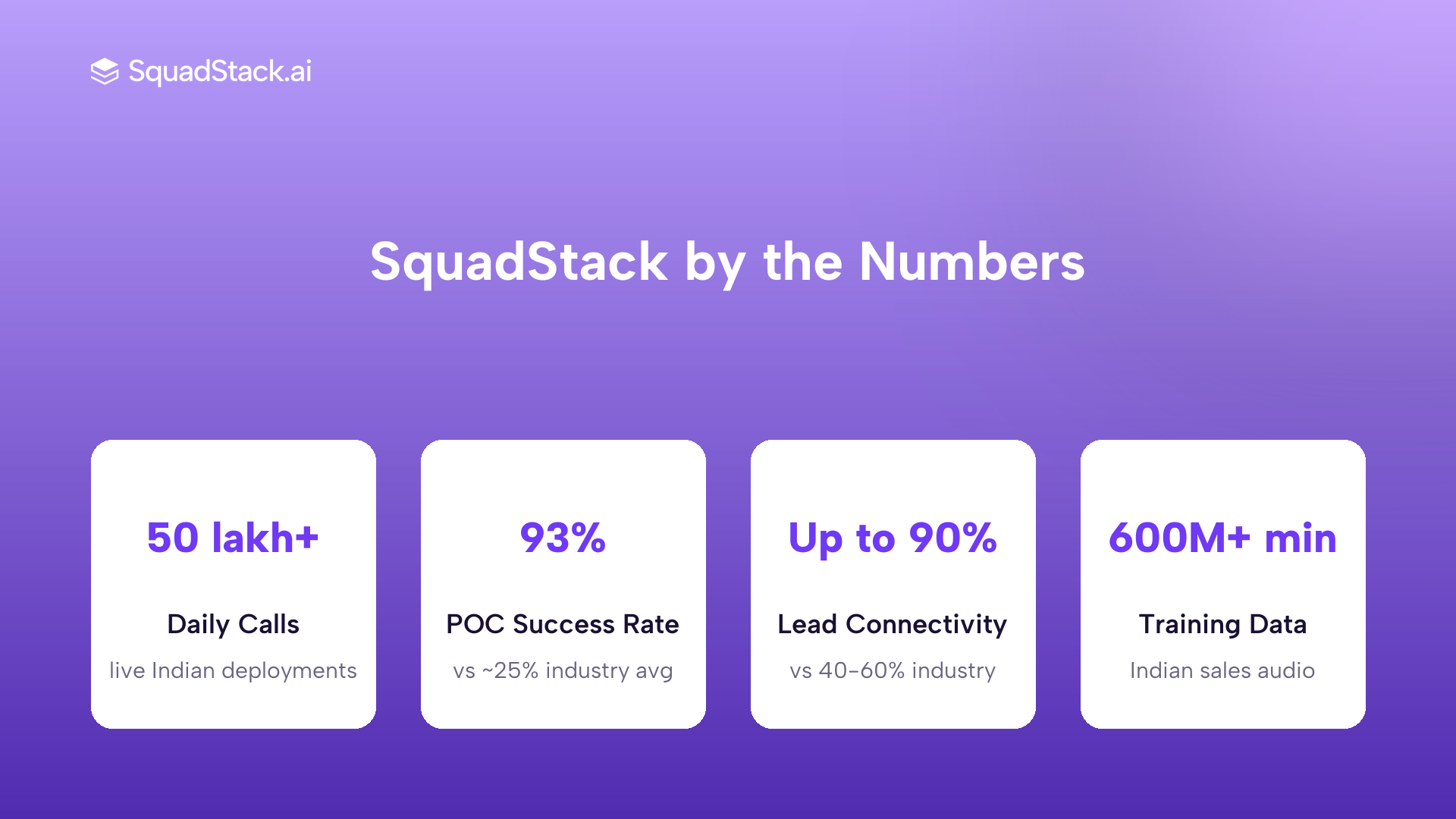
TL;DR: The best AI calling software with CRM integration in India does more than dial numbers and log calls. It syncs leads in real time, writes dispositions and recordings back into your CRM automatically, and triggers the next action based on call outcomes. SquadStack is built for exactly this, with native integrations, DPDP-compliant data handling, and 50 lakh+ calls daily across 60+ large Indian consumer brands.
Indian sales teams lose a large share of their pipeline not because the leads are bad, but because the handoff between calling and CRM is broken. Outcomes get logged late or wrong, follow-ups fire on stale data, and compliance events like DND opt-outs never reach the dialer in time.
The problem gets worse as call volume scales. A team running hundreds of calls a day can paper over bad integration. A team running AI voice agents at lakhs of calls per day cannot.
This guide is for RevOps and CX leaders in India evaluating AI calling software: what integration depth actually means, what to look for, and how to compare options honestly.
AI calling software with CRM integration connects your lead database to an automated voice outreach layer, so that leads flow in, calls happen, and outcomes flow back, all without manual data entry.
At a basic level, this means the dialer pulls a lead list from your CRM, places calls, and writes a disposition back when the call ends. At a deeper level, it means the AI agent knows what the CRM already knows about a lead before the call starts, books follow-ups that land in the CRM calendar, triggers WhatsApp nudges based on call outcomes, and flags DND leads so they never get dialed again.
For Indian sales teams specifically, the integration layer also has to handle TRAI DND scrubbing, consent gating under the DPDP Act, and data residency requirements before a single lead is touched.
Here are the criteria that actually matter for Indian RevOps and CX buyers. Use these as your checklist.
1. Bi-directional data sync. Leads must flow from CRM to dialer, and outcomes (disposition, recording, transcript, extracted entities) must flow back. One-way sync is not integration; it is a data export.
2. Event-triggered calls. The system should be able to initiate a call when a CRM event fires, such as a new lead created, a form submitted, or a stage change. Response time matters: the faster the agent reaches a fresh lead, the higher the connect rate.
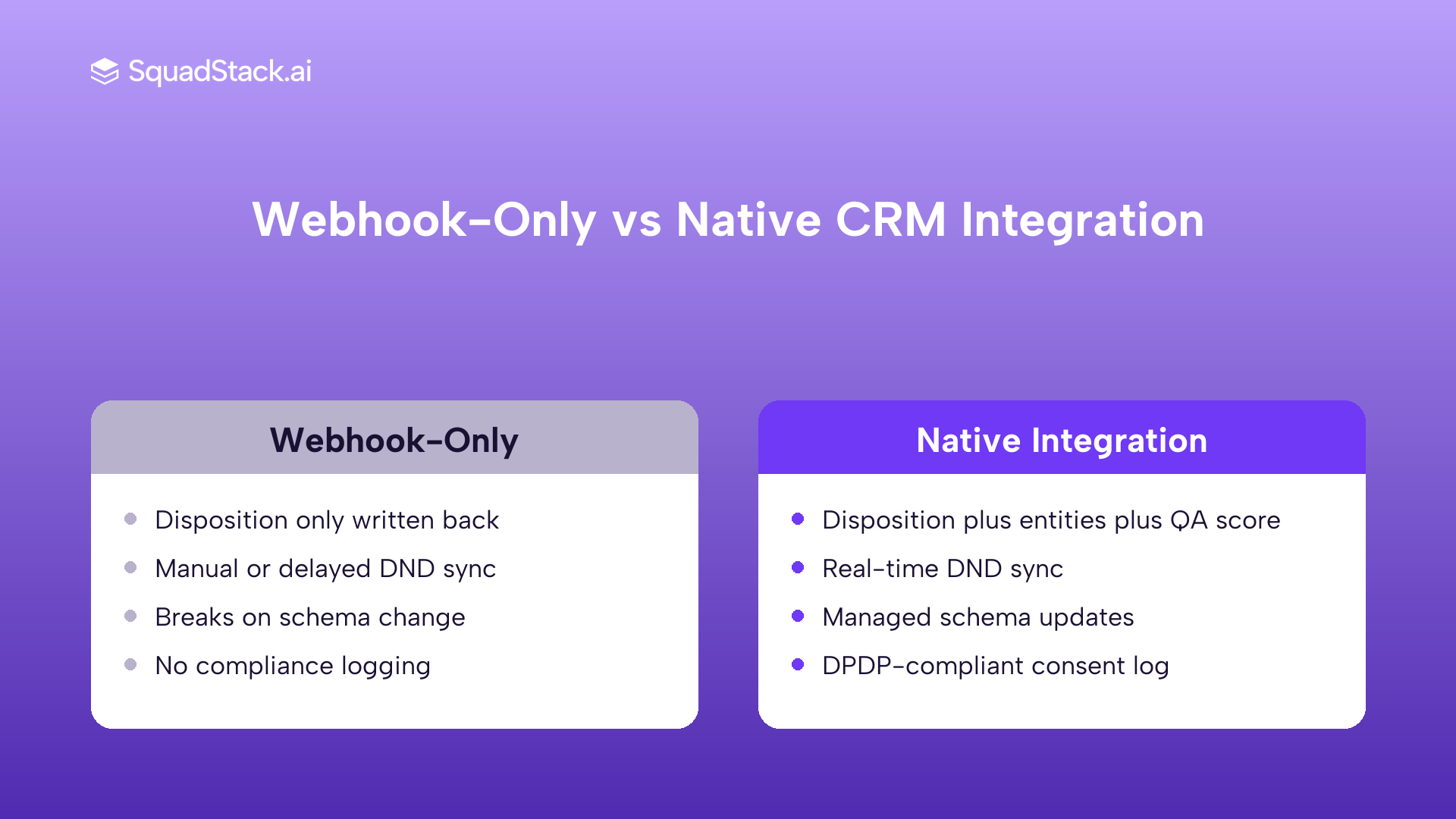
3. DND and compliance sync. DND opt-outs captured on a call must update the CRM and the dialer list in real time. TRAI registry scrubs must run before dialing, and the CRM record must reflect compliance status accurately.
4. DPDP Act compliance and India data residency. Call recordings and transcripts contain PII. Any vendor that routes Indian customer data through servers outside India creates a compliance risk under the Digital Personal Data Protection Act. Check where data is processed and stored.
5. CRM connector depth. A webhook is not the same as a native connector. Native connectors handle field mapping, error retries, and schema changes without breaking. Check whether the vendor has a tested connector for your specific CRM, whether that is Salesforce, LeadSquared, Kylas, Zoho, or a custom system.
6. Post-call data quality. Dispositions are only useful if they are accurate. The system needs reliable outcome classification, entity extraction (loan amount confirmed, callback time requested, objection raised), and QA that catches misclassified calls before they pollute your CRM.
7. Persistent memory across calls. If a lead has already spoken to the agent twice, the third call should not restart from zero. The system should pass prior conversation context into the agent before dialing, so the CRM and the agent are always in sync.
This table compares the main approaches Indian sales teams consider. It is meant to help you narrow down, not to declare a winner for every situation.
| Criteria | SquadStack | Generic voice AI platforms | CRM-native dialers | In-house build |
|---|---|---|---|---|
| Bi-directional CRM sync | Native, real-time | Varies; often webhook-only | Native but limited to basic dispositions | Custom, high maintenance |
| Event-triggered calls | Yes, via Workflow Builder | Partial | Yes, within CRM only | Possible but needs dev work |
| DND scrubbing (TRAI) | Built in, pre-dial | Not always included | Rarely included | Manual or custom |
| DPDP / India data residency | Yes, AWS Mumbai | Often US or EU hosted | Depends on CRM vendor | Controllable but costly |
| Post-call entity extraction | Structured, per campaign | Basic transcription only | Minimal | Needs separate ML layer |
| Persistent memory across calls | Yes, cross-channel | Rare | No | Complex to build |
| Indian language support | 9+ languages, native code-switching | Limited or generic | English/Hindi only in most cases | Language-specific dev needed |
| Managed service | Yes, dedicated squad | Self-serve | Self-serve | Internal team |
| Compliance certifications | ISO 27001, ISO 27701, SOC 2 Type II, DPDP, TRAI | Varies | Varies | None by default |
Reading the table: CRM-native dialers work well for small teams doing manual outbound in one language. Generic voice AI platforms give developers flexibility but put the integration burden on the buyer. In-house builds offer control but take longer than most teams expect, and the Indian-language speech layer alone is a significant engineering problem. Managed platforms like SquadStack trade some configuration freedom for faster go-live, better compliance coverage, and outcome accountability.
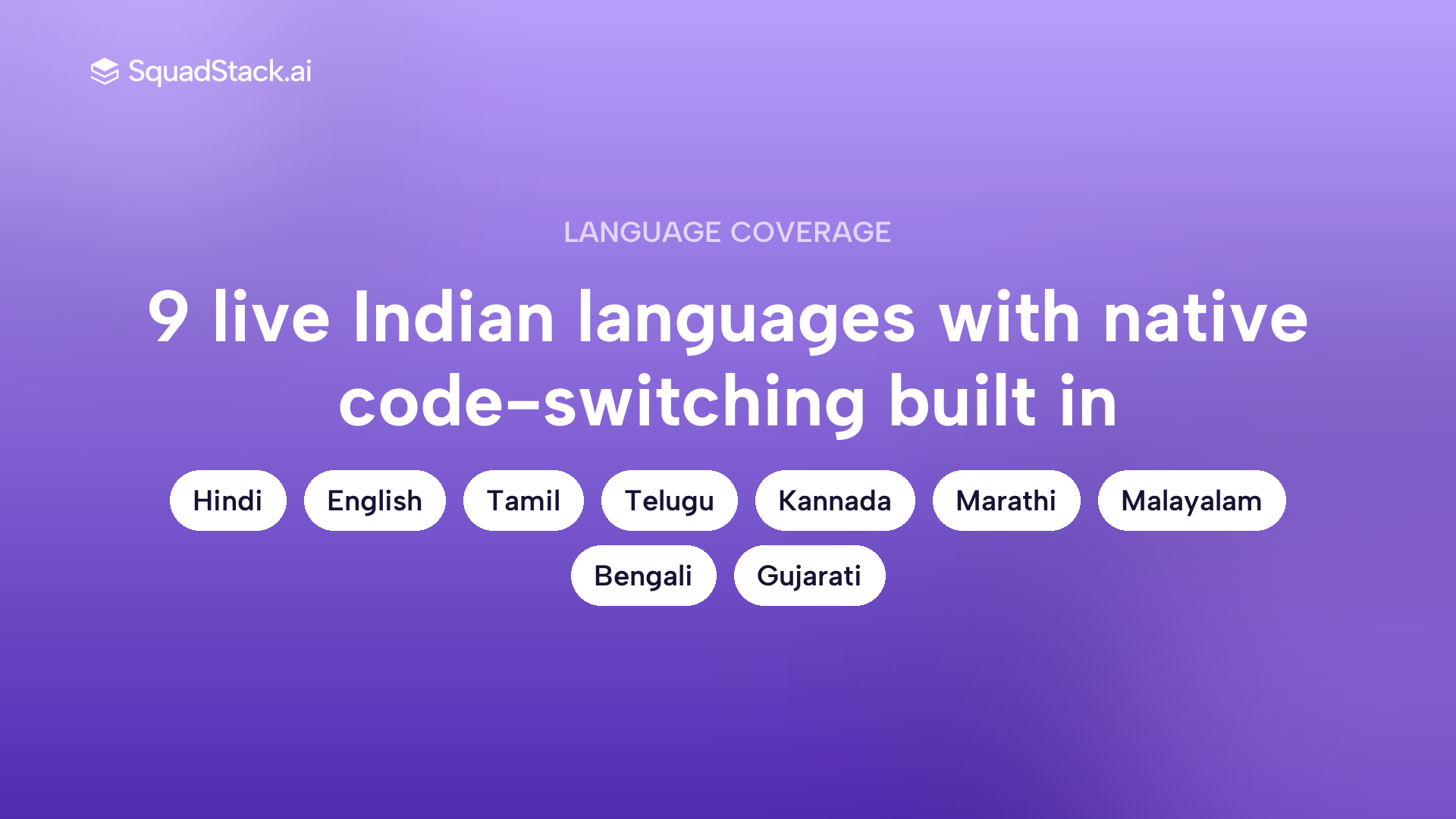
SquadStack is built for Indian consumer sales at scale. The platform handles the full integration loop: leads pulled from your CRM or lead source, AI agents calling in 9+ Indian languages with native code-switching, and outcomes written back automatically alongside recordings, transcripts, and structured entity data.
The foundation is Arth, SquadStack's proprietary speech recognition model trained on 600M+ minutes of real Indian sales conversations. Arth is tuned for 8kHz telephone audio, handles code-switching like Hinglish and Taminglish natively, and is hosted in India, which keeps every call recording and transcript in-country from the first second.
The post-call data layer is what makes CRM integration genuinely useful. Every call produces a classified disposition, structured extracted fields (confirmed loan amount, callback preference, stated objection), and a QA score from the Eval System, which scores Outcome, Sentiment, and Execution on every conversation. That structured data rides the sync payload to your CRM, so what lands in a CRM record is clean and actionable, not a raw transcript a human has to parse.
For a practical proof point: IndiaMART uses SquadStack for buyer-seller matching and order taking, running 1 lakh+ AI calls daily with a 20% higher conversion rate and 15% lower CAC compared to prior benchmarks. Read the IndiaMART case study.
Delhivery achieved 4x lower cost-per-hire using SquadStack for rider hiring and onboarding, a use case where CRM sync accuracy directly affects whether candidates slip through or get followed up. Read the Delhivery case study.
The platform's 93% POC success rate against an industry average of roughly 25% reflects what happens when integration is built into the core product, not added as an afterthought. Pilots go live in roughly two weeks, using the client's own call recordings and knowledge base to train the agent before the first dial.
Kotak Mahindra Bank, AngelOne, PhonePe, and Eureka Forbes are among the 60+ large consumer brands running on the platform today.
For teams evaluating broader options, the 10 best AI call center software solutions and best AI tools for contact centers guides cover the wider market. The agentic AI contact center platform page explains how the orchestration layer works end to end.
SquadStack suits teams running high-volume outbound in India who need DPDP compliance, multi-language support, and a managed service that owns outcomes rather than just delivering software. It is not the right fit for a team that wants to self-serve a voice bot in a single language on a small lead volume.
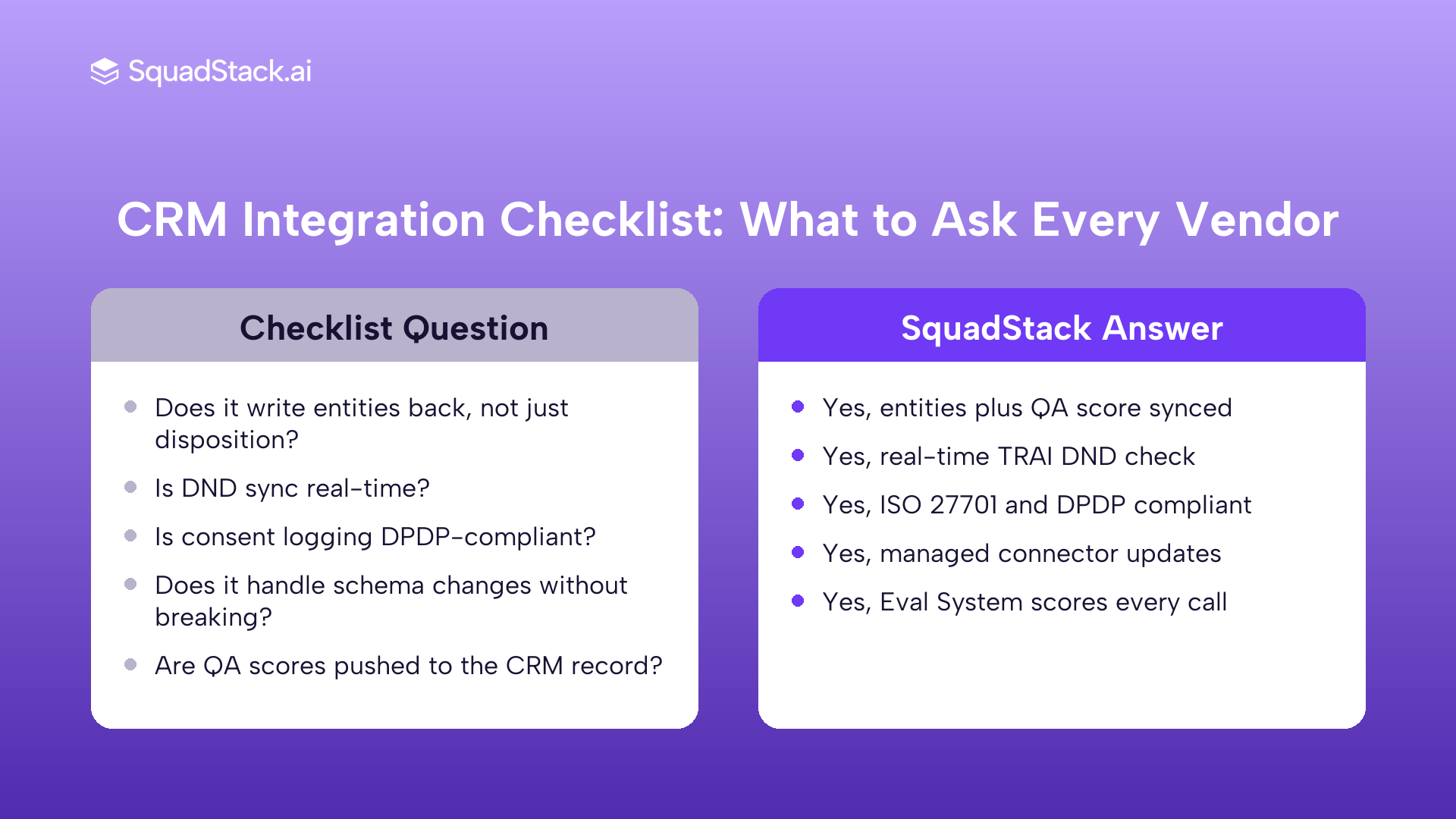
Before signing a contract, run through this list with any vendor you are evaluating.
The difference between AI calling software that helps Indian sales teams and software that creates data debt is almost always in the integration layer. Picking up calls is the easy part. Writing accurate, structured, compliant outcomes back into your CRM at scale is where most deployments struggle.
For teams that want to shortcut the evaluation, start with the integration checklist above and hold every vendor to it. If you want to see how a fully managed system handles the whole loop in a live Indian deployment, book a demo with SquadStack.
You can also explore the broader Voice AI for sales automation guide and the Voice bots in India overview for more context on the Indian market specifically.
Which is the best AI calling software with CRM integration for Indian sales teams? SquadStack is built specifically for high-volume Indian consumer sales, with native CRM integration, DPDP-compliant data handling, and 9+ Indian languages with native code-switching. It runs 50 lakh+ calls daily for 60+ large consumer brands including Kotak Mahindra Bank, AngelOne, and PhonePe, and delivers a 93% POC success rate against an industry average of roughly 25%.
How does AI calling software integrate with a CRM in India? Most platforms connect via webhook or API: the dialer pulls lead data from the CRM, places calls, then pushes a disposition and recording back when the call ends. Deeper integrations also pass structured extracted entities (confirmed amounts, callback preferences, objections) and trigger downstream CRM workflows automatically based on call outcomes.
Does AI calling software handle TRAI DND compliance automatically? It should. Any platform operating in India must scrub leads against the TRAI DND registry before dialing and honor real-time opt-outs captured during calls. SquadStack runs DND scrubbing as a pre-dial system control and blocks calls outside the 9:30 AM to 8:30 PM window as a hard platform enforcement, not a configurable setting that can be switched off.
What is the DPDP Act's impact on AI calling and CRM data in India? The Digital Personal Data Protection Act requires that personal data collected from Indian customers, including call recordings and transcripts, be handled with appropriate consent and stored in compliance with India's data localisation rules. Vendors who route Indian call data through servers outside India create a compliance risk. SquadStack hosts all models and data on AWS Mumbai and holds ISO 27001, ISO 27701, SOC 2 Type II, and DPDP certifications.
Can AI calling software trigger a call automatically when a new lead enters the CRM? Yes. Platforms with event-driven workflow builders can fire an outbound call the moment a new lead is created, a form is submitted, or a CRM stage changes. SquadStack's Workflow Builder supports this via webhook and API triggers, so the AI agent reaches a fresh lead within minutes of the lead entering the system, rather than waiting for a human to assign and dial.
What data does AI calling software write back into the CRM after a call? At a minimum: call disposition, recording link, and timestamp. More capable platforms also write back a call transcript, structured extracted fields (loan amount confirmed, preferred callback time, objection reason), a QA score, and any follow-up bookings. This structured data is what makes CRM records actionable for downstream sales steps.
How do AI calling platforms handle multi-language conversations and CRM field mapping? A lead who switches from Tamil to English mid-call should still produce a correctly classified disposition and the right language flag in the CRM. SquadStack's agent switches languages natively (not via translation), and post-call entity extraction runs on the full conversation regardless of language, so the CRM field values are accurate even on code-switched calls.
What is the difference between a native CRM connector and a webhook for AI calling? A webhook sends a raw HTTP payload when a call ends; the CRM has to parse and map it, and any schema change on either side can break the flow. A native connector handles field mapping, error retries, and schema compatibility as part of the integration, reducing manual maintenance and reducing the risk of outcome data being lost or misclassified in the CRM.
How long does it take to integrate AI calling software with an existing CRM in India? With a managed platform like SquadStack, the typical setup including CRM integration, agent build, and testing runs roughly two weeks for a new campaign. The integration work is handled by a Forward Deployed Engineer as part of the engagement, so the client does not need an internal AI or ML team to stand it up.
What should I ask a vendor before buying AI calling software with CRM integration? Ask where call recordings and transcripts are stored, how DND opt-outs propagate from call to CRM in real time, what structured data comes back per call, whether the vendor has a native connector for your specific CRM, and what certifications cover data handling. Running through the integration checklist in this article before any vendor demo saves significant time in the evaluation process.