

Top AI Outbound Calling Tools in India: Features Compared
October 23, 2026
|

13 min read
Find out how AI voice agents automatically log every call outcome, trigger smart retry logic, and write clean data to your CRM for accurate pipeline tracking.
Call status AI voice tracking is the process by which an AI voice agent automatically detects and records the outcome of every outbound call in real time, whether the lead answered, was busy, had their phone switched off, or was unreachable. Unlike manual tele-calling, where agents log dispositions inconsistently and often late, AI voice agents write the call status directly to a CRM the moment a call ends. RevOps leaders get clean, real-time data on every lead, every attempt, every outcome, with no gaps.
A lead does not answer on the first dial. That is normal. The problem is what happens next. In a manual tele-calling team, the agent marks "no answer," moves on, and the retry either happens on instinct or gets forgotten. By end of day, the CRM has blank fields, wrong dispositions, and calls that were never attempted. RevOps is flying blind.
AI voice agents fix this at the root. Every call produces a logged status, and that status triggers an automatic next step. This post explains the full taxonomy of call statuses, how AI voice agents detect and record each one, and how that data flows into CRM dashboards and sales workflows.
For a broader look at how AI voice agents handle the full outbound sales cycle, that pillar covers the end-to-end picture.
Call status tracking is the automatic detection, classification, and logging of the outcome of every call attempt. The moment a dial ends, the system writes a structured disposition to the lead record: what happened, when, and what should happen next.
This is different from post-call analysis, which examines what was said during a conversation. Call status tracking is about whether a conversation happened at all, and if not, precisely why.
Every outbound call lands in one of these states:
| Status | What it means | What the system does next |
|---|---|---|
| Answered / Connected | The lead picked up and the agent spoke with them | Logs disposition (interested, callback, not interested, etc.); writes to CRM |
| Busy | The line was engaged when the agent dialed | Schedules a retry after a short interval |
| Switched-off | The handset was powered down | Queues for a later attempt; may trigger a WhatsApp nudge |
| Not Reachable | The number is out of coverage or not in service temporarily | Queues for retry; flagged if persistent across multiple attempts |
| Voicemail / IVR Trap | The call connected to voicemail or an automated system, not a human | Logged as a non-connect; does not count as a conversation |
| Ring No Answer | The phone rang but the lead did not pick up within ring time | Queued for retry per cadence rules |
| DND / Blocked | The number is on a do-not-disturb registry | Removed from the active queue; no further dials |
| Cadence Complete | All allowed attempts are exhausted | Lead marked as judged; removed from active dialing |
Each of these is a machine-written record generated at the moment the call terminates, not a note typed in a field after the fact.
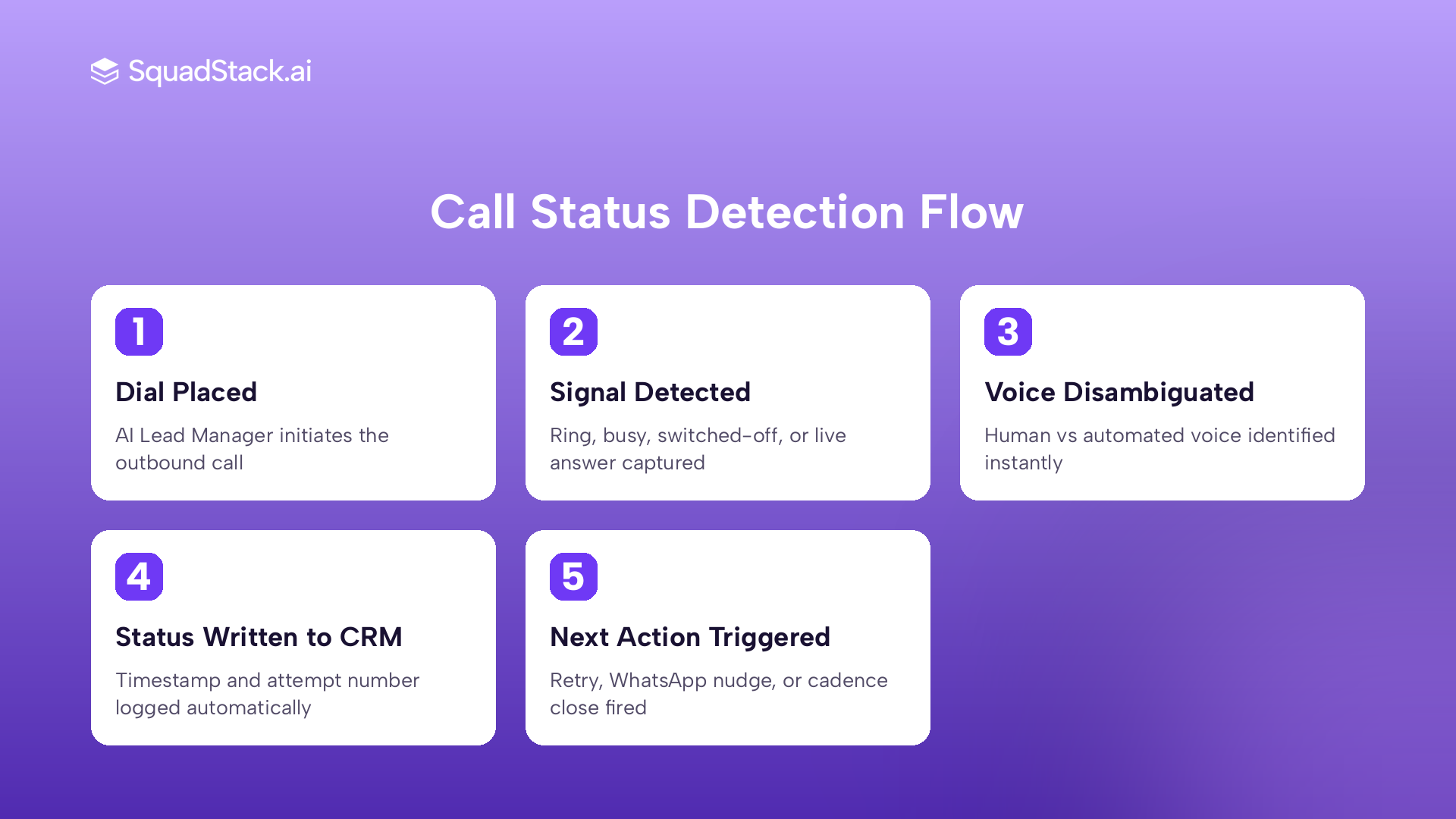
The process runs in four stages, from dial to CRM entry.
Step 1: The dial and signal detection. The AI Lead Manager places the call and the telephony layer listens for the signal. Ring tone, busy tone, a switched-off message, or a voicemail pickup each produce a different audio or SIP signal, read before any human speech occurs.
Step 2: Answer detection and disambiguation. Many Indian numbers route through IVRs, telecom welcome prompts, or operator messages before reaching the user. A naive system logs all of these as "connected." A well-built one distinguishes a human voice from an automated prompt and only logs a live answer when a real person picks up. A false connect inflates your connect rate and wastes follow-up effort.
Step 3: Status write-back to CRM. Once the call ends, the outcome, including status, timestamp, attempt number, and any extracted entities, is written to the lead record automatically. Callbacks booked during the call are also synced here.
Step 4: Re-queue or close. Based on the status, the system takes the next programmed action. A busy signal at 10 AM queues a retry for the afternoon. Three consecutive switched-off readings trigger a WhatsApp message instead of another dial. A cadence-complete status closes the lead from active dialing. The logic is configurable per campaign.
Call outcome data also feeds back into the ROI Optimizer. Connect rates by time-of-day sharpen when to dial each segment, and high drop-off rates on certain attempts surface a cadence problem. Data captured today directly improves calls run tomorrow.
High-volume outbound lending campaigns. A personal loan or gold loan campaign might work tens of thousands of leads in a week. Without clean status data, there is no reliable view of how many leads were genuinely attempted versus dialed once and abandoned. Status tracking gives RevOps an accurate picture: attempted reach, live connect rate, leads pending retry, and leads exhausted. Kotak Mahindra Bank runs personal loan sales through SquadStack; PhonePe uses the platform for merchant and personal loan sales and collections.
Multi-attempt cadences with channel handoffs. When a lead does not answer, the right next step depends on why. A switched-off phone warrants a different follow-up interval than a busy signal. A number that has been not-reachable across three attempts may be better served with a WhatsApp message than a fourth dial. Status-driven logic makes these decisions automatically.
Lead-level attribution for RevOps. When a lead converts, the status log shows the full attempt history: how many dials it took, which attempt connected, and whether a callback was involved. That chain lets a RevOps leader calculate true lead connectivity, build reliable pipeline forecasts, and identify which lead sources are producing unreachable numbers.
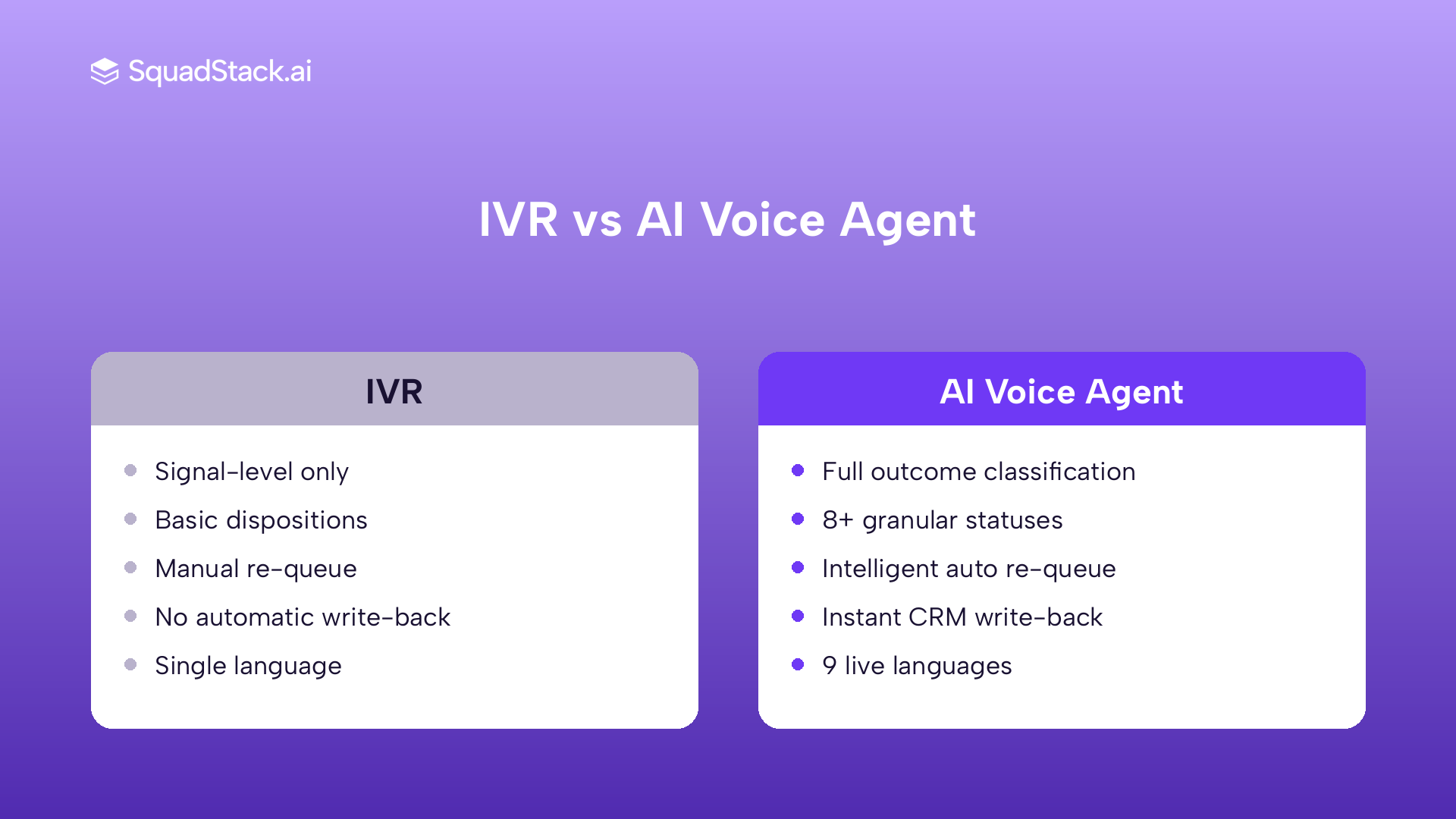
| Dimension | IVR | AI Voice Agent |
|---|---|---|
| Status detection | Detects ring/busy signal; cannot distinguish a live human from a telecom IVR prompt | Distinguishes a live answer from an automated message; logs the correct status for each |
| Disposition logging | Manual or not done at all | Auto-logs structured disposition per call: answered, intent detected, callback booked, not interested, etc. |
| Re-queue logic | None | Status triggers next action automatically: retry interval, WhatsApp nudge, or cadence close |
| Language handling | Fixed language menu; caller must navigate to their language option | Detects and responds in the lead's language from the first sentence; 9 live Indian languages with native code-switching |
| CRM write-back | Requires a separate integration; often a manual export | Writes status, timestamp, entities, and outcomes to CRM in real time, per call |
| Handling mid-call dropout | No visibility; nothing logged | Logs the point of dropout and last confirmed state so follow-up continues from there |
The gap shows up clearly when a telecom operator plays an automated Hindi message saying the subscriber is busy. An IVR logs that as a connect. An AI voice agent recognises it is not a human response and logs the call as not reached. That distinction, multiplied across thousands of daily calls, is the difference between accurate campaign data and noise.
For a detailed comparison of voice technologies, voicebots vs voice AI agents covers the full breakdown.
Answer detection accuracy for Indian telephony. Indian calls frequently hit telecom messages, operator IVRs, and regional-language recordings before reaching the user. The system must classify these as non-connects, not inflate the connected count.
Disposition granularity. A binary "answered / not answered" is not enough. The platform should log the full taxonomy as separate states, each driving different retry behavior.
CRM write-back speed. Real-time is the only acceptable standard. A batch upload at end-of-day means the sales team acts on stale data all morning.
Cadence configurability. Fixed retry schedules waste calls. The system should let teams configure attempt count, gap between retries, channel substitution rules, and calling windows per campaign.
Compliance controls. In India, the calling window is 9:30 AM to 8:30 PM. DND scrubbing against the TRAI registry is mandatory. These should be hard-enforced by the platform.

Indian telephony is not the same as calling a clean number on a fiber line. Calls drop mid-conversation, telecom messages play in regional languages, and a significant share of numbers are on the DND registry or flagged as spam before a campaign starts.
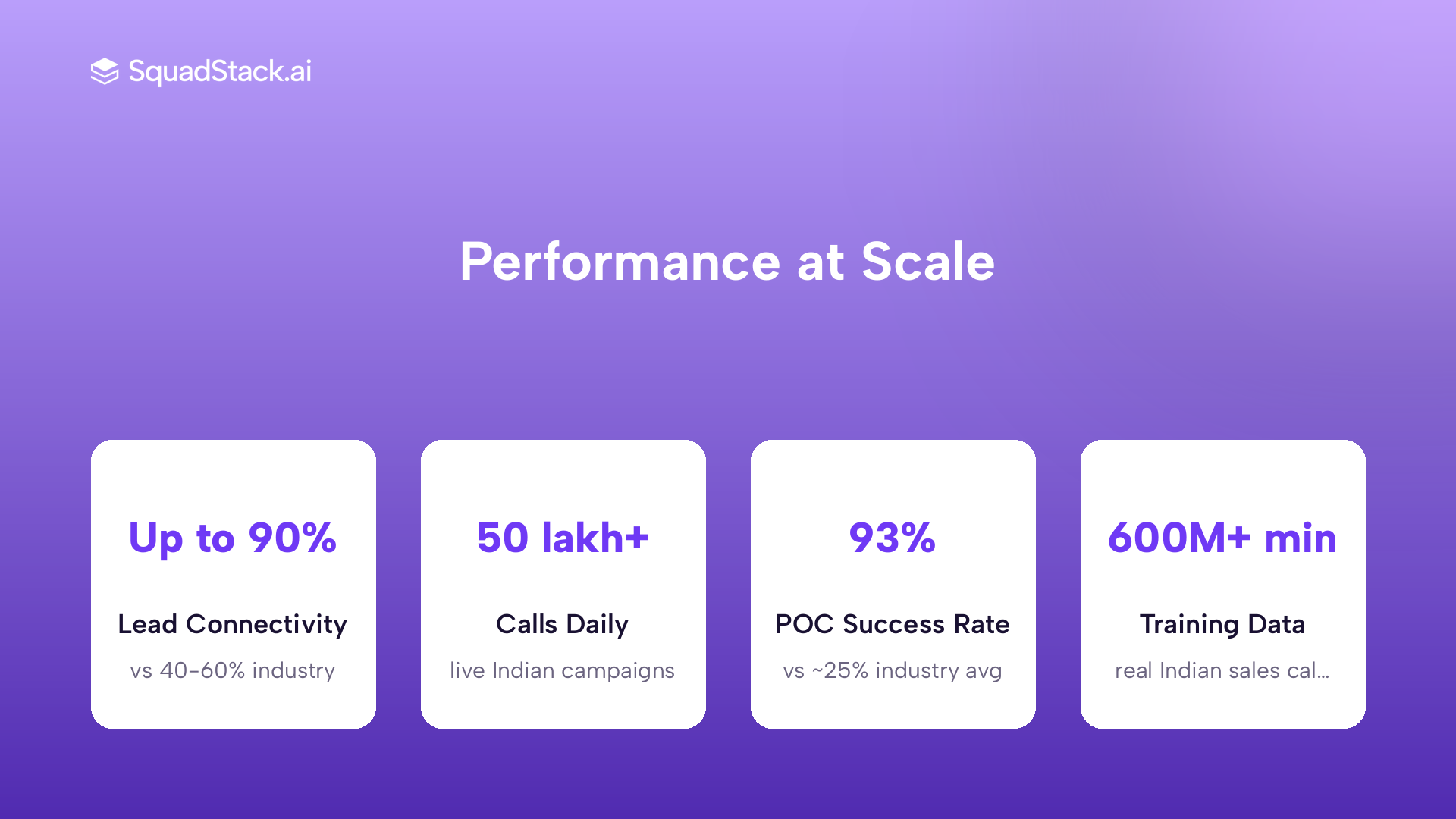
SquadStack's AI voice agent platform was built on this reality. The speech model, Arth, is trained on 600M+ minutes of real Indian contact-center conversations, including noisy 8kHz telephone audio with crosstalk and packet loss. That training is why the system correctly identifies a regional-language telecom prompt as automated, not a human answer, and logs it accordingly.
The AI Lead Manager runs spam-aware number rotation continuously. When a number's connectivity drops below a threshold or gets flagged on Truecaller, the platform rotates it out automatically. The default cadence is five attempts across two days with 180-minute gaps, and every parameter is configurable per campaign. DND numbers are scrubbed against the TRAI registry before dialing, and out-of-window calls are blocked by the platform.
The result is up to 90% lead connectivity, compared to a 40 to 60% industry norm. That figure is lead-level: the share of unique leads reached over the campaign's full attempt cadence, not a single-dial connect rate.
SquadStack's work with a leading gold loan NBFC shows how AI-driven calling with accurate call-status tracking performed in a high-volume lending campaign. Read the full details in the gold loan NBFC case study.
Every call is scored by the Eval System across Outcome, Sentiment, and Execution. The outcome score is a structured call-status record: did this call achieve its objective? That data feeds the ROI Optimizer, which adjusts timing, script, and retry strategy for the next wave of calls.
For teams evaluating pricing models, AI voice agent pricing in India covers how per-minute, per-seat, and pay-per-outcome models interact with campaign economics.
SquadStack is ISO 27001, ISO 27701, SOC 2 Type II, DPDP, and TRAI compliant. Every call is made on dedicated numbers, not a shared pool.
Clean call-status data is not a reporting feature. It is the infrastructure that makes outbound sales tractable at scale. When every attempt is logged accurately, retried on the right logic, and written to CRM in real time, RevOps leaders can see what is actually happening in a campaign and act on it.
If your team is running outbound calling on manual tele-callers or basic IVR and losing leads to missed retries and inaccurate dispositions, SquadStack's AI voice agents close that gap from day one.
Schedule a demo to see live call-status tracking and CRM write-back in action on a real Indian-language campaign.
What is the best AI voice agent for call status tracking in India?
SquadStack's AI voice agent platform is built specifically for Indian telephony conditions. It logs the full taxonomy of call statuses in real time, handles telecom IVR disambiguation, and writes outcomes to CRM automatically. The platform runs 50 lakh+ calls daily across 60+ large consumer brands in India.
Can AI voice agents automatically log call outcomes into a CRM?
Yes. SquadStack's AI voice agents write every call status, timestamp, attempt number, and extracted data point to the lead's CRM record the moment a call ends. Callbacks booked during the call are also synced automatically, with no manual entry needed.
How does an AI voice agent handle a call where the lead does not pick up?
The system detects the specific signal: busy tone, switched-off message, ring no answer, or voicemail, logs the correct status, and queues the lead for the appropriate retry. The retry interval, channel (call vs WhatsApp), and maximum attempt count are all configurable per campaign.
What is the difference between connected rate and lead connectivity rate?
Connected rate is the share of individual dials where someone answered. Lead connectivity rate is the share of unique leads reached at least once across all attempts in a campaign. SquadStack reports lead-level connectivity, which is a more meaningful metric for RevOps because it shows how much of the lead list was actually covered. SquadStack achieves up to 90% lead connectivity vs a 40 to 60% industry norm.
How do AI voice agents avoid logging telecom IVR prompts as live connections?
In India, many calls route through operator messages or regional-language telecom prompts before reaching the user. SquadStack's speech model, Arth, is trained on 600M+ minutes of real Indian telephony audio and correctly identifies automated prompts as non-human, logging them as not reached rather than connected. This keeps campaign connect-rate data accurate.
How does call status data feed into sales pipeline forecasting?
Every status is a structured data point attached to a lead record. The aggregate view shows attempt coverage, genuine connect rate, callback volume, and cadence-complete leads. RevOps can use this to calculate true top-of-funnel activity, identify under-attempted lead sources, and build pipeline forecasts based on actual outreach rather than assumed reach.
What happens to a lead whose number is on the DND registry?
SquadStack scrubs lead lists against the TRAI DND registry before dialing. A DND-registered number is flagged immediately, removed from the active dial queue, and logged accordingly. Clients can also upload their own internal DND lists, which are honored the same way.
Do AI voice agents support calling in Hindi and other regional languages while still tracking statuses correctly?
Yes. SquadStack's agents support 9 live Indian languages including Hindi, Tamil, Telugu, Kannada, Marathi, Malayalam, Bengali, and Gujarati, with native code-switching mid-conversation. Call-status detection and CRM write-back work identically across all languages because the status classification happens at the telephony signal and model layer, not the language layer.
What is the default retry cadence for an unanswered call?
The default cadence is 1+4: one initial dial plus four retries, five attempts total, with 180-minute gaps between attempts across two days. Every parameter, including attempt count, gap length, ring time, and calling window, is configurable per campaign. The calling window is hard-enforced by the platform at 9:30 AM to 8:30 PM.
How does call status tracking support compliance in regulated industries like BFSI?
Status tracking and compliance are linked directly. The platform enforces calling-window restrictions with hard system checks, not manual reminders. DND scrubbing runs before every dial. Consent gating and opt-out honoring are built into the conversation layer. SquadStack is TRAI, DPDP, ISO 27001, ISO 27701, and SOC 2 Type II compliant, which matters for BFSI clients subject to RBI and TRAI oversight.