.svg)





Top AI Outbound Calling Tools in India: Features Compared
October 23, 2026
|

13 min read
See how native Hinglish code-switching works inside a voice AI agent, where failures start, and what to test before choosing a vendor.
Yes, but only if the agent was built for it from the ground up. Most global voice AI models struggle with mid-sentence Hinglish code-switching because they were trained on clean, single-language audio. An AI voice agent handling Hinglish code-switching natively requires a speech model trained on real Indian telephony conversations, not a translation layer bolted on top.
Picture a collections call for a personal loan. The customer says: "Bhai, mujhe kal call karo, right now I'm in a meeting, bas ek minute." A standard IVR plays its next menu option. A poorly trained AI agent either mishears the Hindi words, ignores the English ones, or responds with the wrong intent entirely.
This is not an edge case. It is the default state of most voice calls in India. Hindi and English blend so naturally in spoken conversation that separating them is artificial. For a voice AI agent to work in the Indian market, handling this mix is a baseline requirement, not a premium feature.
If the agent cannot follow what the customer said, it cannot respond appropriately. Misheard intent leads to wrong answers, customer frustration, and dropped calls. In sales or collections, that is direct revenue lost.
Code-switching is when a speaker moves between two languages within a single sentence or conversation. In India, the most common form is Hinglish: a blend of Hindi and English so embedded in daily speech that speakers do not notice they are doing it. Taminglish, Kanglish, and similar blends exist across South India.
For an AI voice agent, code-switching is not the same problem as multilingual support. A multilingual system handles English in one call and Hindi in another. Code-switching requires the agent to process both languages simultaneously, often within the same phrase, and respond in the same natural blend.
There are two ways voice AI can attempt this:
Translation approach. The agent detects a language shift, routes the segment to a translation model, and responds in the dominant language. This adds latency, loses nuance, and sounds robotic because the cadence resets.
Native code-switching. The speech and language models were trained on code-switched data from the start. The agent does not need to detect a switch because its models already expect mixed speech as the norm. Responses stay natural because the model never treated it as an exception.
Only the second approach works in production Indian sales calls.
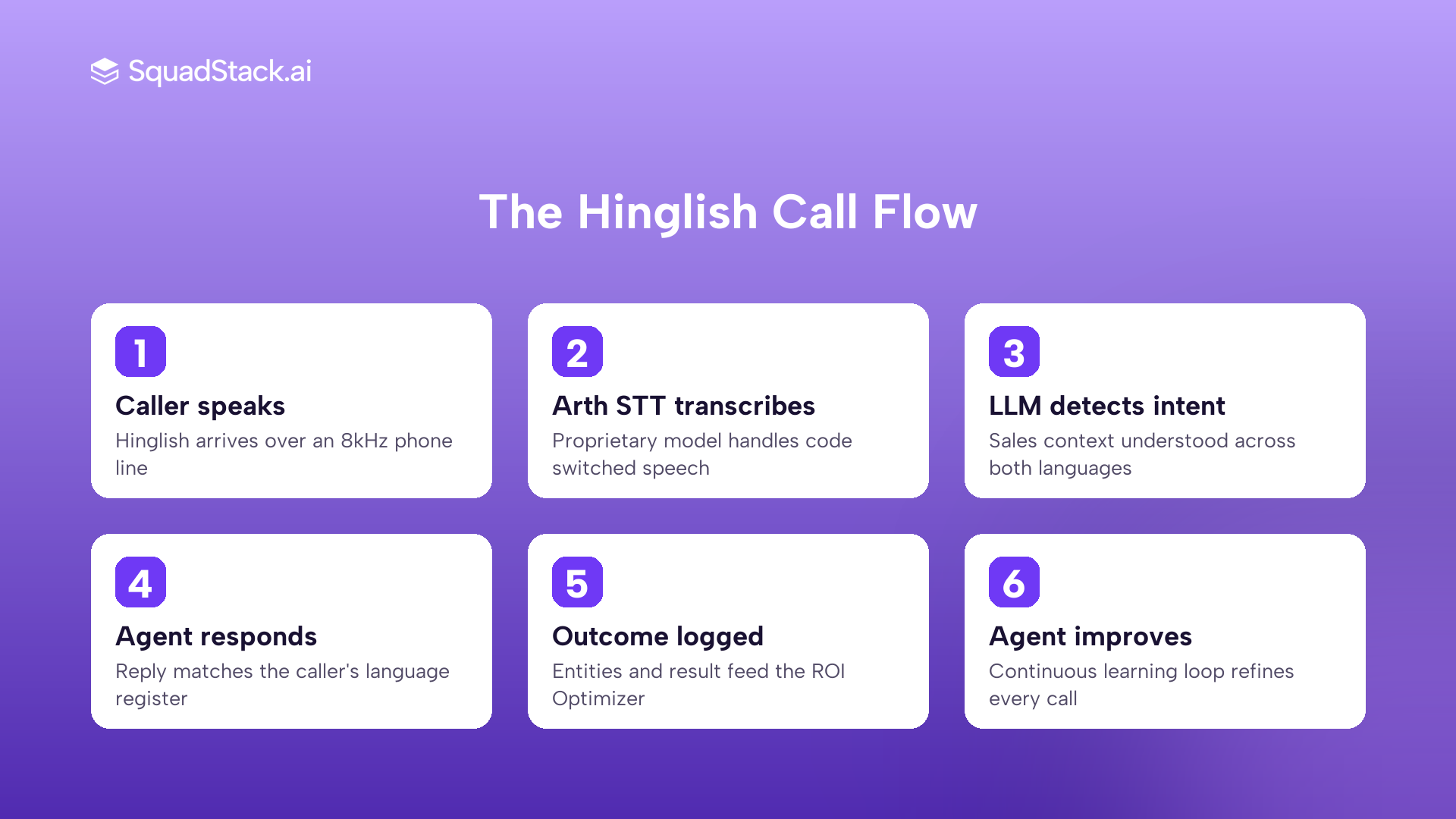
Step 1: Speech recognition on a noisy 8kHz line. The customer speaks. The STT model transcribes what was said. For Indian telephony, this means handling compressed audio, background noise, regional accents, and code-switched speech simultaneously. A model trained on clean studio audio will produce high word error rates here. The STT layer is where most Hinglish failures begin.
Step 2: Intent detection across languages. The language model reads the transcription and identifies what the customer wants. This is harder for code-switched speech because intent markers can appear in either language. "Interest rate kitna hai?" and "What's the interest rate?" and "Rate kya hai, bhai?" all carry the same intent. The model must recognize all three and their infinite blends.
Step 3: Response generation in the customer's register. A native code-switching agent matches the customer's language blend. If the customer spoke Hinglish, the agent responds in Hinglish. If they shifted to formal Hindi, the agent shifts too. This produces a natural conversation rather than a stilted one.
Step 4: Indian entity handling. Financial calls involve names, PAN numbers, amounts, PIN codes, and city names. A specialized model with a campaign-specific vocabulary list handles these far better than a general-purpose STT.
Step 5: Every call feeds the loop. After each call, outcomes, transcriptions, and quality scores flow back into the system. The ROI Optimizer analyzes what worked and what did not, and the agent's script, voice, and response logic improve continuously.
Lending and collections calls. A borrower discussing EMI repayment will naturally mix languages when expressing hesitation. "Agle mahine kar deta hoon, is month cash flow tight hai" is a standard objection. The agent needs to understand this as a rescheduling request, not a refusal.
Lead qualification for financial products. Understanding whether a prospect is genuinely interested or politely brushing off requires reading subtle cues that often appear in the language mix. Brands like PhonePe, KreditBee, and Moneyview run high-volume loan qualification and collections campaigns where this precision matters directly. AI-driven intent detection across language registers is the underlying capability.
Rider hiring in logistics. Blue-collar hiring calls involve candidates who speak primarily in regional languages but use English terms like "timing," "shift," and "location." Delhivery runs rider hiring through SquadStack, where the agent handles exactly this kind of mixed speech.
Education lead qualification. A student saying "Mujhe abhi decide nahi karna, let me think" needs to be scored differently from one saying "Nahi chahiye." Both are code-switched. Only a model trained on Indian conversational data distinguishes the two correctly.
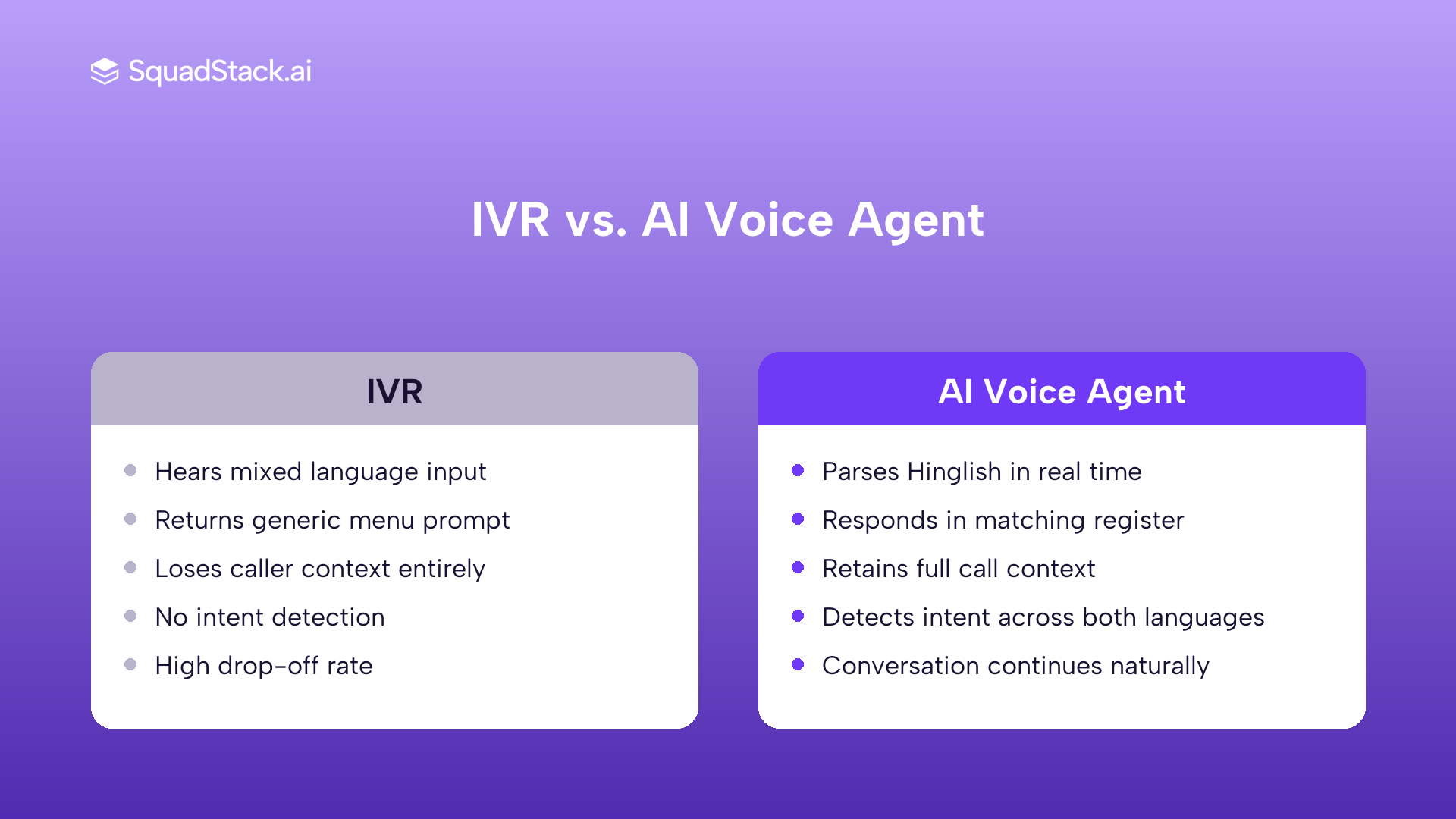
| Dimension | Traditional IVR | AI Voice Agent (Native Code-Switching) |
|---|---|---|
| Language handling | Fixed prompts in one language; caller must conform | Follows the caller's natural language blend mid-sentence |
| When caller says "bhai ek minute" | Plays next menu item; interprets silence as no-input | Pauses, waits, responds to context when the caller returns |
| Financial entity capture (PAN, EMI amount) | Requires DTMF keypad entry or exact phrase match | Extracts entities from free-form speech in any language register |
| Mid-sentence objection in Hindi | Cannot process; falls to "I didn't understand that" | Detects objection, triggers multi-step handling |
| Caller interrupts in English mid-Hindi sentence | Restarts the prompt | Stops, listens, responds to what was actually said |
| Outcome data | Call disposition only | Full transcript, extracted entities, sentiment, intent, all written back to CRM |
The gap is not cosmetic. IVRs were designed for menu navigation. A Hinglish conversation has no menus.
Most vendors list "Hinglish" or "Hindi + English" as a supported language. That claim is easy to make and hard to verify from a demo. Here is what actually matters:
What is the STT trained on? Public datasets like YouTube or read-speech corpora do not reflect real telephony conditions. Ask whether the speech model was trained on live call-center audio at 8kHz, with background noise, and on code-switched speech specifically.
How does the agent respond when it mishears? Every STT makes mistakes. The right behavior is to ask for confirmation rather than guess. If a demo shows the agent confidently producing a wrong answer from a misheard input, that is a production problem.
Does the agent match the customer's language register? Test it. Speak in Hinglish and see whether the agent responds in Hinglish or defaults to formal Hindi or English.
How does it handle Indian entities? Run a test with a PAN number, a city name, and a product name mentioned in passing. If the STT gets these wrong often, every downstream process breaks.
Is code-switching a training outcome or a feature flag? Some platforms implement code-switching as a detection layer on top of a monolingual model. This adds latency and reduces naturalness. Ask directly.
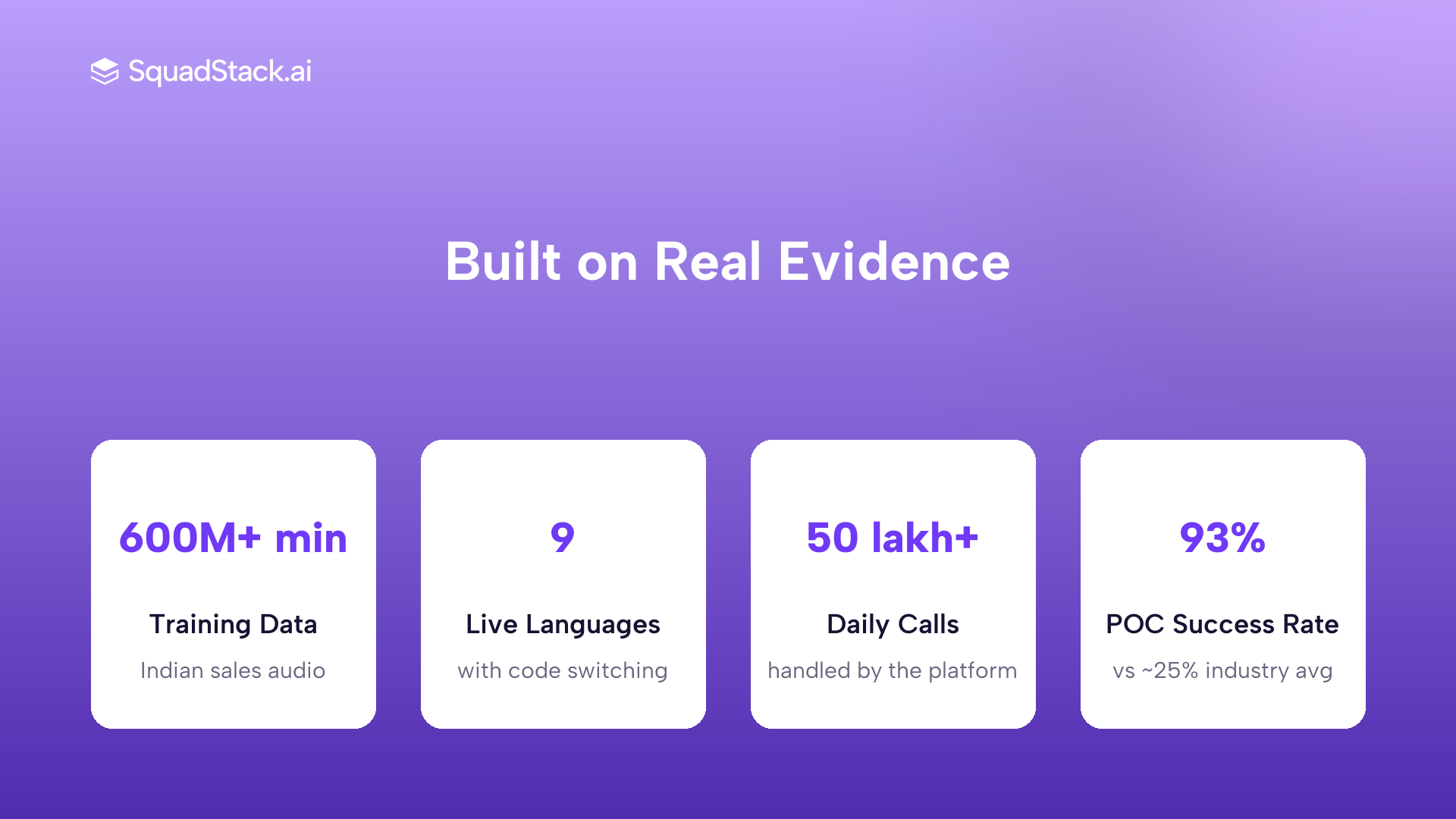
The core difference is the training data. SquadStack's proprietary speech model, Arth, was built on 600M+ minutes of real Indian contact-center conversations: full-duplex telephony recordings from actual sales and collections calls, covering 85%+ of Indian pincodes, with code-switched Hinglish and Taminglish as the norm. No public dataset comes close, and no competitor has equivalent proprietary telephony data from India.
Arth's internal benchmark places it within 0.9 semantic WER points of the best commercial streaming STT available, while being owned, fine-tunable on outcome data, and hosted entirely in India for DPDP compliance.
SquadStack's analysis found that dialogue engineering accounts for roughly 80% of perceived naturalness, with TTS configuration making up the rest. Every Hinglish script is hand-built using transcripts from top-performing human agents, validated by native speakers, with fillers ("तो, देखिए", "है ना"), backchannels ("जी, बिल्कुल"), and AI-signal phrases stripped out. The result is an agent that sounds like a real person from the first sentence.
The proof is in the redBus multilingual deployment, where voice AI engagement across regional language campaigns reached 75 to 85%, above the human baseline in every language tested, feedback captured was 2 to 4x more than the human baseline, and cost per outcome was 50 to 79% lower than human agents.
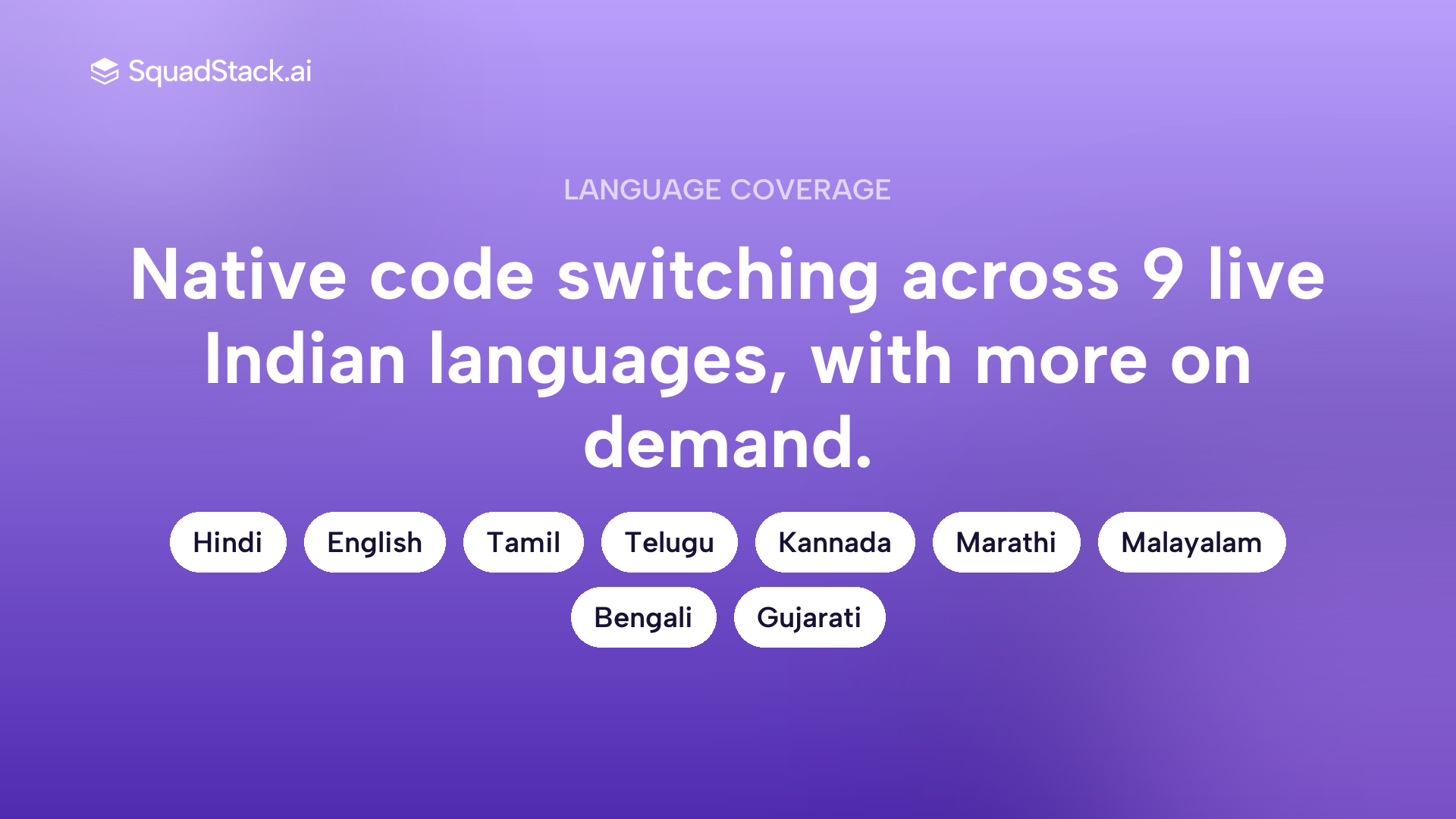
SquadStack runs 50 lakh+ calls daily for 60+ large Indian consumer brands across 9 live languages with native code-switching: Hindi, English, Tamil, Telugu, Kannada, Marathi, Malayalam, Bengali, and Gujarati, with more regional languages are available on demand.
For hyper-personalization, the Sales Decision System chooses the right language, voice, and register for each lead before the call begins. A Hinglish-preferring lead in Mumbai gets a different opener than a Tamil-English bilingual lead in Chennai, automatically.
Book a demo and bring a sample of your real call recordings.
Which AI voice agent is best for handling Hinglish and Indian accents in high-volume sales calls?
SquadStack's voice agents are built on Arth, a proprietary STT model trained on 600M+ minutes of real Indian telephony conversations including code-switched Hinglish. They run at median response latency of 0.8 seconds or less and handle 50 lakh+ calls daily across lending, brokerage, and e-commerce brands in India.
Can AI voice agents handle mid-sentence code-switching between Hindi and English in a live call?
Yes, but only if the speech and language models were trained on code-switched data from the start. SquadStack's agents handle Hinglish natively because the training data includes real call-center conversations where mixing Hindi and English mid-sentence is the standard, not an exception.
What makes an AI voice agent sound natural in Hinglish rather than robotic?
Two things: the speech model must be trained on real telephony audio (not read-speech or YouTube data), and the dialogue must be hand-engineered using transcripts from top-performing human agents. SquadStack's research shows dialogue engineering drives roughly 80% of perceived naturalness. Fillers like "तो देखिए" and backchannels like "जी बिल्कुल" are hardcoded, not generated, so they sound authentic.
How does an AI voice agent detect that a caller has switched languages mid-sentence?
In a natively code-switching model, there is no detection step. The model was trained on mixed-language speech, so it processes Hinglish as its normal input rather than flagging a language change and routing to a separate model. This is why native training data matters more than a translation overlay.
What are the common failure modes when deploying Hinglish voice AI in production?
The most frequent failures are: high word error rates on noisy 8kHz telephony lines, missed Indian entities like PAN numbers or city names, wrong intent classification when key phrases appear in the less-dominant language, and agents that respond in formal Hindi when the customer used Hinglish. Test all four before committing to a vendor.
Can AI voice agents handle collections calls in Hinglish without sounding threatening or off-tone?
Yes, when the dialogue is designed for it. SquadStack's Eval System scores every call on Outcome, Sentiment, and Execution, so tone is monitored on every call and flagged when it deviates. The lead scoring and intent detection layer also adjusts follow-up strategy based on how the call landed.
How do I test a vendor's Hinglish capability before buying?
Run three tests: speak a financial entity (a PAN number or EMI amount) in a natural Hinglish sentence and check if it is captured correctly; interrupt the agent mid-sentence in a different language and see if it responds to what you said; ask an off-script question in Hindi after an English prompt and see if intent is correctly identified. These three scenarios expose most real-world weaknesses.
Does supporting more Indian languages on a voice agent affect response latency?
Not if the architecture is built for it. SquadStack's agents maintain median response latency of 0.8 seconds or less across all nine live languages, because the sub-800ms target is an engineering constraint held across the full language set, not just English.
What Indian languages are available beyond Hinglish for AI voice agents?
SquadStack's voice agents support Hindi, English, Tamil, Telugu, Kannada, Marathi, Malayalam, Bengali, and Gujarati as live languages today, all with native code-switching. More regional languages are available on demand based on business requirements.
How does language choice in an AI voice agent affect sales conversion?
Significantly. Calls made in a customer's preferred language and register see higher engagement and lower early drop-off rates. SquadStack's hyper-personalization layer matches language, voice, and register to each lead's profile before the call, which is a direct input to conversion. The redBus multilingual deployment saw feedback capture 2 to 4x above the human baseline across regional language campaigns.

