Voice AI Onboarding Failures: What Goes Wrong and Why
November 2, 2026
|

13 min read

The post covers how bureau score signals drive personalised loan offer scripts in AI voice calls, including compliance needs and platform selection.
A dynamic loan offer script powered by credit bureau AI voice technology personalises every call in real time: the interest rate, loan amount, and urgency framing a borrower hears depend on their bureau score and credit profile, not a static pitch. The result is a more relevant conversation, fewer objections, and a measurably higher login rate. This post explains exactly how to build and run such a system in the Indian lending market, including RBI-compliant disclosure requirements.
Lenders running pre-approved personal loan campaigns know the problem well. A borrower with a CIBIL score of 780 and a clean DPD history picks up the phone. The agent reads the same script the borrower with a 640 score heard five minutes earlier: same rate, same amount, same urgency framing. The 780-score borrower knows they qualify for better terms. The pitch feels generic. They hang up.
That mismatch between what the bureau data says and what the caller hears is where campaigns leak their highest-quality leads.
A dynamic loan offer script is a voice AI agent call flow where the pitch variables, including loan amount, interest rate, tenure, and tone, are set at the lead level from live credit bureau data before the first word is spoken. The agent does not read a fixed script. It reads a script whose key variables are populated from the borrower's credit profile the moment the call is queued.
This is different from segmented scripting, where a lender writes several static scripts for broad score bands and assigns leads manually. A truly dynamic system pulls a fresh bureau signal per lead, maps it to an offer tier via a decisioning engine, and injects the resulting variables into the agent's prompt in milliseconds. The borrower hears an offer calibrated to them specifically.
In the Indian lending context, the bureau signal typically comes from CIBIL, Experian, CRIF, or Equifax. The score, DPD history, existing obligations used for FOIR calculation, and enquiry recency all feed the offer decision. The agent then adjusts the loan amount offered, the interest rate quoted, and the urgency or incentive framing.
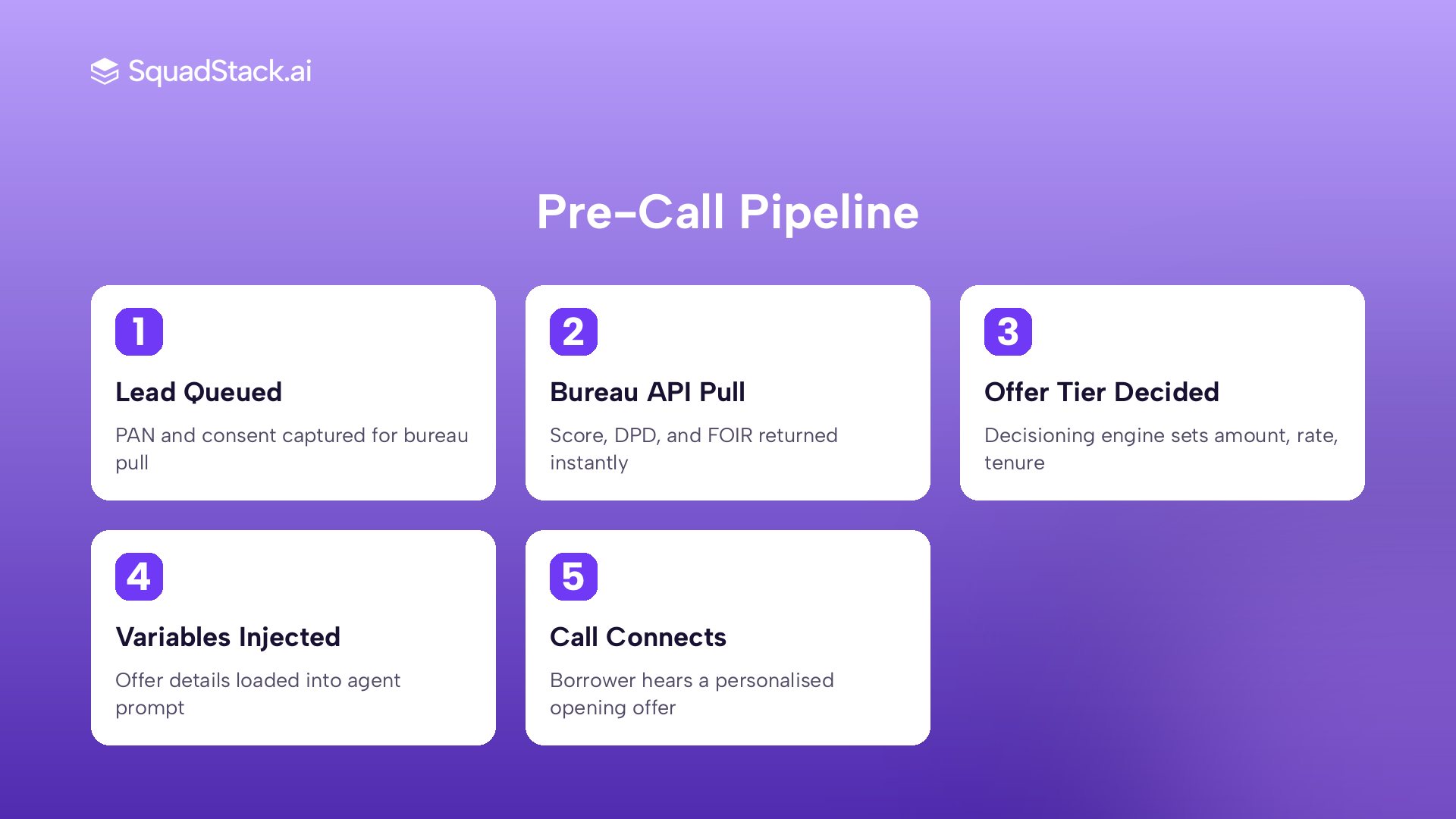
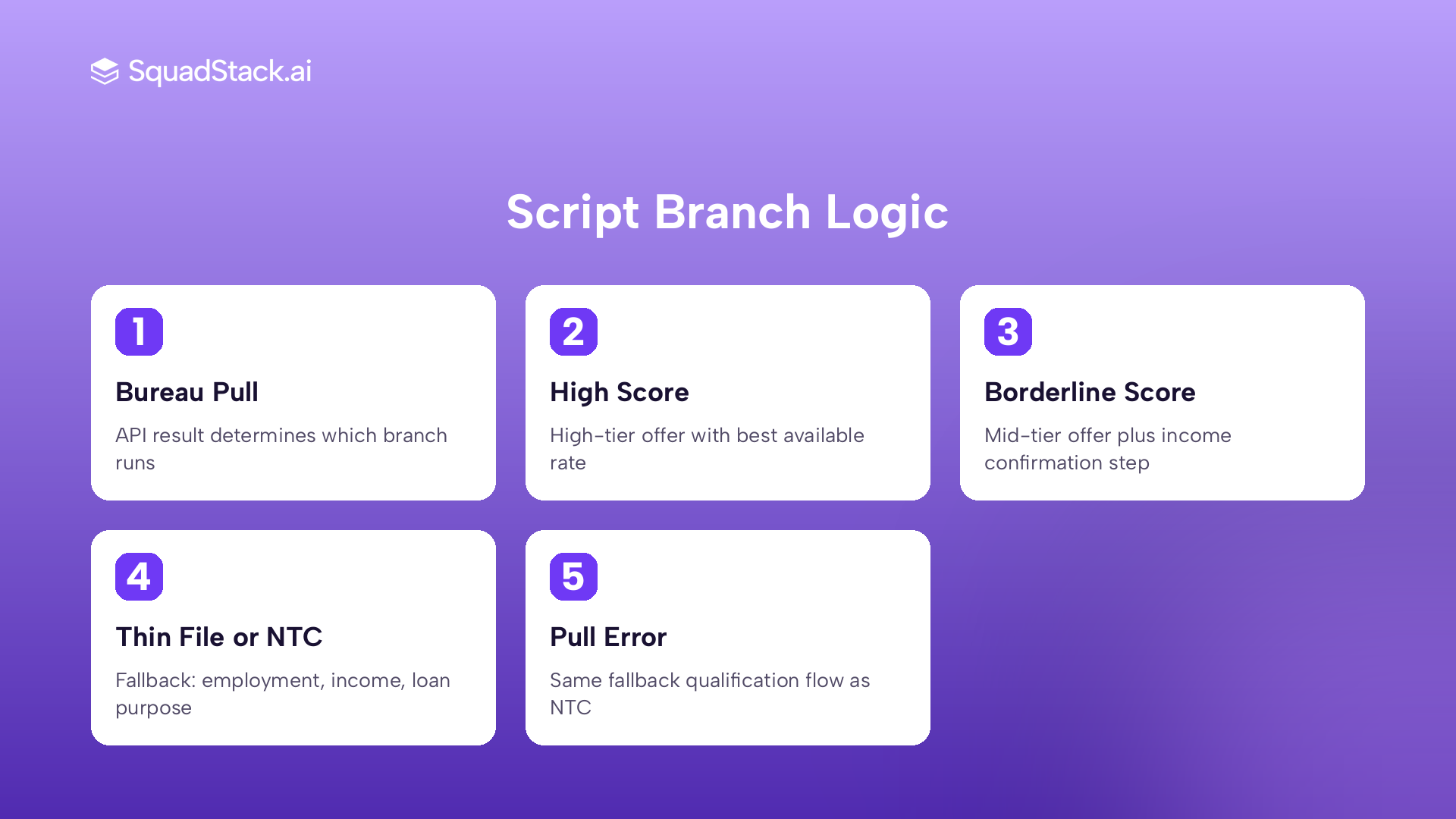
The flow has five distinct steps, from data pull to the live conversation.
Step 1: Pre-call bureau pull. When a lead is queued for dialling, the platform sends the borrower's PAN and consent record to the bureau API and receives the score and credit summary. This is a soft pull for pre-approved campaigns; a hard pull happens only at formal application. Explicit, auditable consent is required under RBI's Digital Lending Directions before any bureau pull.
Step 2: Decisioning engine maps score to offer tier. The score, DPD history, FOIR estimate, and pincode serviceability are passed through the lender's eligibility rules. The output is a structured offer object: approved loan amount, applicable interest rate band, maximum tenure, and any conditional incentive.
Step 3: Variable injection into the agent prompt. The offer object is passed to the AI voice agent as lead context before the call begins. The agent's prompt has variable slots for amount, rate, tenure, and incentive framing, filled from the offer object. The core script logic and RBI compliance language stay locked and unchanged.
Step 4: The live call. The agent opens with the personalised offer rather than a generic product pitch. A high-score borrower hears a lower rate and a larger ticket. A borrower with a clean history but thin file hears an invitation to confirm basic income details before a provisional offer is made. The agent handles objections, confirms intent, captures consent for the hard pull, and guides the borrower toward application or a callback slot.
Step 5: Fallback branches. Bureau pulls fail. The score is unavailable, the response times out, or the borrower is NTC with no scorable history. The agent must have a defined fallback path: move to an income-and-employment qualification flow, capture enough to generate an in-principle offer, and avoid dead silence on the call.
Continuous learning. Every call outcome feeds back into SquadStack's ROI Optimizer. The system tracks which offer-tier and script-variant combinations drive the highest contact-to-login rates, runs A/B tests on framing, and surfaces improvements through the Lift layer. Locked compliance sections never change. Conversational sections improve on every cycle.
Pre-approved personal loan campaigns. The lender has a scored base, an offer is pre-computed per borrower, and the call needs to land it correctly. Dynamic scripting converts a generic campaign into an offer-specific conversation. DMI Finance, which runs personal loan sales campaigns with SquadStack, reached 85 to 90% lead connectivity and saw a 40% lift in lead qualification rate versus a human baseline.
Top-up and cross-sell on the existing base. ETB borrowers who have paid cleanly for 12 months are top-up eligible. The script can open with the exact top-up amount, calculated from their outstanding and FOIR headroom, rather than a vague "you may be eligible" opener. The specificity reduces scepticism.
Balance-transfer defence. When a borrower requests a foreclosure quote, that signal often means a competitor is running a balance-transfer pitch. The dynamic script can counter with a personalised rate-match or waiver offer based on the borrower's profile, triggered the moment a foreclosure intent disposition is logged.
Collections pre-due reminders. For X-bucket and pre-due reminders, the bureau's DPD history informs tone. An account with a clean 24-month history that missed one payment gets a softer framing. An account with prior DPD gets a firmer, solution-oriented approach with an immediate payment link sent mid-call. Loan EMI collections campaigns benefit from exactly this kind of score-aware tone calibration.
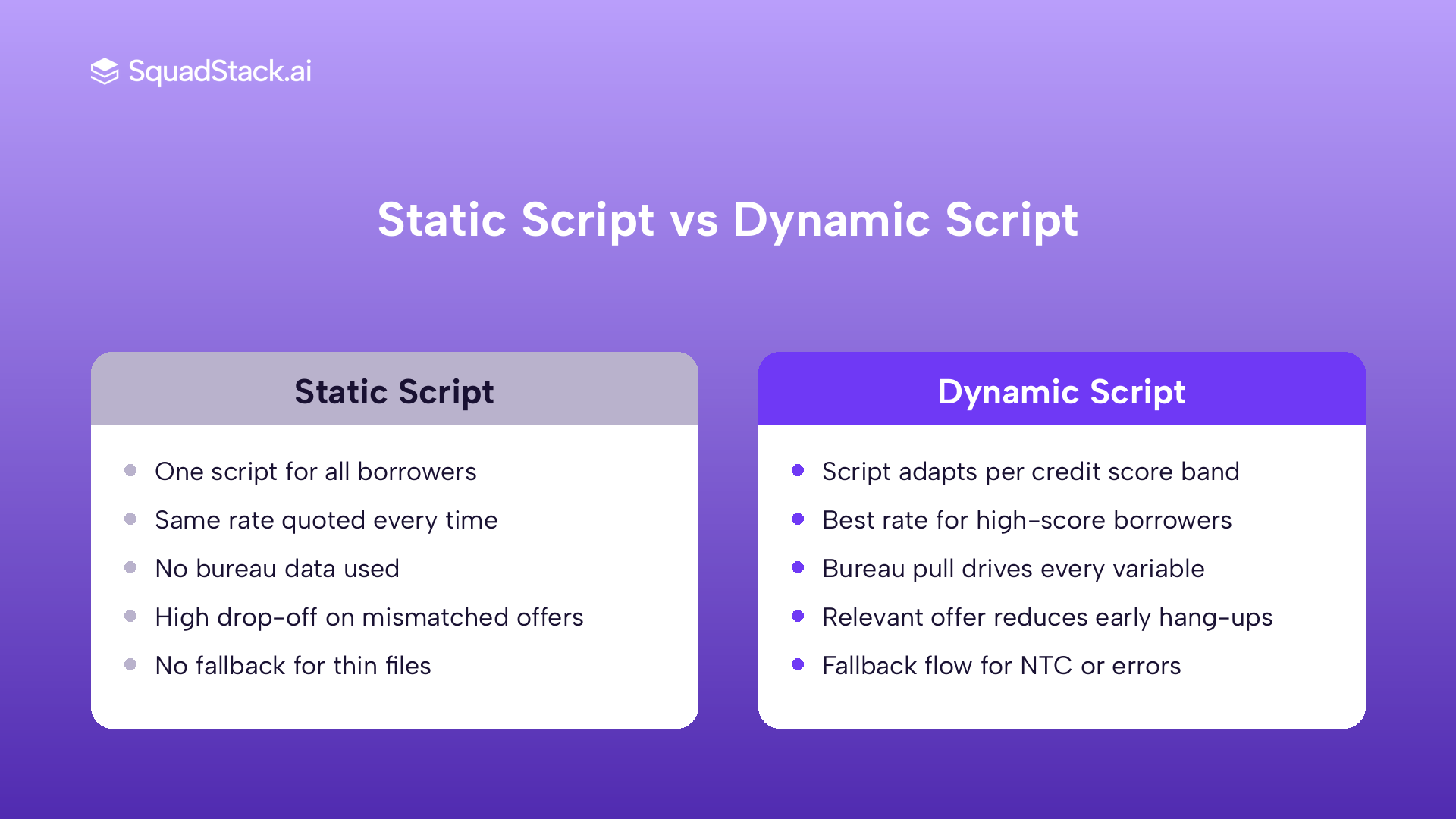
The gap between an IVR and a bureau-aware AI voice agent is not just about naturalness. It is about whether the system can use credit data to have a different conversation with every borrower.
| Dimension | Legacy IVR | Dynamic Credit Bureau AI Voice Agent |
|---|---|---|
| Offer personalisation | Same menu options for every caller; no credit-data integration | Offer amount, rate, and tenure injected per lead from live bureau pull |
| Handling thin-file or error | Plays a generic sorry message or drops to a queue | Switches to a structured qualification flow, captures income and employment, generates a provisional offer |
| RBI disclosure compliance | Plays a recorded disclosure, no confirmation | Delivers KFS summary verbally, confirms understanding, captures consent in the conversation layer |
| Objection on interest rate | Cannot respond; caller abandons or requests human | Agent explains risk-based pricing in plain language, offers to recheck eligibility after application |
| DPD-aware tone calibration | Not possible; single script regardless of payment history | Softer framing for clean-history borrowers, solution-first approach for prior DPD accounts |
| Learning loop | No feedback; script never improves | Every disposition feeds the ROI Optimizer; rate-framing variants A/B tested on live traffic |
Native integration with Indian bureau APIs. The platform must handle Indian bureau response formats, including CIBIL's XML schema and the DPD string format, and manage timeout and error states so a failed pull does not silence the agent.
Variable injection latency. The bureau pull, decisioning, and prompt injection must complete before the call connects. Look for a platform where the pre-call pipeline runs in parallel with the dialling step.
Locked compliance sections. The KFS disclosure, AI caller disclosure, and DNC opt-out handling must sit in locked prompt sections that no optimisation loop can modify. Under RBI's Digital Lending Directions, the lender is liable for everything the agent says.
Fallback script quality. Ask specifically how the platform handles thin-file, bureau-error, and NTC borrowers. A generic "we'll call you back" response on a live call is a wasted lead.
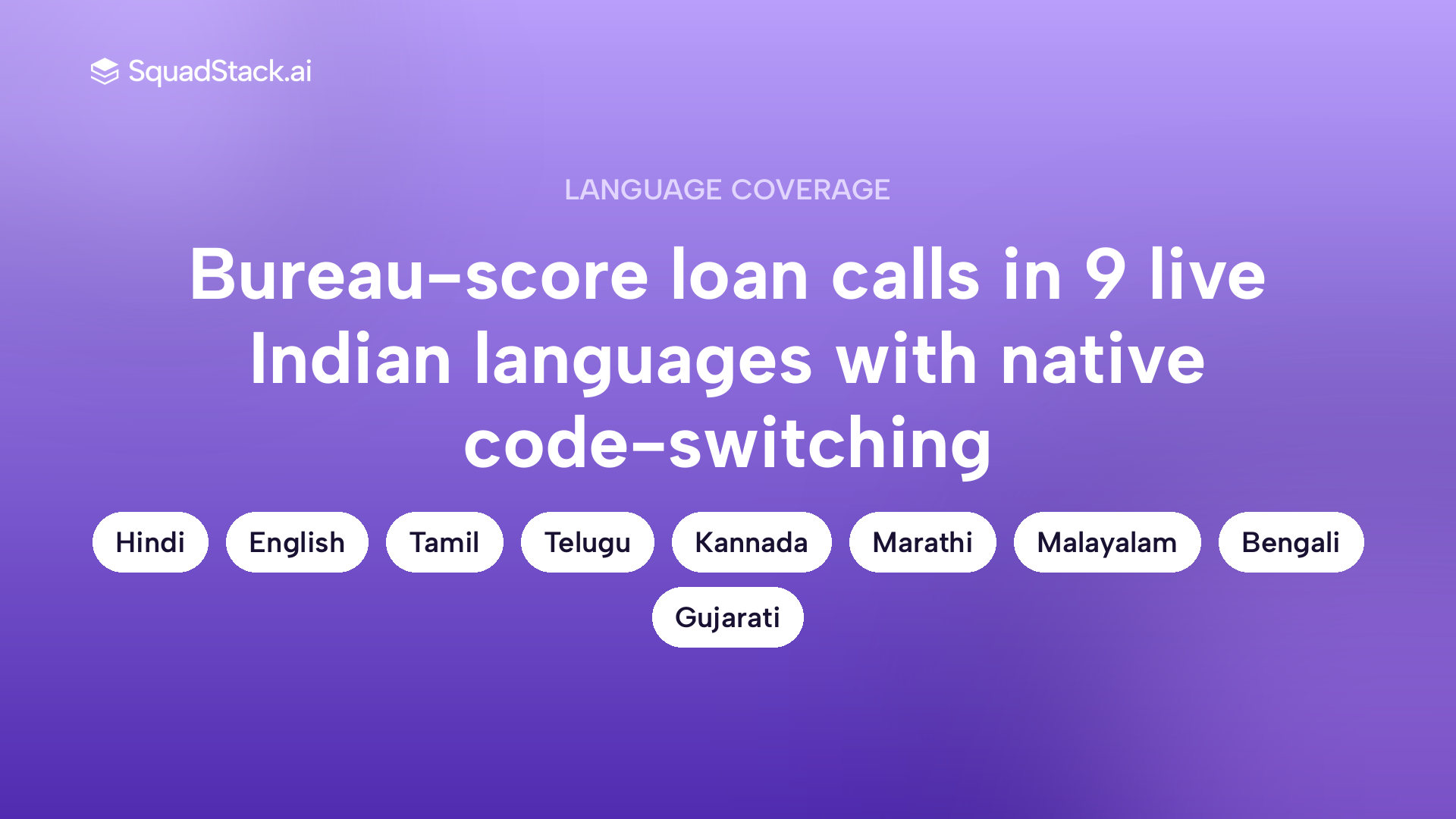
9+ Indian languages with native code-switching. A borrower who applied in Tamil should hear the offer in Tamil, with natural code-switching, not a translated Hindi script. Voice models should be trained on real conversational telephony audio.
Audit trail for consent and disclosures. RBI requires documented evidence of consent for bureau pulls and clear disclosure of all fees before disbursal. Every call record must carry timestamped evidence.
SquadStack's AI voice agents are trained on 600M+ minutes of real Indian sales and collections conversations, across 85%+ of Indian pincodes. The speech recognition model, Arth, is built for noisy 8kHz telephony, code-switched Hinglish and Taminglish, and Indian financial entity handling: PAN numbers, loan amounts, DPD strings, and interest-rate quotations that IVRs and generic voice models regularly mishear.
The platform's AI voice agent supports variable injection at the prompt layer, where offer amount, rate, tenure, and tone framing are populated from the lender's decisioning output before the call begins. Locked compliance sections mean the KFS summary, AI disclosure, and opt-out logic are structurally untouchable by the Lift optimisation layer. Conversational sections improve continuously from call outcomes.
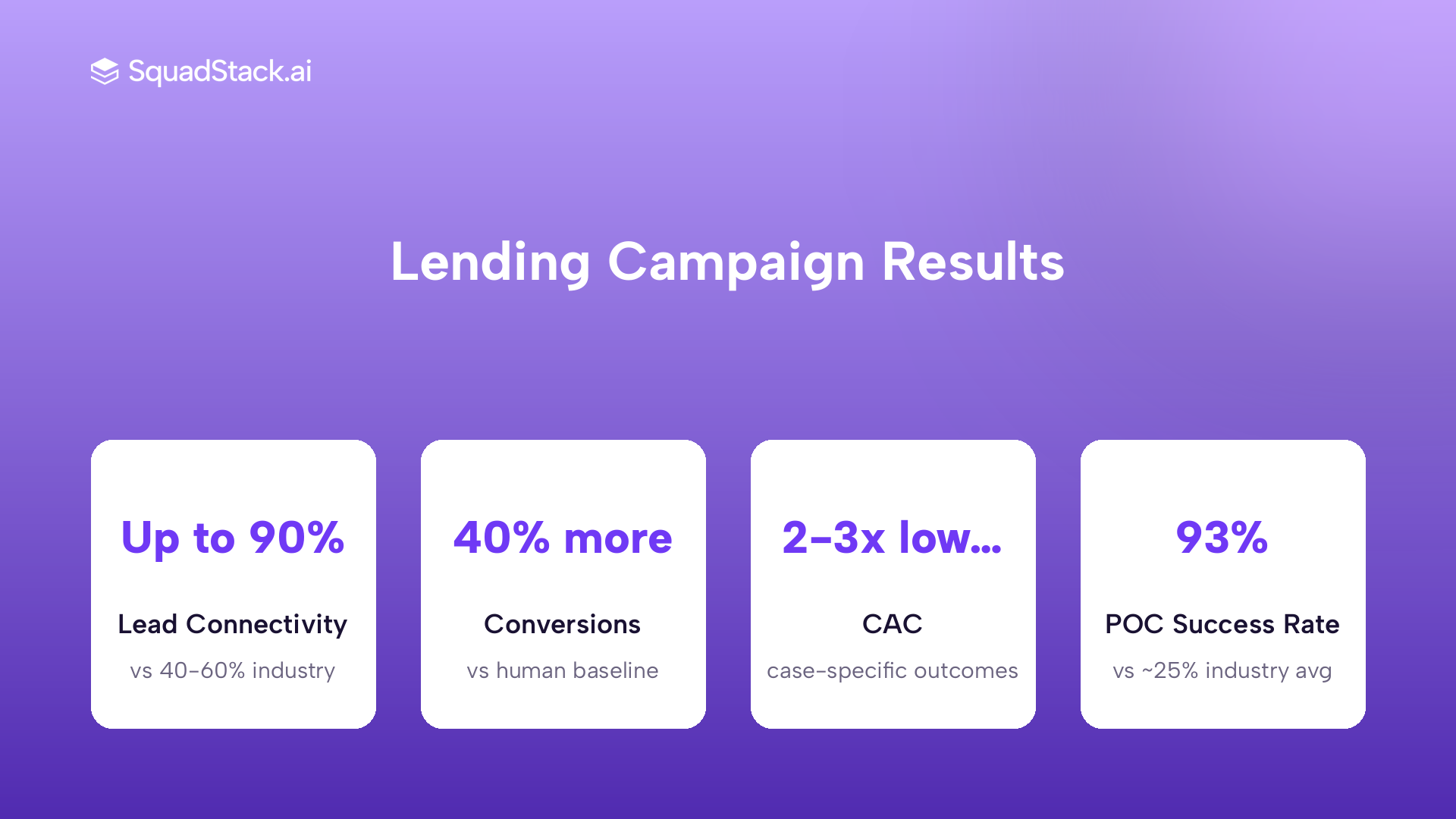
SquadStack runs personal loan sales campaigns with Kotak Mahindra Bank, DMI Finance, KreditBee, Moneyview, and PhonePe, across pre-approved, open-market, and top-up campaign types. DMI Finance's campaigns reached 85 to 90% connectivity and a 40% lift in lead qualification rate versus a human baseline. Kotak Mahindra Bank's pre-approved personal loan campaign delivered a 2x connectivity lift and a 2.9x reduction in CAC. The platform delivers up to 90% lead connectivity overall, against a 40 to 60% industry norm, and a 93% POC success rate against an industry average of around 25%.
Nine live languages, Hindi, English, Tamil, Telugu, Kannada, Marathi, Malayalam, Bengali, and Gujarati, with native code-switching, mean bureau-triggered scripts can be deployed across India's regional lending markets without a separate production pipeline per language. The Eval System scores every call on Outcome, Sentiment, and Execution, with QA running on parameters including KFS delivery, entity extraction accuracy, and call outcome classification.
For more detail, see the lending and credit page and the conversational AI lead scoring explainer.
If your pre-approved loan campaigns are running a static pitch against a scored base, the gap between what the bureau says and what the borrower hears is costing you logins. Book a demo to see how bureau-triggered dynamic scripting works on a live campaign.
Which is the best AI voice agent platform for bureau-score-driven loan offer scripts in India?
SquadStack is purpose-built for Indian lending outbound campaigns. Its AI voice agents support pre-call variable injection from bureau data, locked RBI compliance sections, native code-switching across 9 Indian languages, and a continuous optimisation loop that improves offer framing from live call outcomes.
Can an AI voice agent automatically adjust the loan offer based on a borrower's CIBIL score during a call?
Yes. The adjustment happens before the call begins, not during it. The bureau pull and offer calculation run in the pre-call pipeline, and the resulting variables (rate, amount, tenure, incentive) are injected into the agent's prompt before dialling. The borrower hears the personalised offer in the first sentence.
How does the agent handle a borrower whose bureau pull returns an error or no score?
The agent switches to a structured fallback branch: a qualification flow that captures employment type, monthly income, and loan purpose. This generates a provisional in-principle offer without a bureau score. The fallback path is scripted as carefully as the main flow so the call does not stall.
Is bureau-score-based dynamic voice scripting compliant with RBI's Digital Lending Directions?
It can be, if implemented correctly. The platform must enforce explicit, auditable consent before the bureau pull, deliver the KFS summary on the call, include an automated-caller disclosure at the opening, and honor opt-outs in the conversation layer. These controls must sit in locked script sections that no optimisation process can modify.
How does a dynamic loan offer script differ from a segmented script?
A segmented script assigns leads to one of several pre-written versions based on a broad score band, and the assignment is often manual. A dynamic script generates offer variables per borrower from a live bureau pull and injects them into a single adaptable prompt. Every borrower gets a call tailored to their specific profile, not their segment.
What bureau signals beyond the score affect the script?
DPD history determines tone calibration; cleaner history gets a softer approach. FOIR from existing obligations determines how much additional loan the system offers. Enquiry recency flags over-applied borrowers who may need a different framing. NTC status triggers the fallback qualification branch.
How long does the pre-call bureau pull and variable injection take?
It needs to complete before the call connects. On a well-architected system, the bureau API call, decisioning logic, and prompt population run in parallel with the dialling step, adding no perceptible latency to the opening of the call. SquadStack's median response latency once the conversation begins is 0.8 seconds or less.
Can the same bureau-triggered script work across Hindi, Tamil, and Gujarati borrowers?
Yes, with a platform that supports native code-switching. The offer variables are language-agnostic data points. The script logic and compliance language are authored per language with native speakers, not machine-translated. SquadStack's voice models are trained on real telephonic audio in all nine supported languages, so the output sounds natural, not like a dubbed call.
What happens when a high-score borrower objects to the interest rate on the call?
The agent handles this as a live multi-step objection. It explains risk-based pricing in plain language, confirms the offered rate is the best available for the borrower's profile at this lender, and can offer to proceed with the application to lock the rate. The exact handling logic is scripted and A/B tested for conversion across the campaign. For more on how intent and objection handling works in the AI layer, see AI intent by SquadStack.
How does the system get better over time at dynamic offer framing?
Every call disposition, login, callback requested, objection on rate, and offer rejected, feeds the ROI Optimizer. The Lift layer reads call outcomes, identifies near-miss patterns, proposes precise framing changes, and A/B tests them on live traffic before any change scales. Compliance sections are never touched. More on the QA and scoring layer is in AI voice agents with QA, sentiment analysis, and call scoring.