Voice AI Onboarding Failures: What Goes Wrong and Why
November 2, 2026
|

13 min read
A practical look at how event-triggered AI voice calls use buyer behaviour and CRM context to personalise outreach at scale.
Event-triggered AI voice calls personalisation means a voice agent fires automatically the moment a meaningful buyer action occurs, such as a cart abandonment or a loan application drop-off, and delivers a call that references exactly what just happened. The result is a conversation that feels personal because it is, not because a script was dressed up with a first name. For Indian consumer brands running at scale, this is where AI voice finally earns its place over a WhatsApp nudge or a blast-dial campaign.
Most outbound calling treats every lead the same: same script, same time, same voice, regardless of what that person just did or where they are in the funnel. That is not personalisation. It is bulk calling with a name tag on it.
Event-triggered AI voice calls work differently. A defined business event, a shopper leaving a checkout page, a borrower stopping midway through a loan form, a policyholder whose renewal date is three days away, fires a call at exactly that moment. The AI voice agent already knows what happened. It opens the conversation there, not at the top of a generic pitch.
This post explains how the trigger-to-call flow works, which events drive the best outcomes in Indian consumer sales, and what to look for before you build or buy this capability.
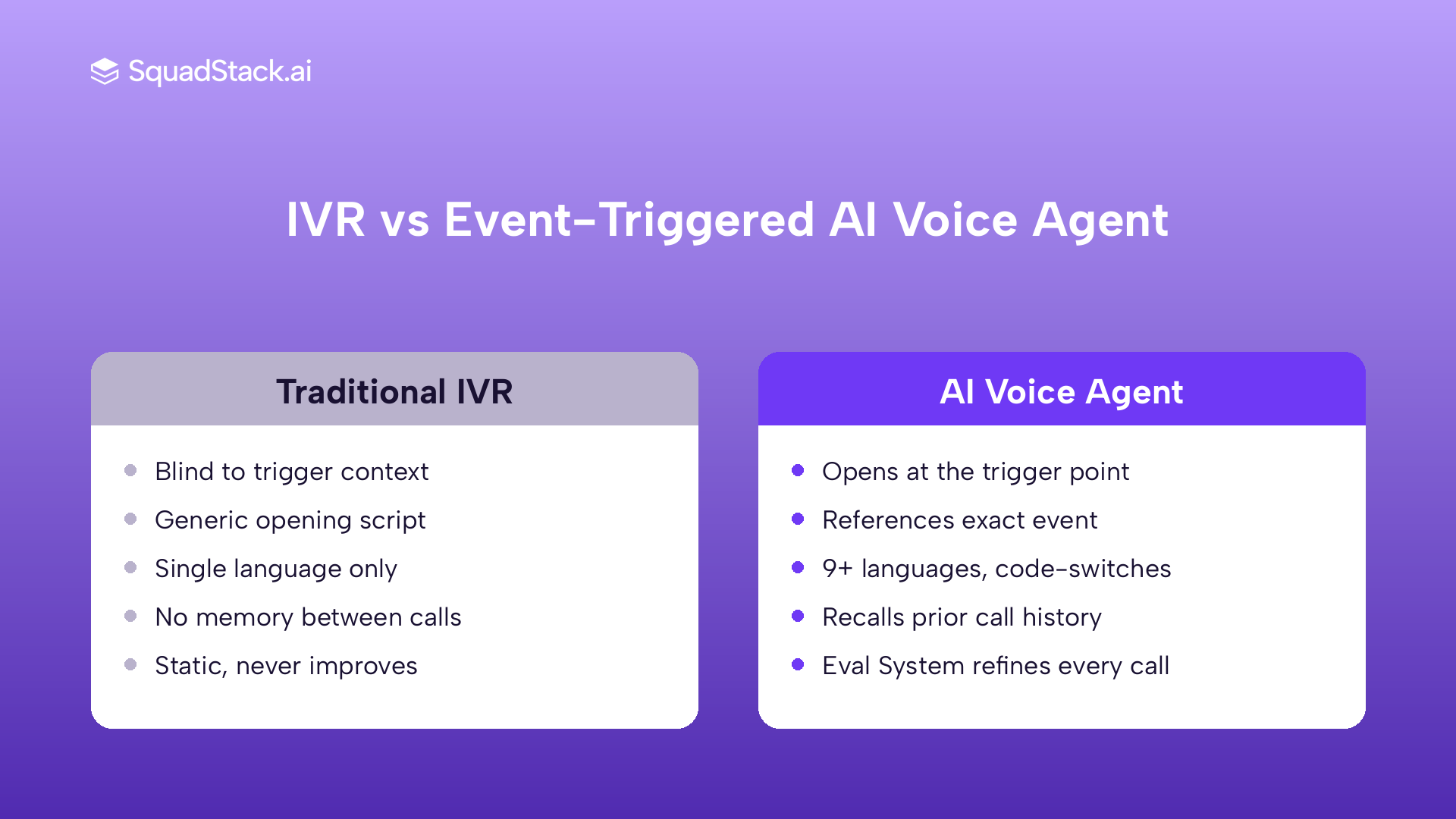
Event-triggered AI voice calls are outbound calls placed automatically when a lead performs, or stops performing, a specific action. The trigger is a real-time behavioural signal. The call is personalised to that signal. Nothing waits for a human to notice the event or queue a callback.
Unlike scheduled campaigns that dial leads in a batch, event-triggered calls are reactive to intent. A lead who just dropped off a form is in a very different state than one whose data was collected three weeks ago. The call content, tone, language, and voice persona are all shaped by what the system knows about that specific person at that specific moment. This is not more variables in a mail-merge; it is a different conversation entirely, built from live context.
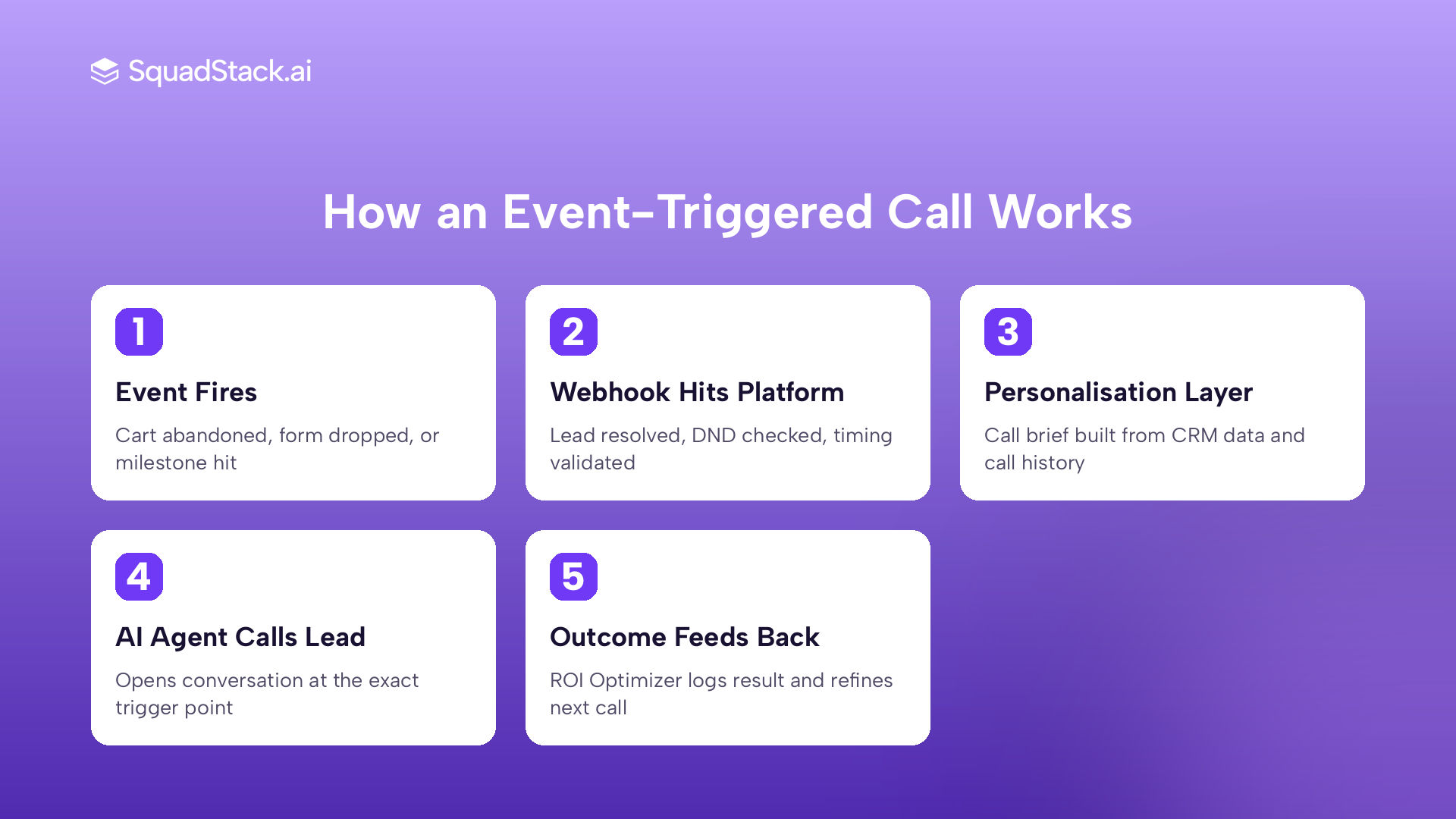
The flow has five steps, and personalisation is mostly resolved before the call connects.
Step 1: The event fires. A webhook from the source system, your CRM, e-commerce platform, LMS, or insurance policy database, sends a structured payload to the calling platform. The payload carries the event type, the lead's identifiers, and relevant context: loan amount applied for, product left in cart, policy expiry date, last completed course module.
Step 2: The lead is resolved and scored. The platform matches the event to a lead record and checks eligibility: is the number on a DND list, has the lead been contacted today, is it within the compliant calling window (9:30 AM to 8:30 PM under TRAI rules)? If the lead passes, a propensity score ranks how urgently to dial. High-intent events, like a mid-form loan abandonment, move to the front of the queue.
Step 3: The personalisation layer assembles the call brief. Before dialing, the system pulls the triggering event, the lead's language preference, prior call history, past objections, and funnel stage. Persistent Memory means a lead who spoke to the agent two days ago does not start from scratch. The agent already knows the loan amount they mentioned, the EMI concern they raised, and where they stopped in the form.
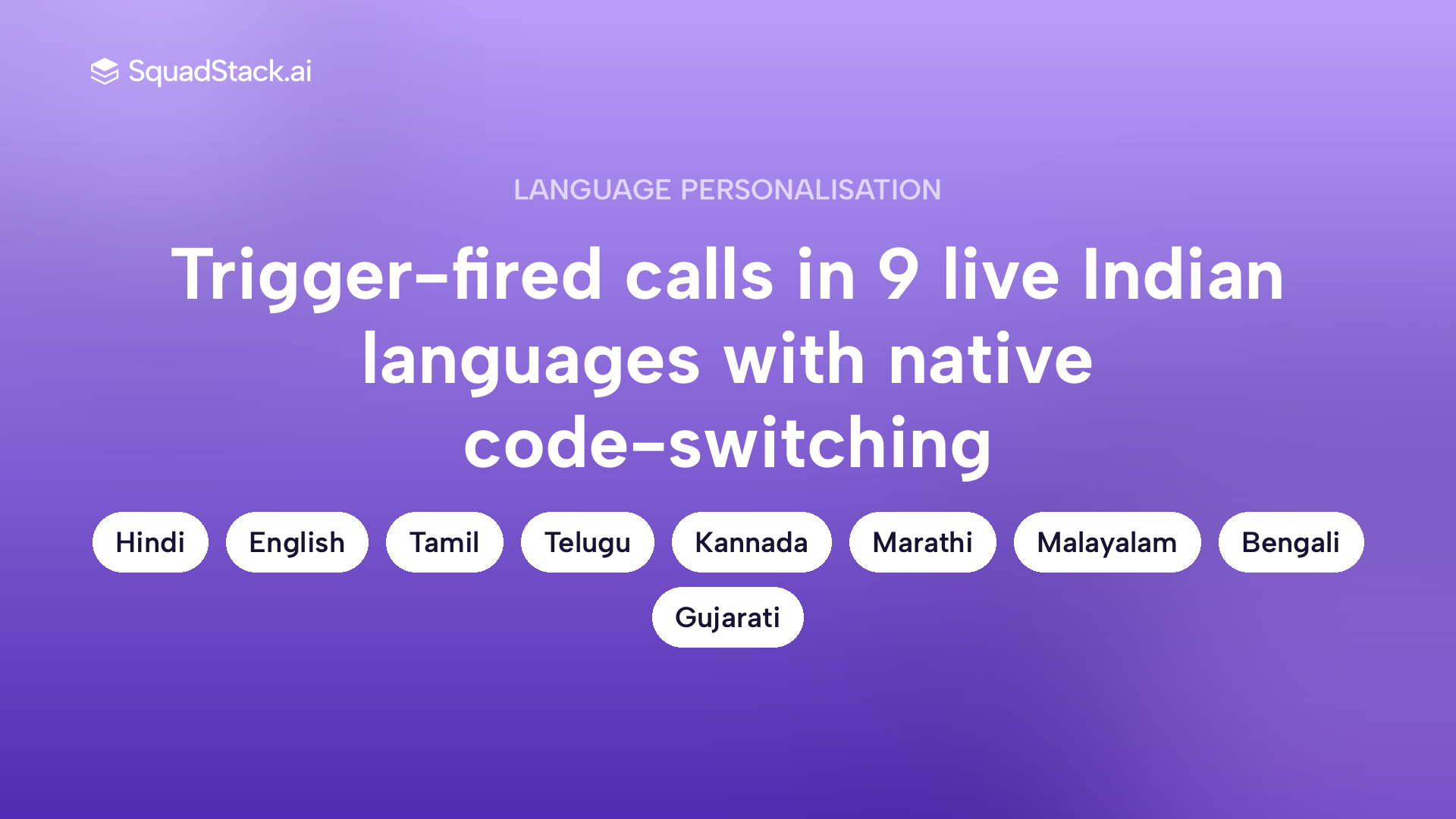
Step 4: The call goes out. The agent opens with a reference to what just happened. A cart-abandonment call begins with the product the person was looking at. A loan drop-off call picks up from the last completed step. The agent holds a natural, two-way conversation in the lead's preferred language, with native code-switching across Hindi, Tamil, Telugu, Kannada, Marathi, Malayalam, Bengali, Gujarati, and English. Median response latency stays at 0.8 seconds or less.
Step 5: The loop closes. Every call outcome feeds back into the ROI Optimizer. Which script framing converted on cart-recovery calls today? Which voice persona drove higher engagement on policy-renewal calls in Marathi? The Optimize layer runs A/B tests across voice, timing, and script simultaneously. Over time, the agent gets sharper on each trigger type without anyone manually reviewing thousands of calls.
Eight trigger types cover most of the high-value moments in Indian consumer sales.
Cart abandonment is the clearest intent signal in e-commerce and D2C. A voice call within minutes of drop-off, referencing the exact product, beats a push notification for customers in vernacular cohorts. Bellavita and Shiprocket both run abandoned cart recovery with SquadStack's voice agents.
Loan application drop-off targets a borrower who completed three of five steps and stopped. A call that opens at the step where they stopped converts at a meaningfully higher rate than one that opens with "are you interested in a loan?"
Policy anniversary or renewal window fires 15 to 20 days before expiry, referencing the specific policy and existing coverage. A leading general insurer running this trigger on SquadStack's platform achieved 85% connectivity and 60% lower renewal cost.
Account activation lag triggers for brokerage when a new demat account is opened but not funded within a few days. A call walking the user through first-trade activation converts far more accounts than an email.
Course completion or drop in edtech fires either an upsell call on completion or a re-engagement call on inactivity, referencing the module last accessed and progress made.
Post-inquiry silence covers leads who submitted a form or chatted on the website but never spoke to anyone. A call within the first hour captures far more leads than a 24-hour callback queue.
EMI pre-due reminder uses a gentle outbound call a few days before the due date, referencing the amount and due date from the CRM, to reduce early delinquency without the friction of a collections interaction.
Onboarding milestone triggers fire when a user completes one step but stalls on the next, such as a rider who passed a background check but has not uploaded documents. The AI voice agent for lead qualification handles these at scale across Delhivery's rider hiring funnel, achieving a 4x lower cost-per-hire.
IVR systems were built to route volume, not to personalise conversations. The gap matters most when a lead's situation does not fit the menu.
| Dimension | Traditional IVR | Event-Triggered AI Voice Agent |
|---|---|---|
| Trigger awareness | Cannot respond to a real-time event; the lead must call in | Fires automatically on the event; lead does not have to initiate |
| Opening context | Plays a generic greeting regardless of what the lead just did | Opens with direct reference to the triggering event and the lead's history |
| Language handling | Fixed to the language of the IVR tree selected; no code-switching | Detects and matches the lead's preferred language mid-conversation, across 9+ Indian languages |
| Objection handling | Routes to a menu option or drops the call if input is unexpected | Handles objections across multiple turns; does not break on off-script responses |
| Memory between contacts | Every call starts cold; the IVR has no record of prior conversations | Persistent Memory carries prior call context, objections, and funnel stage across interactions |
| Outcome learning | No self-improvement; the IVR tree stays static until a human edits it | Every call outcome feeds back into script and timing optimisation automatically |
The clearest illustration is a mid-form loan drop-off. An IVR plays an option menu. The lead presses a number, lands in a queue, and either waits or disconnects. An AI voice agent calls them directly, says "You had applied for a personal loan and completed your PAN verification. Ready to upload your bank statement?", and guides them through the step they stopped at, in one call.
For a deeper look at how conversational AI handles lead scoring and intent in real time, see SquadStack's AI intent and lead scoring approach.
Five questions separate a capable platform from a generic vendor.
Does it support real-time webhook ingestion? The trigger must fire within seconds of the event. A platform that batches leads overnight is not event-triggered; it is a scheduled campaign with a better story.
How deep is the personalisation injection? The system should carry CRM fields, prior call history, funnel stage, and language preference into the call before it connects, not just a name in the opening line.
Can it handle Indian language complexity? Code-switching mid-sentence, Hinglish, Taminglish, and the specific vocabulary of financial products in regional languages are patterns that generic multilingual platforms handle poorly. The training data behind the speech model matters as much as the languages listed on the feature page.
Does it have guardrails for TRAI compliance? Event-triggered calls must still respect DND registries, the 9:30 AM to 8:30 PM calling window, and 140-series number requirements. The platform should enforce these as hard system checks, not manual configurations.
Does it have a continuous learning loop? Conversion from event-triggered calls is highly sensitive to timing and script framing. Those variables should be testable and improvable with each campaign cycle. See conversational AI for lead scoring for more on how real-time scoring improves trigger campaigns over time.
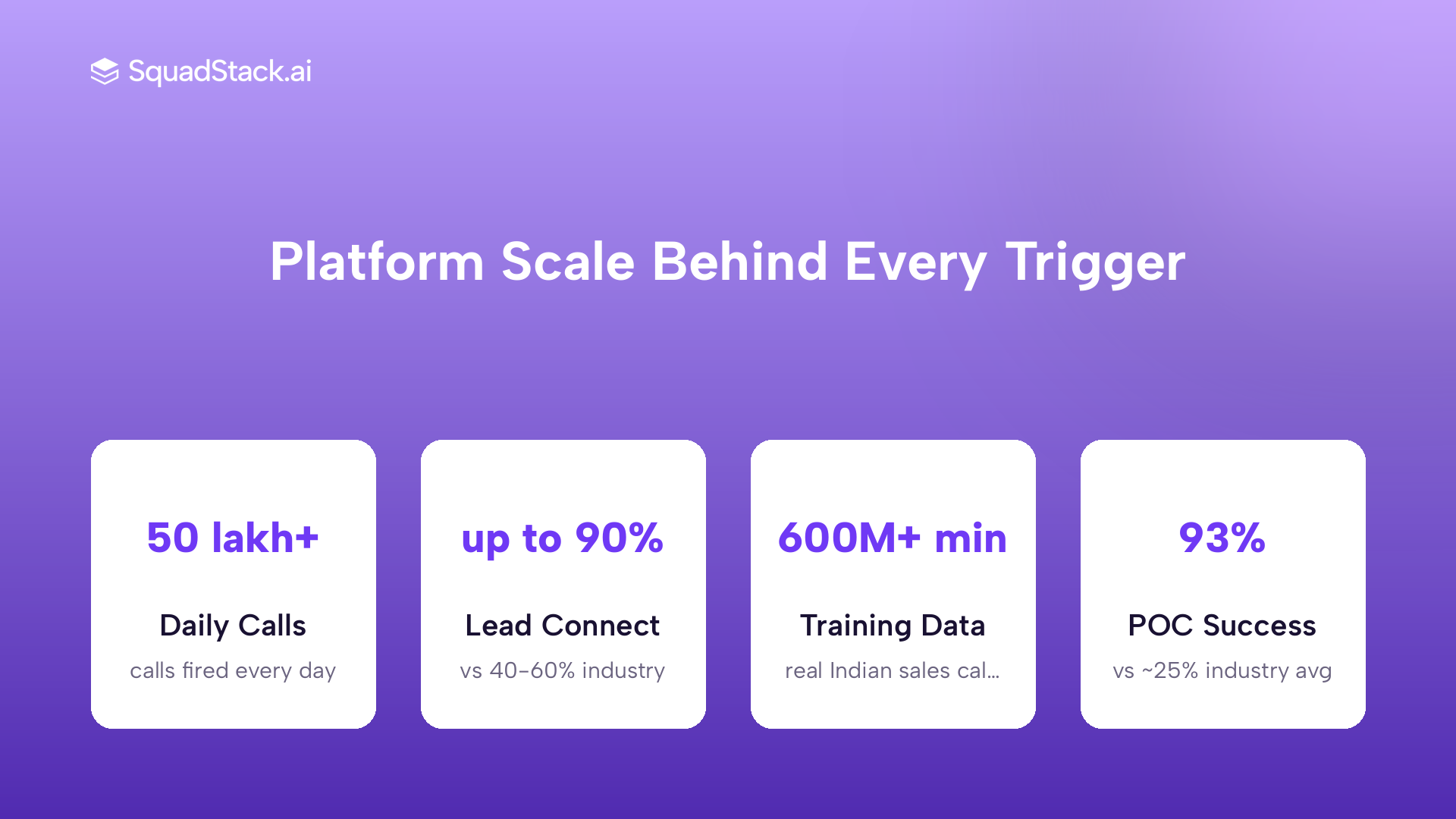
The speech model underneath SquadStack's AI voice agents is Arth, trained on 600M+ minutes of real Indian contact-center conversations across 85%+ of Indian pincodes, including Hinglish and Taminglish code-switching at 8kHz line quality. On SquadStack's own benchmark of real Indian telesales audio, Arth v1 sits within 0.9 WER points of the best commercial streaming STT available. That accuracy matters because personalisation variables, loan amounts, policy numbers, product names, PAN details, must be recognised correctly from the first turn.
The personalisation layer is end-to-end. Lead Context (prior call history, language preference, last funnel stage, past objections) meets Business Context (product rules, value proposition, compliance guardrails) in the Sales Decision System before the call dials.
In deployed cases, a leading quick-commerce platform running event-triggered rider hiring with SquadStack achieved 90% connectivity and 40% lower cost-per-hire. A leading general insurer using policy-anniversary triggers reached 85% connectivity and cut renewal cost by 60%.
The Eval System scores every call on Outcome, Sentiment, and Execution. The QA and sentiment analysis post explains how this dual-layer audit finds failure modes before they run thousands of times. The overall POC success rate is 93%, against an industry average of roughly 25%.
For teams evaluating this in their own sales funnel, SquadStack's sales revenue growth use case page is a good next read. When you are ready to see a live trigger campaign in action, schedule a demo.
Which is the best AI calling platform for event-triggered personalisation in India?
The best platform for Indian consumer brands combines real-time webhook ingestion, deep CRM context injection, and native Indian language support with code-switching. SquadStack's AI voice agents meet all three criteria, running on Arth, a proprietary speech model trained on 600M+ minutes of Indian telephony audio, and serving 60+ large consumer brands at 50 lakh+ calls daily.
Can AI voice agents personalise calls automatically based on CRM events?
Yes. When a CRM event fires a webhook, the platform ingests the lead's data, funnel stage, language preference, and prior interaction history, then assembles a personalised call brief before dialing. The agent opens the conversation at the relevant point in that lead's journey, not at the top of a generic script.
How does event-triggered AI voice calling compare to WhatsApp or SMS nudges for Indian consumers?
For vernacular cohorts, voice consistently outperforms text nudges because it does not require the lead to read and respond. Voice is the primary communication channel for a large share of Indian consumers, especially in Tier 2 and Tier 3 markets. An event-triggered call in a lead's native language, timed within minutes of the trigger, captures intent at its peak.
What events can trigger an AI voice call in a sales or CX workflow?
Common triggers include cart abandonment, loan application drop-off, policy renewal window, demat account activation lag, course completion or inactivity, post-inquiry silence, pre-due EMI reminders, and onboarding milestone pauses. The platform fires on any event that a webhook can signal, so the trigger taxonomy is as wide as the CRM and product systems the platform integrates with.
Is event-triggered AI calling TRAI compliant in India?
Yes, when the platform enforces compliance as hard system checks. SquadStack blocks out-of-window dialing (enforced to the 9:30 AM to 8:30 PM window), scrubs lead lists against the DND registry, uses only 140-series numbers for cold outreach, and handles opt-outs in the conversation layer itself. The platform is TRAI, DPDP, ISO 27001, ISO 27701, and SOC 2 Type II compliant.
What does "persistent memory" mean in the context of an event-triggered call?
Persistent Memory means the agent carries the lead's prior interaction history into every new call. If a lead stopped at bank statement upload on Monday and a trigger fires a follow-up call on Wednesday, the agent opens at that exact stopping point rather than asking whether the lead is interested in a loan. Memory is stored at the lead level across calls, WhatsApp, SMS, and in-app interactions.
How quickly can an AI voice agent call after a trigger event fires?
Trigger-to-dial time depends on the platform's ingestion and scheduling architecture. The system checks DND status, call eligibility, and the active calling window before placing the attempt. Within the compliant window, high-priority events such as mid-form loan drop-offs are queued immediately, with the attempt going out within minutes of the trigger.
How does the system improve over time on event-triggered campaigns?
Every call outcome, converted, dropped, rescheduled, or objection raised, feeds back into the ROI Optimizer. Native A/B testing (Optimize) runs experiments across script framing, voice persona, and call timing simultaneously on live traffic. Lift, the self-improvement layer, reads near-miss and early drop-off calls to propose precise script edits, each reviewed by a human before being tested on a small traffic slice and progressively ramped if it wins.
Can the same AI voice agent handle multiple trigger types across different products?
Yes. The Sales Decision System resolves the right script, language, persona, and value proposition per trigger type and per lead within a single campaign. One agent can carry multiple products or audience segments, with the call brief assembled dynamically from the triggering event and the lead's CRM context. What the call covers and how it covers it is decided at the time of the trigger, not at the time of campaign setup.
What does SquadStack's event-triggered setup look like in practice?
Engagement starts with a roughly two-week setup: solutioning (defining trigger types, webhook fields, personalisation variables, and the pilot success metric), agent build (trained on the client's real call recordings, knowledge base, and FAQs), integration, and UAT. The dedicated squad includes an AI Agent Product Manager, a Forward Deployed Engineer, a Conversational AI Designer, and a QA specialist. The pilot runs on real leads with real traffic, not a sandbox. For AI agents in sales operations, this managed model is what keeps a 93% POC success rate.