Just Launched

Icon Introducing persistent memory

Introducing Persistent Memory: Your Voice AI Agent Now Remembers Every Conversation

Just Launched

Icon Humanoid Vision Agent

Introducing Persistent Memory: Your Voice AI Agent Now Remembers Every Conversation

Introducing Persistent Memory: Your Voice AI Agent Now Remembers Every Conversation

SquadStack's Persistent Memory gives voice AI agents lead-level context across calls, so follow-ups pick up where the last conversation left off, not from scratch.

April 8, 2026

  •  

4 Minutes

  •  
Apurv Agrawal

Apurv Agrawal

Introducing Persistent Memory: Your Voice AI Agent Now Remembers Every Conversation

Contents

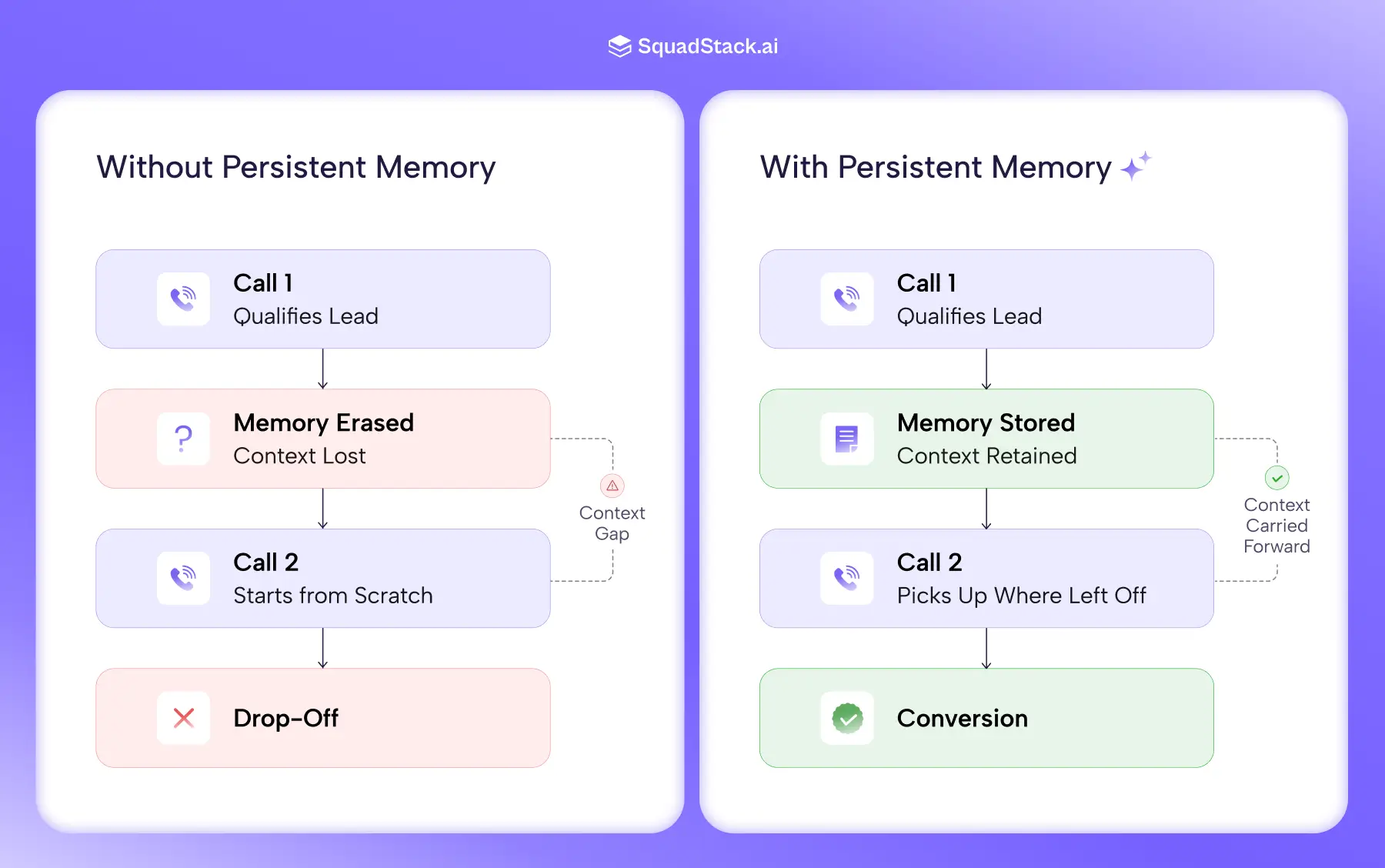
A lead starts a personal loan application on Monday. Your AI agent calls, confirms their income and loan amount, and walks them through PAN verification. The lead completes PAN but drops off at bank statement upload. Says they'll do it later from their laptop.

Wednesday arrives. Your agent dials them. Opens with: "Hi, I'm calling from [company]. Are you looking for a personal loan?"

The lead hangs up.

That's what stateless voice AI costs you. Every call starts cold. Every returning lead gets treated like a stranger. For businesses running multi-touch outbound campaigns or handling repeat inbound calls, this is where revenue leaks.

We built Persistent Memory to fix it.
How it works

Persistent Memory adds a lead-level memory layer that carries across interactions within your campaigns.

Every lead is identified through a secure, masked fingerprint within your campaigns. When a call ends, the system extracts specific data points you've defined and stores them against that lead's identity. When the same lead is reached again or calls back, the agent retrieves that stored context before the conversation begins.

Your follow-up call opens with "You'd completed PAN verification last time. Ready to link your bank statement?" instead of restarting the entire application. The lead never repeats themselves.

What you configure

You define what the agent extracts from each call, written in plain language with no engineering dependency. Up to 20 extraction points per agent.

Examples of what you can extract:
  • Callback preferences and preferred time slots
  • Stated objections and reasons for hesitation
  • Last completed application step and drop-off point
  • Product interest, budget range, tenure preference
  • Sentiment signals and engagement level

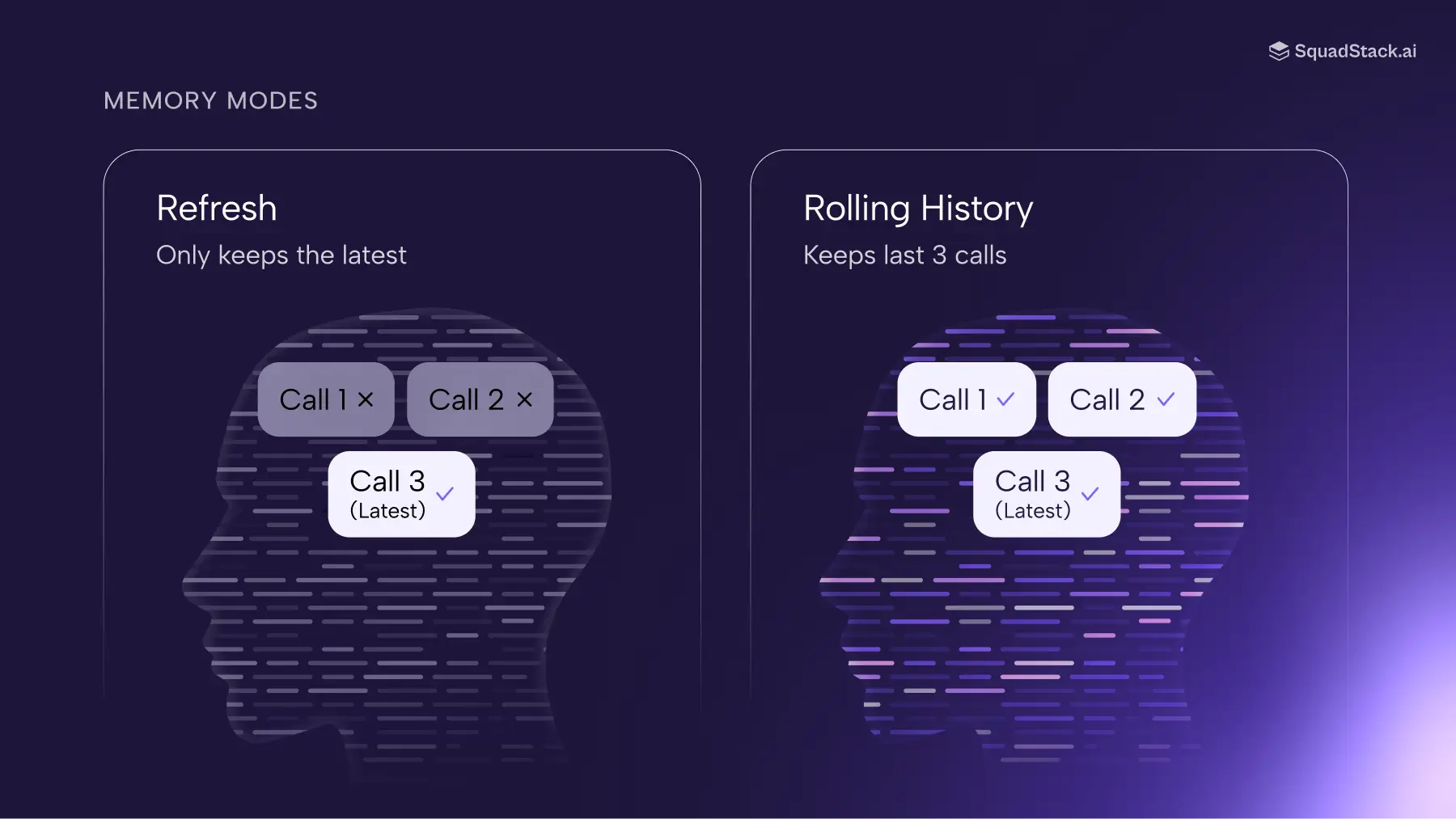
Two memory modes

  • Refresh: Replaces previous context with the latest from each call. Best when only the most recent response matters, like updated preferences or rescheduled callbacks.
  • Rolling History: Retains context across the last few calls, so the agent can track how a lead's position has shifted over time. Built for multi-step campaigns where the full arc matters.

Two ways to surface context

  • Pass-through: Delivers data points exactly as captured, directly into the agent's context before the call. Eg.: "Loan amount: 5L. PAN: verified. Bank statement: pending. Last completed step: PAN verification."
  • AI-summarized briefing: Processes stored memory through a summarization layer before the call begins. Instead of a flat list, the agent gets a distilled briefing: a two-sentence history, a suggested opening line, or the single most relevant data point for this stage. You configure the instructions once. The system applies them to every returning lead automatically.

Where Memory Moves the Needle

  • Multi-step outbound campaigns: Qualification, objection handling, and commitment happen across three to five calls over a week. Each call now has access to what came before. The journey progresses instead of restarting.
  • Follow-ups on specific requests: A lead says "call me back Thursday after 4 PM." The agent that calls on Thursday knows exactly why it's calling, what was discussed, and what the lead cares about.
  • Partially completed applications: A lead verified PAN but dropped off at bank statement upload. Another completed everything except e-sign. The next call picks up from the exact step where they stopped, not from the beginning of the funnel.
  • Repeat inbound calls: When a lead calls in for the second or third time, the agent has the full context of prior interactions. The lead doesn't repeat themselves.

Every voice AI platform can handle a single call. The problem has always been what happens between calls. Persistent Memory fixes that. Each call builds on the last. That's what turns a sequence of dials into a campaign that actually converts.
FAQ's

arrow-down

arrow-down

arrow-down

arrow-down

arrow-down

Book a Consultation Now

Learn how you can outsource a Telecalling team with SquadStack!
We respect your privacy. Read our Policy.
Have specific requirements? Email us at: sales@squadstack.com

Book a Consultation Now

The search for a telecalling solution ends here

Join the community of leading companies
star

Related Posts

View All