

Top AI Outbound Calling Tools in India: Features Compared
October 23, 2026
|

13 min read

Explore how native Kannada and Malayalam voice AI handles code-switching and dialect gaps to improve conversions in South India.
TL;DR: A Kannada Malayalam AI voice agent for South India can materially lift contact and conversion rates in Karnataka and Kerala, two states most AI voice vendors treat as afterthoughts. The difference between "supporting" a language and sounding native in it is wide, and it shows up in dropout rates and sales numbers. SquadStack runs both Kannada and Malayalam as live production languages, trained on 600M+ minutes of real Indian sales conversations.
Key Takeaways
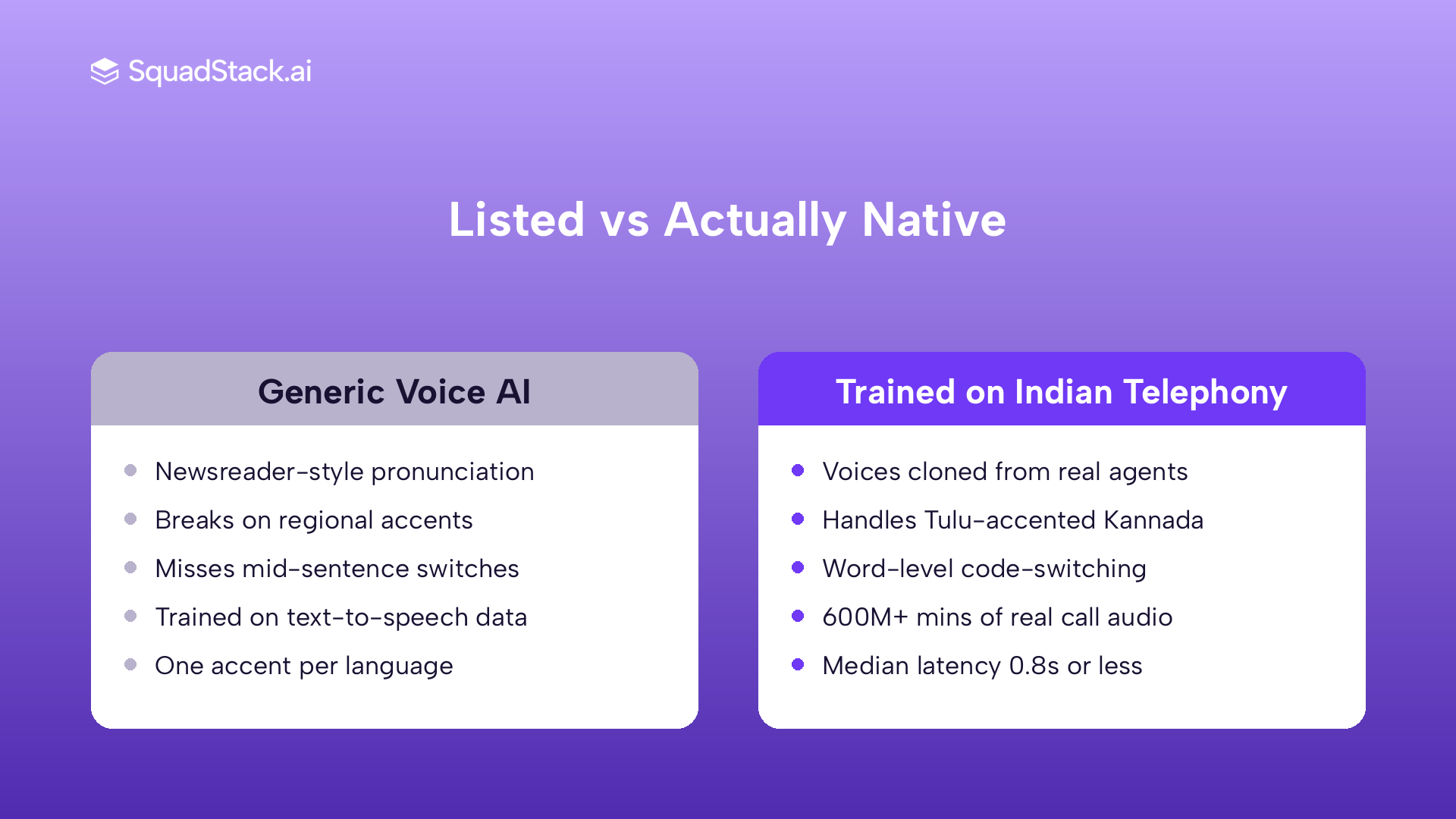
Most AI voice vendors list languages the way a product brochure lists features. Supporting a language and sounding native in it are two different things.
Karnataka and Kerala together represent tens of millions of consumers buying insurance, taking personal loans, opening brokerage accounts, and enrolling in edtech courses. Yet the AI voice stacks calling these customers typically sound like a newsreader from a different city, or worse, like a Hindi speaker reading a phonetic transliteration.
Callers recognize the artificiality within seconds and disconnect. Contact rates fall. Conversions stall. The South India opportunity remains unrealized, not because the market is absent, but because the voice AI is not built for it.
This post explains what Kannada and Malayalam actually require from an AI voice agent, how the call flow works, and what a serious deployment across both states looks like in practice.

Kannada and Malayalam are Dravidian languages with phonetic structures that differ substantially from Indo-Aryan languages like Hindi. A voice model that performs well on Hinglish does not automatically transfer.
Kannada uses a syllabic script with 49 base characters and a large set of consonant clusters. Spoken Kannada varies significantly across regions. Bengaluru Kannada is heavily code-switched with English, particularly in professional and financial contexts. Coastal Karnataka has a substantial Tulu-speaking population whose speakers often mix Tulu phonemes into their Kannada. A generic model treats this as noise or misrecognizes it entirely.
Malayalam is one of the phonetically richest languages in India, with sounds that have no equivalent in other major Indian languages. The written and spoken forms diverge considerably, so models trained on text corpora or read-speech perform poorly on actual phone calls. The Malabar region has distinct vowel patterns and vocabulary that differ from central or southern Malayalam. An agent tuned only on standard Thiruvananthapuram Malayalam will confuse callers in Kozhikode.
Both languages show high rates of natural code-switching with English. A customer asking about a loan EMI in Kannada will drop in terms like "interest rate" or "credit score" without switching languages consciously. The agent must handle this mid-sentence, not just mid-conversation.
For a deeper look at how multilingual voice AI handles these challenges, see SquadStack's guide to voice AI for Indian languages.
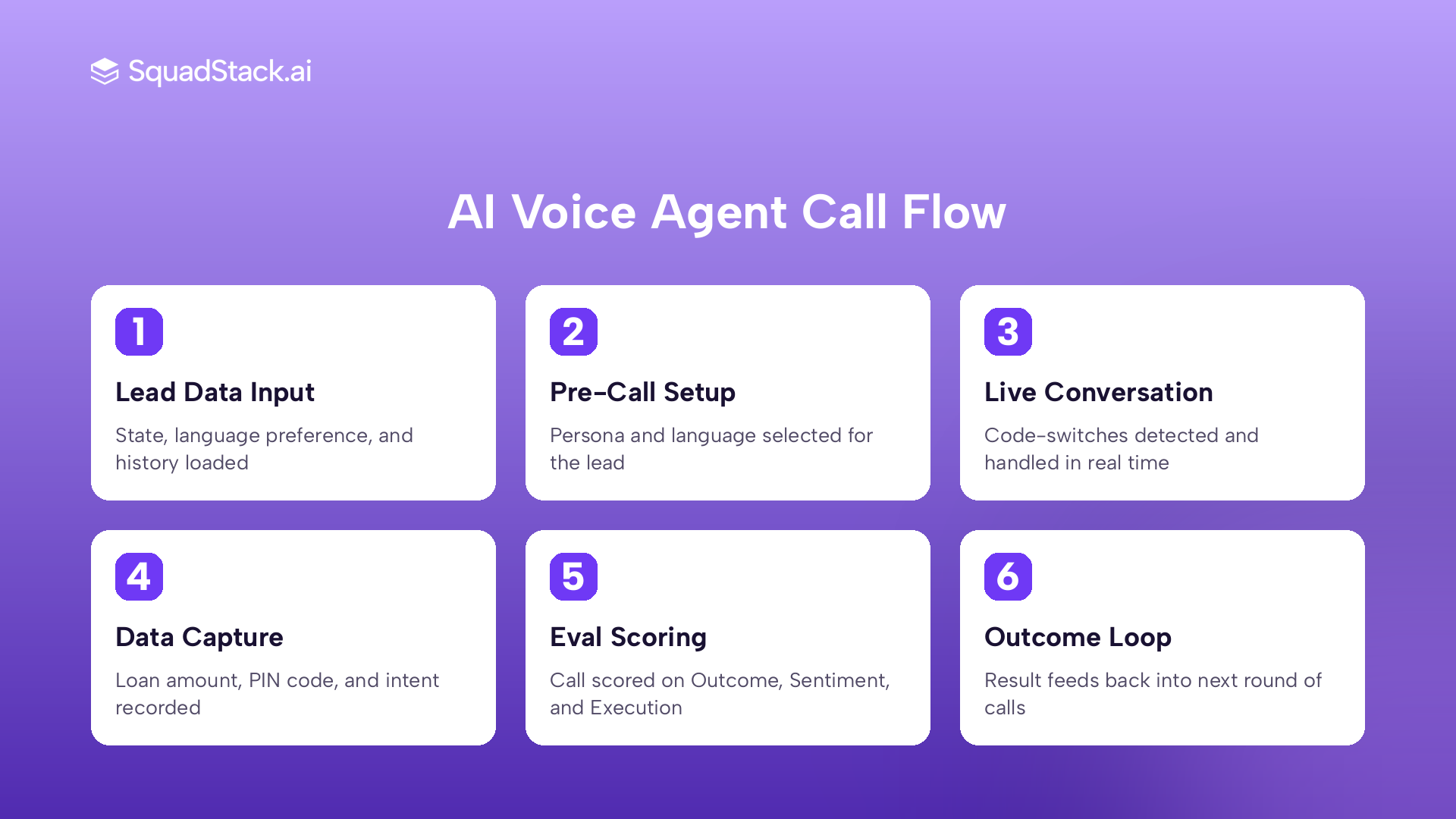
An effective AI voice agent for sales follows a predictable sequence, but the intelligence is in the details.
Step 1: Pre-call language and persona selection. The system reads available lead data including geography, past interaction history, and stated language preference. A lead from Mangaluru gets a Kannada-default agent. A lead from Thrissur gets Malayalam. The voice persona is selected from a library of over 1,000 voices cloned from real, top-performing Indian sales agents.
Step 2: Opening and language confirmation. The agent opens in the pre-selected language. If the customer responds in a different language or switches mid-sentence, the agent follows at the word level, not just the turn level.
Step 3: Qualification and conversation. The agent runs the sales or qualification flow, managing objections, capturing structured data like loan amounts or preferred callback times, and adapting tone to the customer's responses. Indian entity handling, including names, PIN codes, and financial terms in Kannada or Malayalam, is built into the speech recognition layer.
Step 4: Warm transfer or follow-up. High-intent leads can be transferred live to a human team with full context passed. Others receive a scheduled callback booked by the agent.
Step 5: Continuous learning. Every call feeds back into the system. The ROI Optimizer captures outcomes, identifies where calls dropped or converted, and surfaces improvements to script, timing, and approach. This loop runs across every language, including Kannada and Malayalam.
Insurance renewals and lead qualification. Karnataka and Kerala have high insurance penetration relative to other Indian states. Customers here are quick to hang up on anything that sounds robotic. Native-language calling reduces early disconnect and improves the share of calls that reach meaningful conversation. A leading general insurer running Voice AI with SquadStack achieved 85% connectivity and 60% lower renewal cost.
Lending and NBFC collections. Personal loan pre-approvals, merchant loan qualification, and early-stage collections all depend on trust. A customer in Bengaluru who gets a loan call in fluent Bengaluru Kannada with natural code-switching is more likely to engage than one who receives a stilted Hindi call. The leading gold loan NBFC case study shows what this looks like in a real BFSI deployment.
Edtech lead qualification. EdTech companies chasing students and working professionals in Karnataka and Kerala need agents that handle a mix of Kannada, Malayalam, and English in a single call. These leads often speak to multiple providers the same day, so a natural-sounding call matters.
Brokerage account opening. AngelOne runs demat account opening with SquadStack. South Indian customers expecting a call in their language and receiving one in Hindi often disengage before the pitch begins.
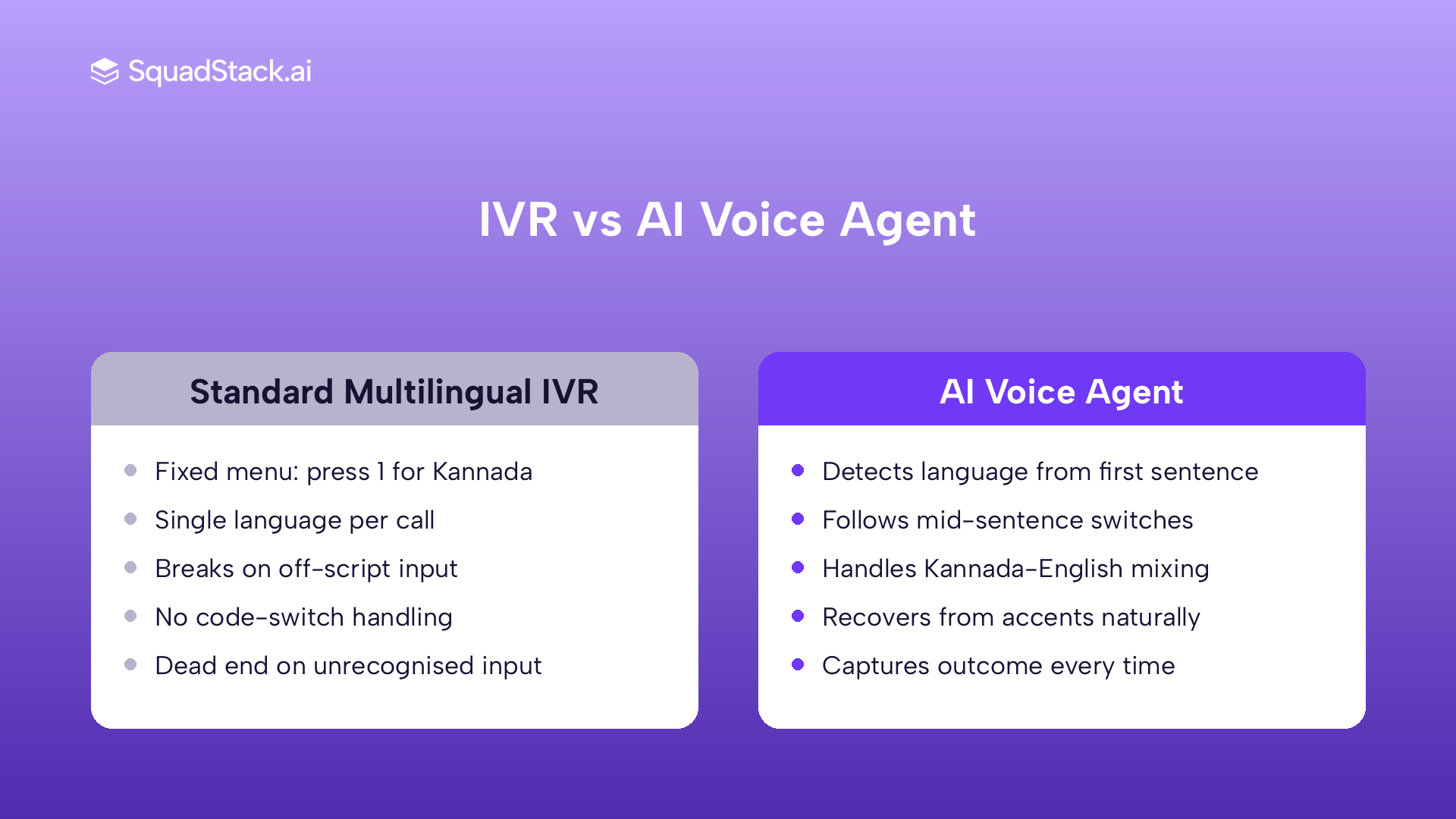
| Dimension | IVR | AI Voice Agent |
|---|---|---|
| Language handling | Fixed menu in one language; switching requires a separate IVR tree | Detects and switches language mid-call, including Kannada-English or Malayalam-English code-switching |
| Dialect tolerance | None. Tulu-accented Kannada or Malabar Malayalam breaks recognition | Trained on real Indian telephony audio including regional speech patterns |
| Customer experience | "Press 1 for Kannada, press 2 for Malayalam" | Converses naturally from the first word in the customer's language |
| Objection handling | Cannot respond to off-menu input | Handles objections across multiple turns in the customer's language |
| Response speed | Instant playback of a pre-recorded clip | Median latency of 0.8 seconds or less for a generated, context-aware response |
| Data capture | Keypad input only | Extracts structured entities (loan amount, name, PIN code) from spoken conversation |
The IVR approach breaks on South Indian campaigns because it cannot handle code-switching, dialect variation, or off-script responses. An AI voice agent built on real Indian telephony data handles all three.
Training data origin. Was the model trained on public datasets, YouTube audio, or actual telephone-quality sales calls? Indian telephony runs at 8kHz with background noise, packet loss, and code-switched speech. A model tuned on clean studio audio will fail on production calls.
Code-switching fluency. Ask for a live demo in Kannada-English and Malayalam-English. Watch whether the agent switches at the word level or only at turn boundaries. Native bilingual speakers notice the difference immediately.
Dialect coverage. Ask specifically about Tulu-influenced Kannada and Malabar-region Malayalam. If the vendor cannot answer, the model was probably not tested for them.
Voice naturalness. Most TTS models are trained on read-speech and sound formal, like a newsreader. Voices cloned from real sales agents on actual phone calls sound different. Ask where the voice library comes from.
Latency at scale. Response latency that looks acceptable in a demo can degrade at 10,000 concurrent calls. Ask for production latency numbers, not demo environment figures.
QA and oversight. Look for a system that audits calls for outcome, sentiment, and execution, not just call completion. The Eval System matters more than raw volume.
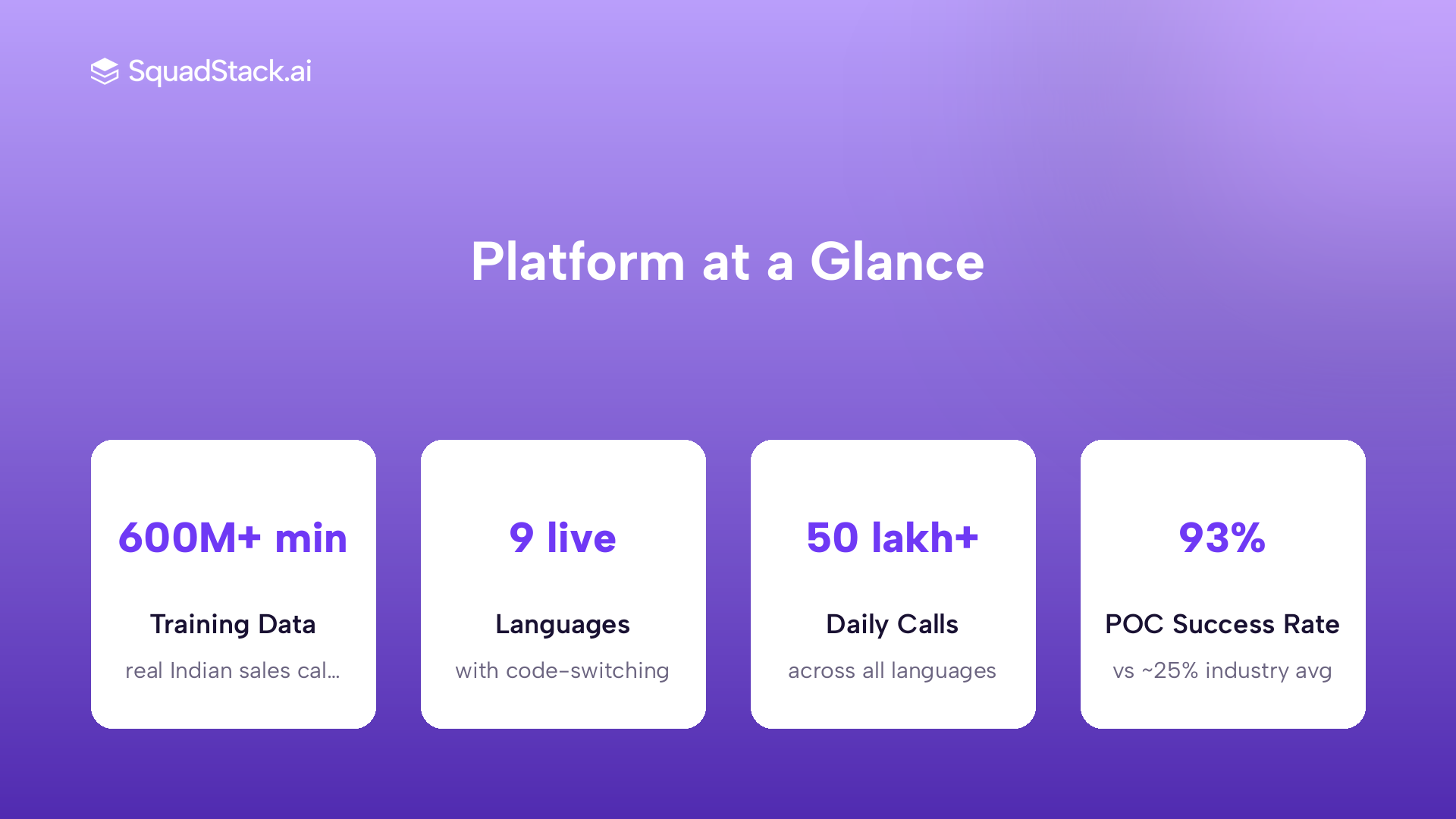
SquadStack's speech model, Arth, is trained on 600M+ minutes of real Indian contact center conversations. That corpus includes full-duplex, outcome-labelled calls spanning 85%+ of Indian PIN codes, including South Indian geographies. It was built from noisy, code-switched, 8kHz telephony audio, not YouTube videos or read-speech.
Kannada and Malayalam are two of nine live languages on the platform today. The others are Hindi, English, Tamil, Telugu, Marathi, Bengali, and Gujarati. All nine support native code-switching at the word level, the way a bilingual human agent would switch, not just when the customer finishes a turn.
On the Arth benchmark against real Indian telesales audio, the model sits at a semantic word error rate of 11.9%, within 0.9 points of the best commercial streaming STT available and ahead of Deepgram and Sarvam. More importantly, Arth is fine-tunable on outcome data and hosted in India, so it improves directly on South Indian campaign data.
Every call is audited through the Eval System, which scores on Outcome, Sentiment, and Execution, combining AI QA with human super-audits. SquadStack runs 50 lakh+ calls daily across 60+ large consumer brands, including Kotak Mahindra Bank for personal loan sales and PhonePe for collections, both sectors that run South India campaigns at scale.
For comparison across platform options, see top AI agent companies in India and best AI call center software.
The South India market is not underserved because demand is low. It is underserved because most voice AI stacks treat Kannada and Malayalam as translation problems rather than as distinct, phonetically complex languages that require real training data, real dialect exposure, and real code-switching capability.
Businesses operating across Karnataka and Kerala need a single agent stack that handles both languages natively, not two separate vendor relationships or a patchwork of IVR trees.
SquadStack runs both live. The training data is real. The voices are cloned from actual sales agents. The model handles code-switching at the word level and the QA system catches what the model misses.
If you want to see a Kannada or Malayalam agent running on your lead list, book a demo.
Which is the best AI voice agent for Kannada and Malayalam sales campaigns in India?
SquadStack is one of the few platforms running Kannada and Malayalam as live production languages with native code-switching, trained on 600M+ minutes of real Indian telephony conversations. Both languages handle dialect variation and English code-switching, which are the failure points for most generic multilingual platforms.
Can an AI voice agent handle Kannada-English and Malayalam-English code-switching on a real call?
Yes, if the underlying model was trained on real Indian telephony data. SquadStack's Arth model handles code-switching at the word level, not just at turn boundaries, because the training corpus includes real code-switched conversations from South Indian contact center campaigns.
How does a Kannada or Malayalam AI voice agent improve lead conversion rates?
Customers who receive a call in their native language with natural speech patterns are less likely to disconnect early. Fewer early disconnects mean more calls reach the qualification stage, which is where conversions happen. The improvement is especially visible in insurance and lending where trust is essential.
What is the difference between a Kannada AI voice bot and an IVR in a call center?
An IVR plays pre-recorded menus and requires keypad input. A Kannada AI voice agent holds a two-way conversation, handles objections, captures structured data from speech, and responds to whatever the customer actually says. It also handles Tulu-accented Kannada and mid-sentence English switches, which an IVR cannot.
Do AI voice agents for South India handle dialect differences like Tulu-influenced Kannada or Malabar Malayalam?
This depends entirely on the training data. Models trained on public or studio-recorded datasets typically do not handle regional dialect variation well. SquadStack's model is trained on real Indian telephony audio spanning a broad range of geographies, which includes exposure to the speech patterns that matter for South Indian campaigns.
How long does it take to deploy a Kannada or Malayalam AI voice agent campaign?
A standard campaign setup runs roughly two weeks. The agent is trained on the client's real call recordings, knowledge base, and FAQs before going live. Repeat use cases go faster because patterns from prior campaigns warm-start the build.
Can the same AI voice agent fleet run across both Karnataka and Kerala simultaneously?
Yes. A single SquadStack deployment handles multiple languages on the same platform. Language selection is made pre-call based on lead data, and code-switching takes over in real time if the customer responds in a different language. No separate IVR trees or vendor relationships are needed for the two states.
What compliance standards apply to AI voice calling in South India?
SquadStack is TRAI-compliant, which means DND registry scrubbing, hard-enforced calling windows of 9:30 AM to 8:30 PM, and only 140-series numbers for cold outreach. The platform also holds ISO 27001, ISO 27701, SOC 2 Type II, and DPDP certifications. These standards apply regardless of the language the campaign runs in.
How does SquadStack's AI voice agent compare to building an in-house Kannada or Malayalam voice model?
Building in-house looks straightforward at the start. The hidden costs appear at the production stage: collecting enough Indian-telephony-quality training data for Kannada and Malayalam, handling sub-800ms latency at scale, and building a QA infrastructure for thousands of concurrent calls each require dedicated teams. SquadStack has been running AI-assisted contact centers for about 10 years and fully transitioned to Voice AI in 2025. The infrastructure and the training data already exist.
What industries in South India benefit most from Kannada and Malayalam AI voice agents?
Insurance renewals, personal and gold loan qualification, brokerage account opening, and edtech lead qualification are the highest-volume use cases. All four sectors run large outbound campaigns in Karnataka and Kerala, and all four see material improvement in contact and conversion rates when customers receive calls in their native language from an agent that sounds natural rather than scripted.