.svg)





Top AI Outbound Calling Tools in India: Features Compared
October 23, 2026
|

13 min read

A closer look at how language coverage and code-switching ability affect outbound call conversion across India's regional markets.
TL;DR: This regional-language calling report India represents our first structured look at how outbound sales calls perform across Hindi, English, Tamil, Telugu, Kannada, Marathi, Malayalam, Bengali, and Gujarati, using first-party data from SquadStack's voice AI platform. Language match matters more than most operators expect: connect rates and conversions both shift meaningfully when a lead is called in their native language. This post covers what the data shows, what it means for teams running multi-state campaigns, and where the gaps still are.
Most consumer brands in India started outbound calling in Hindi and English. That made sense when call centers were concentrated in a few metros. But as digital acquisition has expanded into Tier-2 and Tier-3 cities, the customer on the other end is increasingly someone whose first language is Tamil, Telugu, Kannada, Marathi, or Gujarati.
The result is a structural mismatch. Sales teams built around Hindi-and-English coverage are now dialing leads who would respond far better in another language. Because the gap rarely shows up as a clean metric on a dashboard, it stays invisible until a brand starts looking at conversion by geography or lead source.
This report is a first attempt to surface that gap using SquadStack's own call data.
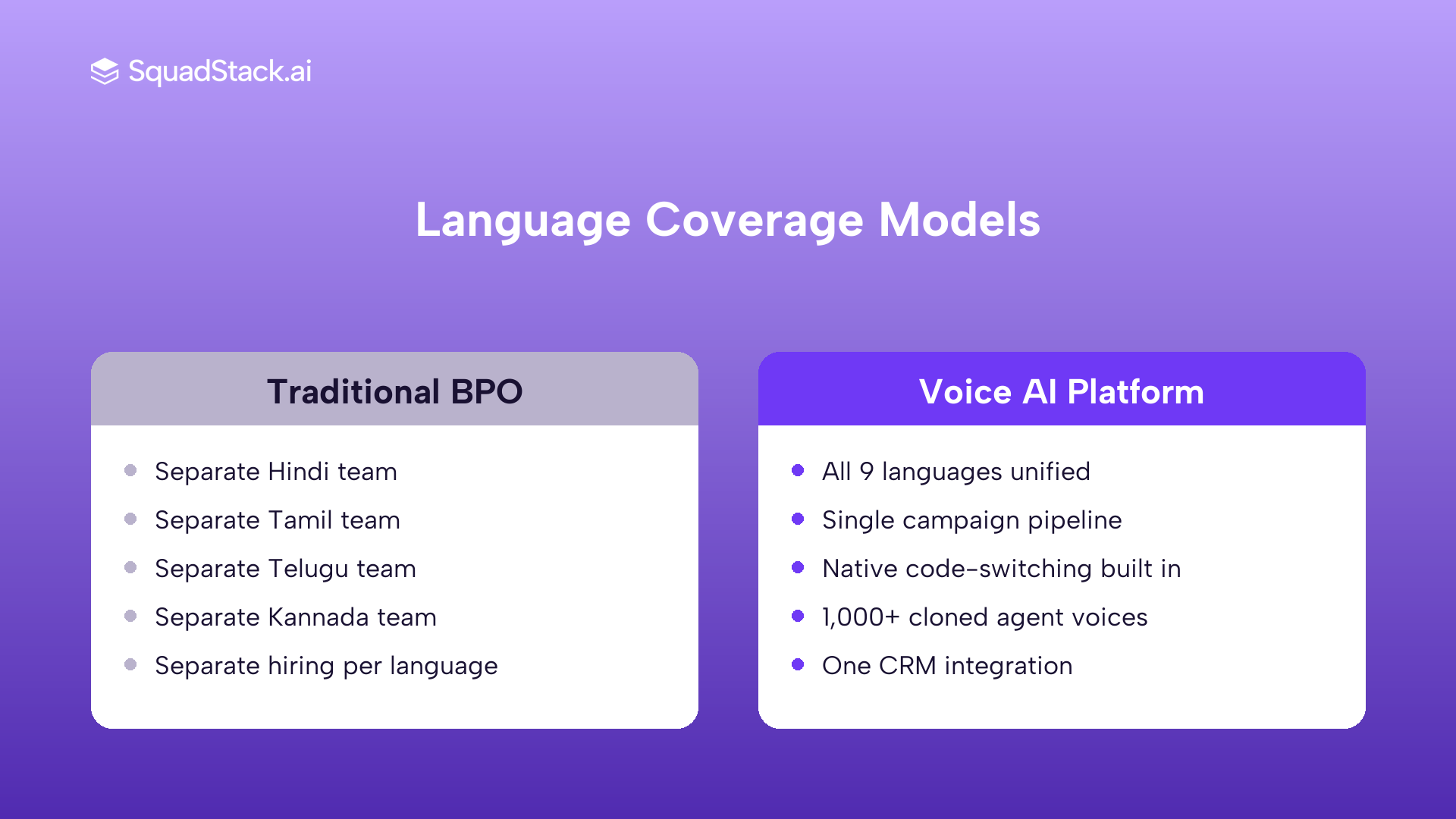
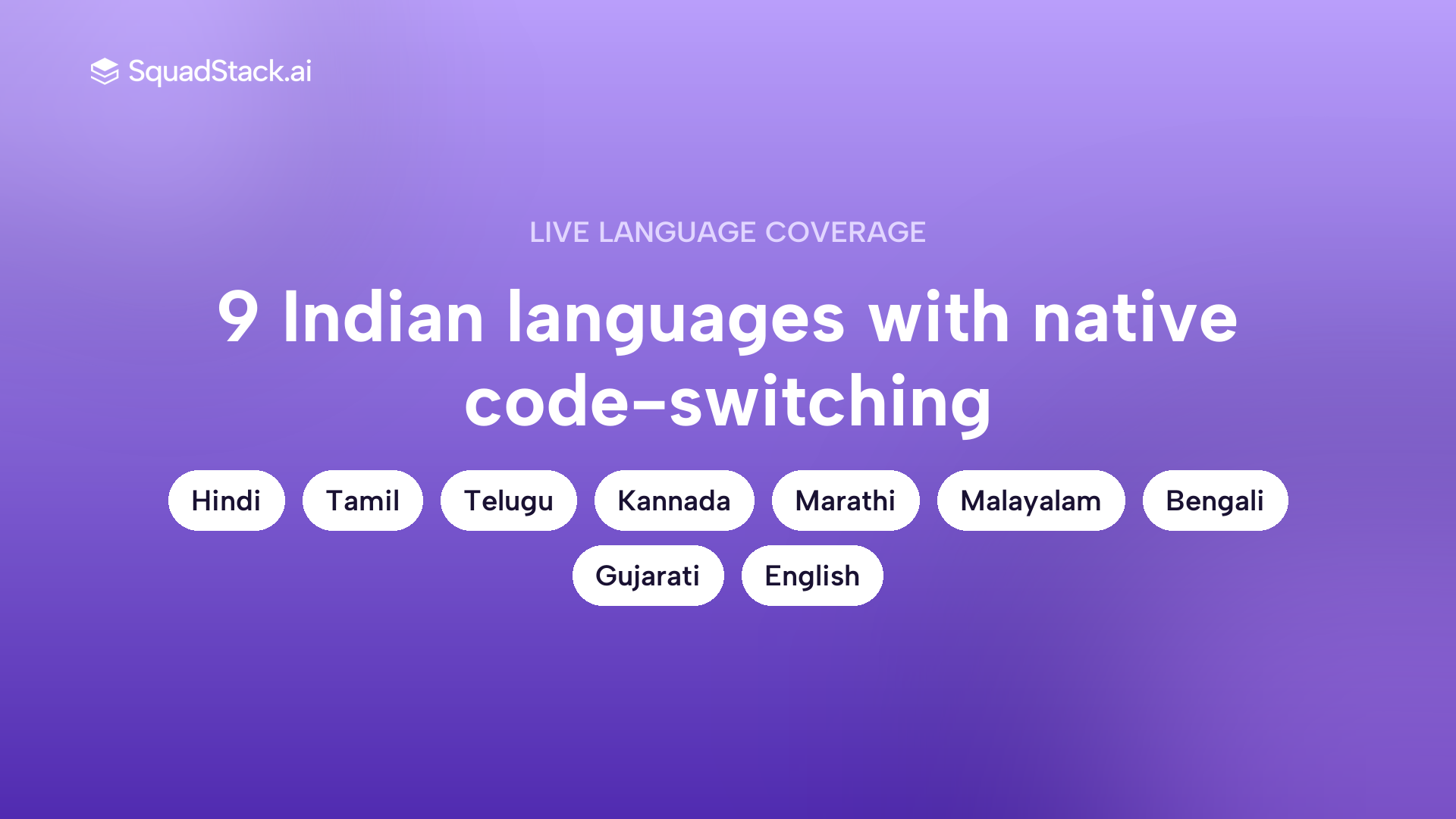
SquadStack's voice AI platform runs campaigns across nine live languages: Hindi, English, Tamil, Telugu, Kannada, Marathi, Malayalam, Bengali, and Gujarati. The platform logs outcomes at the call level, including connect status, engagement (whether the lead stayed on past the opening), and disposition (qualified, not interested, callback booked, and so on).
The findings draw on observations across live campaigns running in multiple Indian languages simultaneously. Because campaign mix, lead quality, and use case all affect outcomes, the comparisons here are directional rather than controlled experiments. Where a precise number is not available in the verified dataset, we describe the pattern qualitatively.
This is a first-pass report. The goal is to give operators a structured starting point, not a finished benchmark.
For more background on how the platform works, see our multilingual voicebot solution overview and the broader discussion on voice bots in India.
Headline finding: Calling a lead in their native language produces measurably better engagement and conversion than calling the same lead in a language they understand but do not prefer.
Connect rate is the share of unique leads actually reached over a full campaign cadence. Across SquadStack's campaigns, the platform reaches up to 90% of leads, against a 40 to 60% industry norm.
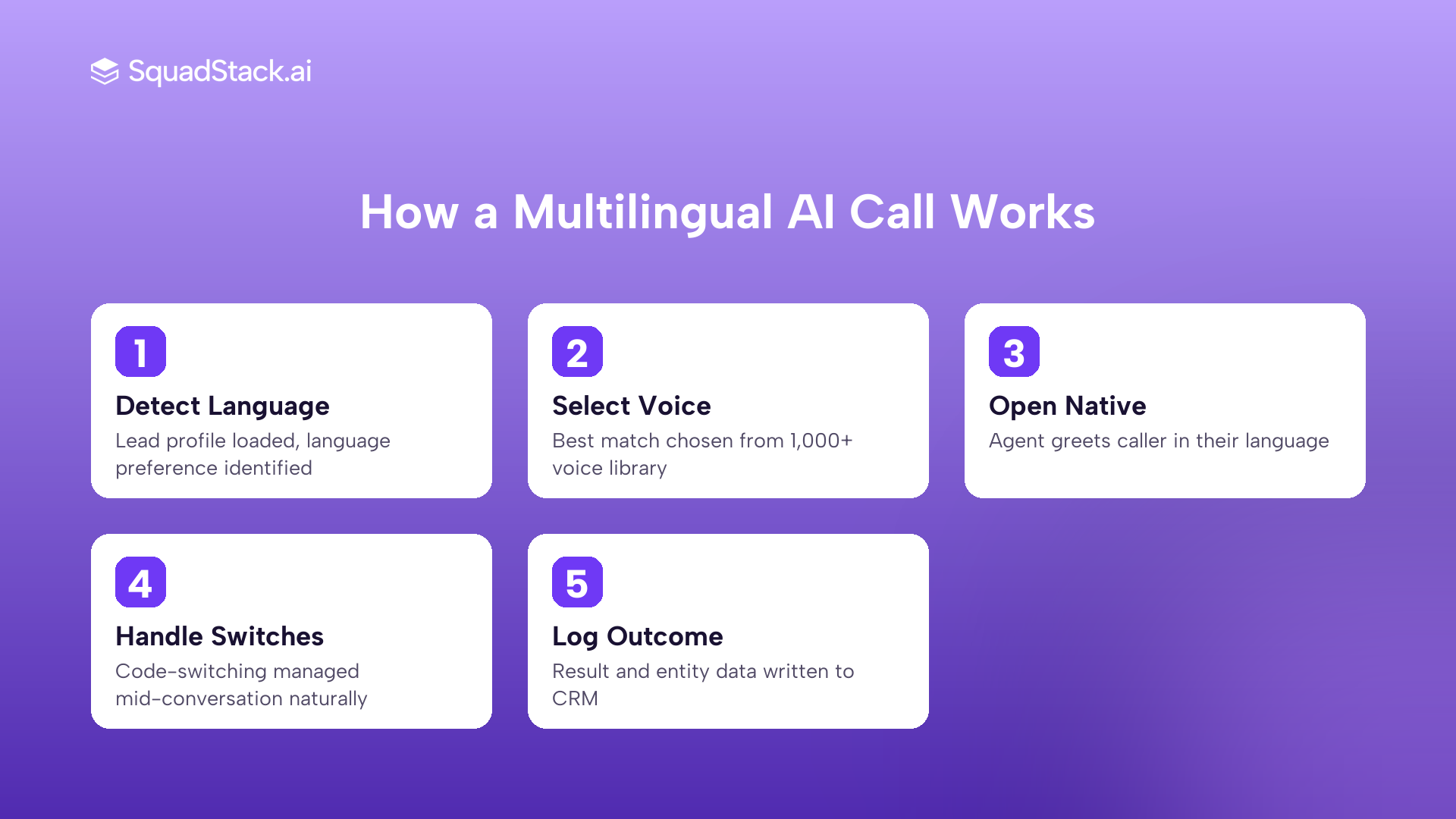
Language affects connect rate in a subtle but real way. When a lead's registered state maps to a language the platform supports natively, the platform can use local-language IVR prompts, local-language agent personas, and regional timing signals, lifting pick-up rates compared to generic Hindi or English outreach to the same geography.
The effect is most visible in South India. Tamil Nadu, Karnataka, Andhra Pradesh, and Telangana are active markets for consumer lending, edtech, and e-commerce. Leads in these states, when called in their regional language by an agent that sounds genuinely local, show meaningfully higher engagement than when called in Hindi or neutral English.
Engagement is measured as whether a lead stays on the call past the first 10 seconds after the opening. SquadStack tracks this through Abruptly Disconnected Rate (ADR), the share of calls dropped within 10 seconds of AI identification.
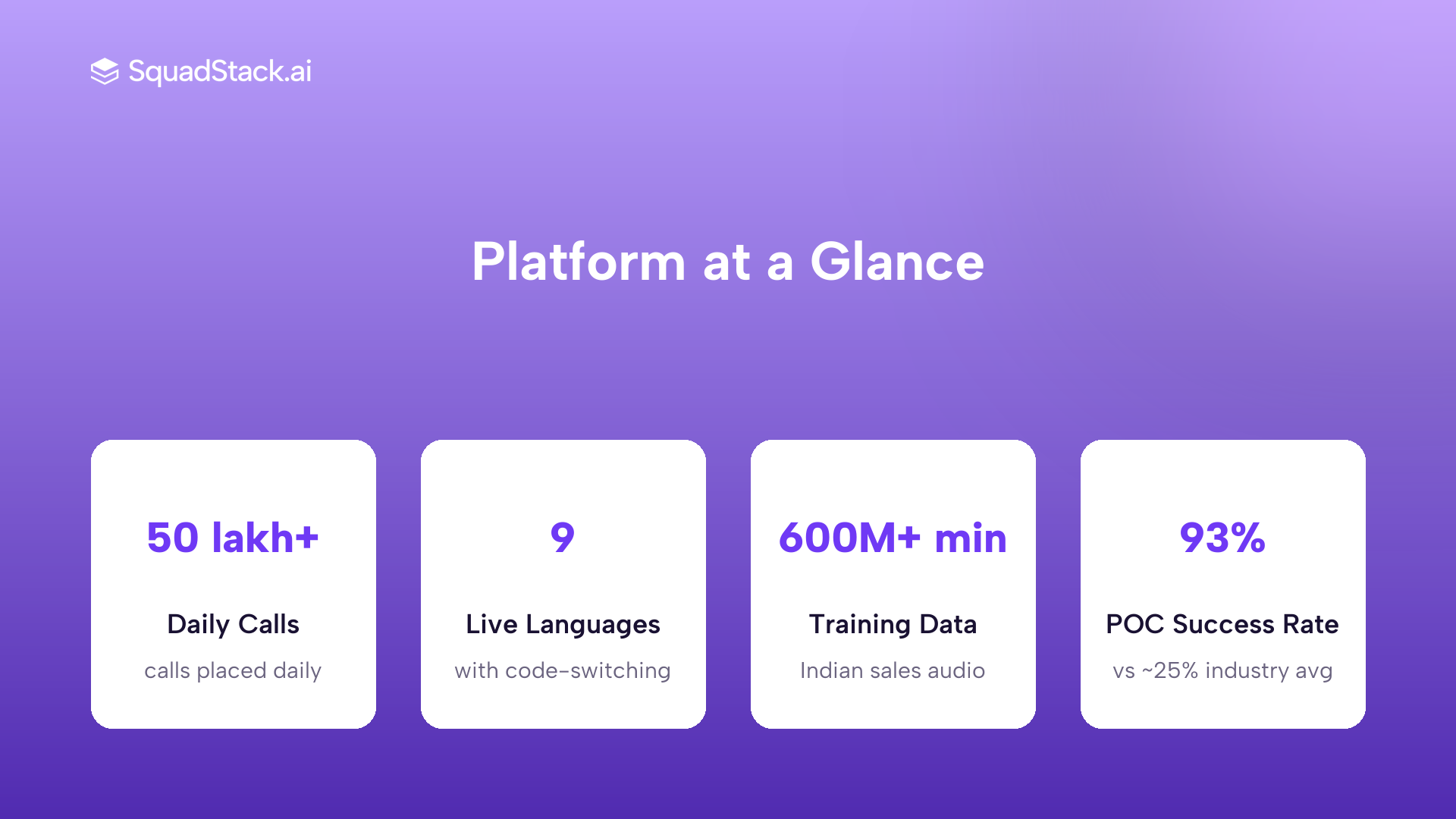
For generic voice AI, ADR can run very high. SquadStack's agents run at around 10% ADR, inside the range typical of human agent campaigns. That figure holds across all nine live languages because the naturalness engineering for each language is separate and real: dialogue is hand-written by native speakers, not translated from Hindi or English, and every voice is tested on actual 8kHz telephone lines.
If your current ADR on regional-language campaigns is significantly higher than on Hindi or English campaigns, the gap is almost certainly a naturalness problem, not a lead quality problem.
The table below summarises directional findings. Specific conversion numbers vary by campaign, use case, and lead quality, so treat these as relative patterns rather than fixed benchmarks.
| Language | Relative Connect Rate | Relative Early Drop-Off | Relative Conversion Rate | Key Observation |
|---|---|---|---|---|
| Hindi | High | Low | High | Deep training data; strong code-switching with English |
| English | High | Low | High | Works well for urban, high-income segments |
| Tamil | High | Low to moderate | High | Requires genuine Taminglish, not translated Hindi scripts |
| Telugu | High | Low to moderate | High | Strong in Tier-2 AP/Telangana markets |
| Kannada | Moderate to high | Moderate | Moderate to high | Growing; urban Bengaluru vs. rural Karnataka performs differently |
Across all nine languages, SquadStack's agents exceed human-agent engagement baselines. The redBus multilingual deployment is the most detailed public proof: engagement across all regional languages ran at 75 to 85%, above the human baseline in every language, and feedback captured was 2 to 4x more than the human baseline per campaign. Cost per outcome on vernacular campaigns ran 50 to 79% lower than human agents.
A common mistake when setting up regional-language campaigns is treating language as a binary: either the agent calls in Hindi, or it calls in Tamil. Real Indian sales conversations do not work that way.
A customer in Chennai might answer in Tamil, switch to English for a product term or a number, then return to Tamil. A borrower in Hyderabad might ask a question in Telugu but confirm their loan amount in English. This is not unusual. It is the default behaviour of bilingual Indian consumers.
An agent that cannot follow these switches loses the thread of the conversation. The customer notices. Trust drops. The call ends.
SquadStack's agents are trained on 600M+ minutes of real Indian sales conversations, including naturally occurring code-switched speech: Hinglish, Taminglish, and regional-English combinations that do not exist in public training datasets. The model does not translate mid-conversation. It continues in whatever direction the conversation moves, because it has heard that pattern thousands of times before.
Supporting nine languages is an engineering problem. Sounding native in all five, and handling code-switches between them, requires training data that only comes from years of running real contact center operations in India. For more on how this works technically, see our piece on natural language processing in AI voice bots.
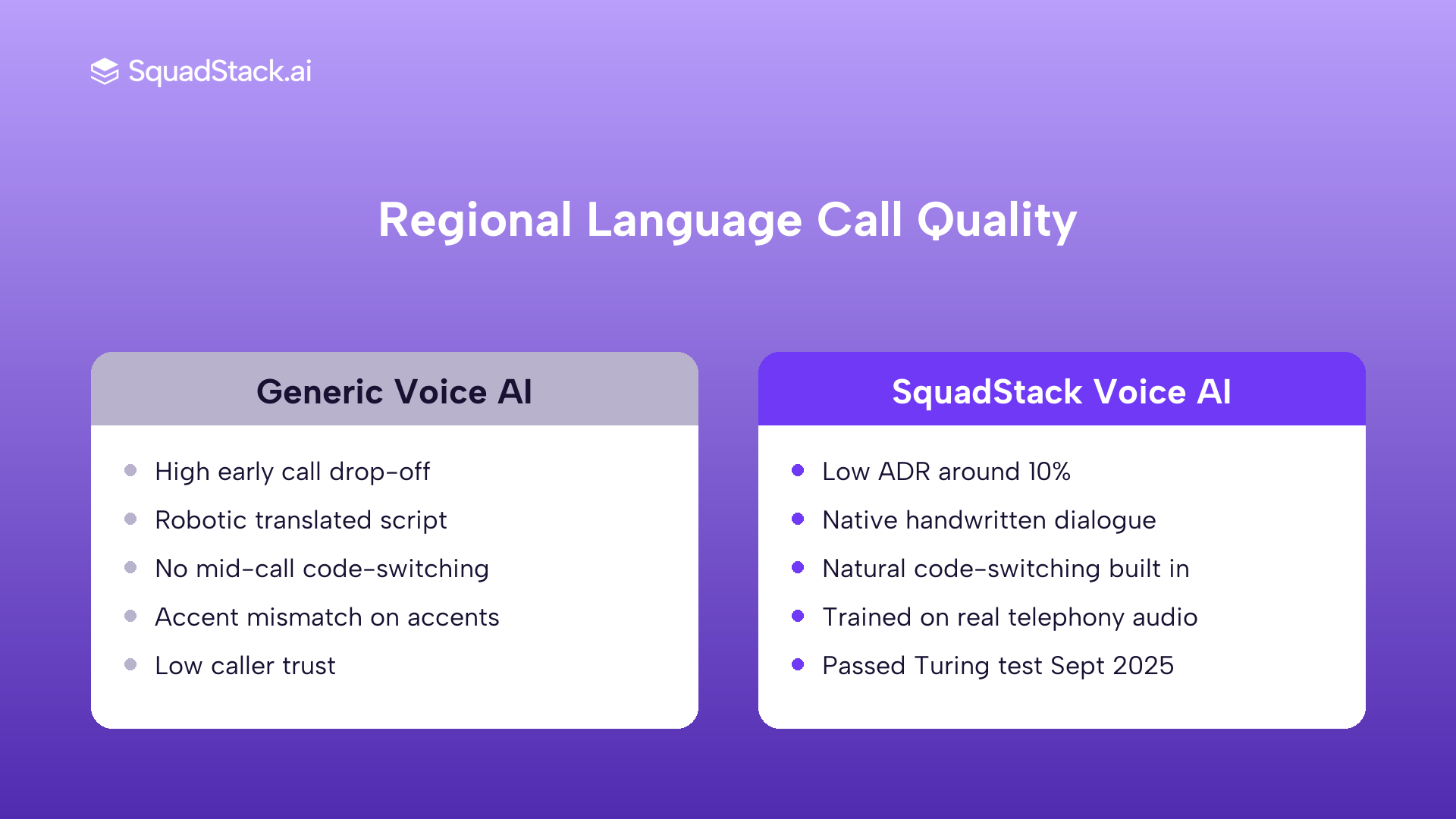
Language coverage is a revenue variable, not a support feature. Most RevOps and CX teams treat language as a compliance checkbox: "we have a Tamil option." But if the Tamil agent sounds like a newsreader or struggles with common Taminglish phrases, it is not a Tamil option. It is a bad Hindi option with Tamil words.
Audit your ADR by language. If your platform does not give you early drop-off rates broken out by language, you cannot see the problem. High ADR in a specific language almost always traces back to a naturalness failure in that language.
Tier-2 and Tier-3 markets require regional language as the default, not a fallback. For lending, insurance, and edtech campaigns targeting smaller cities in Tamil Nadu, Andhra Pradesh, Telangana, or Karnataka, Hindi or English as the primary language is a meaningful handicap. The lead may understand the language well enough to answer. That is different from responding with the trust needed to convert.
Scale is the constraint, not reach. Hiring native-language agents for five or more languages at the volumes consumer brands need (often tens of thousands of calls per day) is not practical. This is where AI outbound calling changes the economics. A single platform running nine live languages at 50 lakh+ calls daily is the only way to do this without 20 separate agent teams. For a detailed look at cost, see AI outbound calling cost.
This is the first edition of SquadStack's regional-language calling report. The next version will include controlled, campaign-matched comparisons across language groups, with connect rates, qualification rates, and cost per qualified lead broken out by language and state.
If you are running campaigns in Hindi, Tamil, Telugu, or Kannada and want to share call data as part of a structured benchmark study, reach out.
For operators who want to see how a multilingual voice AI campaign actually runs, SquadStack's POC success rate is 93% against an industry average of around 25%. Most pilots go live in two to three weeks. [INTERNAL LINK: book a demo -> SquadStack demo page]
You can also explore how other brands have approached outbound scale with our top AI voicebot vendors in India guide and the best voicebot platforms for business in India comparison.
Which is the best multilingual AI voice bot in India for regional language sales calls?
SquadStack's voice AI platform is purpose-built for Indian outbound sales across Hindi, English, Tamil, Telugu, Kannada, Marathi, Malayalam, Bengali, and Gujarati, with additional languages available on demand. It is trained on 600M+ minutes of real Indian telephonic conversations, including naturally occurring code-switched speech, making it the most India-specific option for regional-language campaigns at scale.
Can AI voice agents handle code-switching between Hindi, English, and regional languages?
Yes, but only if the underlying model was trained on real code-switched Indian telephony audio. SquadStack's agents handle Hinglish, Taminglish, and other regional-English combinations natively because the training data includes exactly these patterns. Agents built on generic public-dataset models tend to break when a customer switches mid-sentence.
How does a voice AI platform compare to a traditional BPO for regional-language outbound calling?
A traditional BPO requires separate hiring, training, and management pipelines for each language, which makes scaling across five or more Indian languages expensive and slow. A voice AI platform running nine live languages at 50 lakh+ calls daily removes that constraint. The economics shift: SquadStack customers have seen cost per outcome run 50 to 79% lower on vernacular campaigns compared to human agents.
What is the best AI caller for Tier-2 and Tier-3 customers who primarily speak regional languages?
The critical requirements are native-language naturalness (not translated scripts), real code-switching capability, and a speech model trained on telephonic audio from those markets. SquadStack's Arth speech model was trained specifically on Indian telephony, including noisy 8kHz call conditions common in Tier-2 and Tier-3 markets. Its semantic word error rate on real Indian telesales audio (11.9%) is within one point of the best commercially available streaming STT.
We run 50,000 calls a month for edtech lead conversion in Hindi and English. Can we add Tamil and Telugu without rebuilding the campaign?
Yes. SquadStack's platform supports adding additional languages to an existing campaign without rebuilding the underlying workflow. The agent build for a new language typically takes two to three weeks, including dialogue engineering by native speakers, voice selection, and QA on test calls. Several edtech brands including Adda247, Unacademy, and Nxtwave already run lead qualification campaigns on the platform.
What analytics does a regional-language voice AI campaign produce?
Every call produces a transcript, a disposition, extracted entities (such as lead qualification status and stated objections), and a quality score evaluated on Outcome, Sentiment, and Execution through SquadStack's Eval System. These feed into a real-time dashboard with full-funnel visibility and write back to the client's CRM automatically.
How do you measure whether a regional-language AI agent is actually working?
The two most useful signals are Abruptly Disconnected Rate (the share of calls dropped within 10 seconds of the opening, a proxy for whether the agent sounds real) and language-specific qualification rate compared to the Hindi or English baseline. SquadStack's agents run at around 10% ADR, inside the range typical of human agent campaigns, across all nine supported languages.
Is a multilingual voice AI platform TRAI-compliant for outbound calling in India?
SquadStack's platform is TRAI-compliant. Calling windows are hard-enforced by the system (9:30 AM to 8:30 PM), lead lists are scrubbed against the TRAI DND registry before dialing, and only 140-series numbers are used for cold outreach. Compliance rules apply regardless of the language the campaign runs in.
What languages does SquadStack's voice AI support today?
Nine languages are live today: Hindi, English, Tamil, Telugu, Kannada, Marathi, Malayalam, Bengali, and Gujarati, all with native code-switching. More regional languages are available on demand. Further regional languages can be added based on business requirements.
How long does it take to go live with a regional-language voice AI campaign?
Most campaigns go live in two to three weeks. The setup involves training the agent on the client's real call recordings, knowledge base, and FAQs, then QA on test calls before production. Simple, well-scoped use cases can have a testable prototype ready faster. The pilot runs for four to eight weeks against a pre-agreed success metric before scaling.

