.svg)






Subscriber Churn Prediction Calls: AI Voice for OTT and Streaming
October 10, 2026
|

12 min read
Learn how to match voice AI or human agents to the right revenue use case using a structured framework built for Indian market conditions.
TL;DR: Not every sales call needs a human. The question of which business case is better solved by AI comes down to three things: volume, variability, and the cost of a mistake. High-volume, structured outbound work like lead qualification, EMI reminders, and NPS surveys consistently deliver better outcomes with Voice AI. Complex negotiation, sensitive complaints, and high-stakes advisory calls still benefit from a trained human.
You have a large lead list. You have a limited team. And you have targets to hit this quarter.
The instinct is to add headcount. But hiring, training, and managing agents takes months, and attrition resets the clock every few weeks. The harder question is: which of these calls actually need a human?
Getting this wrong in either direction costs you. Throw human agents at every outbound call and you blow your cost-per-acquisition budget. Automate the wrong conversations and you lose deals that needed judgment, warmth, or context.
This post builds a practical decision framework for that choice, grounded in how consumer sales actually works in India.
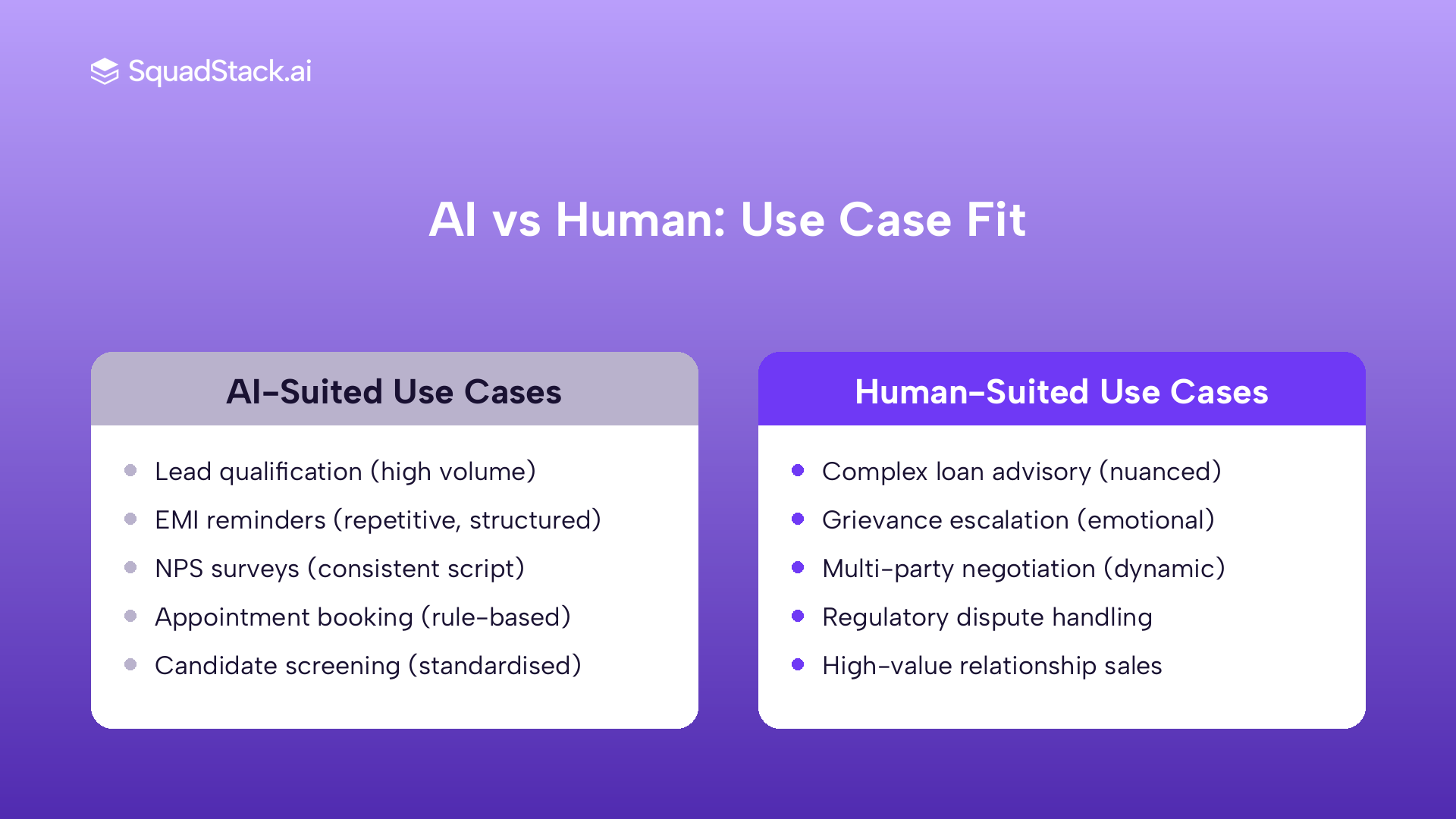
The answer depends on four variables: call volume, conversation structure, the cost of a bad interaction, and whether the outcome is binary or requires negotiation.
Use the matrix below to map your use cases before committing to a model.
| Use Case | Volume | Structure | Cost of Error | Best Fit |
|---|---|---|---|---|
| Lead qualification (BFSI, edtech, SaaS) | Very high | High | Low to medium | Voice AI |
| EMI / payment reminders (pre-due) | Very high | Very high | Medium | Voice AI |
| NPS and feedback surveys | High | High | Low | Voice AI |
| Appointment booking / confirmation | High | High | Low | Voice AI |
| Abandoned cart recovery | High | Medium | Low | Voice AI |
| Rider / candidate screening | High | High | Low to medium | Voice AI |
| Pre-approved loan or credit card offers | High | Medium-high | Medium | Voice AI (with warm transfer) |
| Complex loan advisory (20+ min calls) | Medium | Low | High | Human (AI assist) |
| Grievance resolution / escalations | Medium | Low | Very high | Human |
| Multi-party negotiation | Low | Very low | Very high | Human |
| Fraud detection callbacks | Medium | Medium | Very high | Human or supervised AI |
The pattern is clear. When the conversation follows a predictable arc, the outcome is well-defined, and the volume is high, AI outperforms humans on every operational metric. When the conversation requires reading unstated emotion, improvising in real time, or making a judgment call that carries financial or reputational risk, a trained human is still the safer choice.
This is the strongest AI use case in Indian consumer sales. A qualification call typically covers four to six fields: loan amount, income, employment type, city, and consent. The script is fixed. The outcome is binary. The volume is enormous.
Human agents calling at scale introduce inconsistency, fatigue, and availability constraints. A well-trained Voice AI agent runs the same conversation at any hour, in the lead's preferred language, and reaches far more leads per day than a human team of the same cost.
Brands like Adda247, Unacademy, Shiprocket, and multiple BFSI lenders use SquadStack's Voice AI platform for exactly this work. The ROI case is direct: more leads qualified per rupee, at consistent quality.
Reminders before an EMI due date are high-frequency, low-complexity, and time-sensitive. A human calling 50,000 borrowers before the 5th of the month is a logistics problem. An AI agent calling all of them the day before, in their preferred language, is a systems problem, and systems are easier to solve.
PhonePe and Moneyview both run collections-related outreach through SquadStack. Pre-due reminders sit squarely in AI territory: the message is consistent, compliance guardrails are built into the dialogue, and the cost per outcome drops sharply versus a human team.
Survey calls suffer from two human-agent failure modes: rushing to close the call and anchoring the respondent's answer through tone. An AI agent asks every question with the same neutral pacing and captures responses accurately.
TVS Motors uses Voice AI for buyer and non-buyer NPS. The redBus case study shows 50% lower survey cost compared to human agents. For any brand running post-purchase feedback at scale, this is a straightforward win.
Booking confirmations are almost entirely structured: date, time, location, and a confirmation code. Cancellations require one branch. The entire conversation can be mapped before the call starts. Voice AI handles this faster, at lower cost, and with no hold time. Medibuddy uses it for doctor-appointment booking; JustDial uses it for appointment booking alongside data verification.
Hiring at scale for gig roles, delivery fleets, and contact centers involves screening hundreds of candidates daily against a fixed checklist. The questions are the same every time. The disqualifying conditions are clear. Voice AI handles this consistently without scheduling constraints. Delhivery achieved 4x lower cost-per-hire using this approach. Swiggy and Everest Fleet run the same model for rider onboarding.
AI is not the right answer everywhere. Three categories belong with human agents.
Complex financial advisory. A 30-minute call helping someone choose between two insurance plans, understand the implications of a top-up loan, or work through a pension consolidation involves ambiguity that a structured script cannot capture. The customer may not know what they want at the start of the call. A skilled human agent navigates that. Agentic AI contact center platforms can assist by providing context, but the conversation itself benefits from human judgment.
Grievance escalations. When a customer is angry about a failed transaction, a wrongly issued policy, or a missed delivery, the priority is de-escalation and resolution. These calls are unpredictable, often involve compensation decisions, and carry reputational risk. Human agents with authority to resolve are better placed here.
Multi-party negotiations. Business loan discussions with an SME owner, negotiations on a large AMC renewal, or enterprise sales cycles involve multiple stakeholders, unstated constraints, and shifting positions. These are low-volume, high-value conversations where a skilled sales rep earns their cost many times over.
The right operating model for most consumer brands is not AI or humans. It is AI handling the volume, with warm transfer to a human at the moments that genuinely need one.
Most content on this topic is written for English-first markets. India is different in ways that directly affect which business cases AI can solve well.
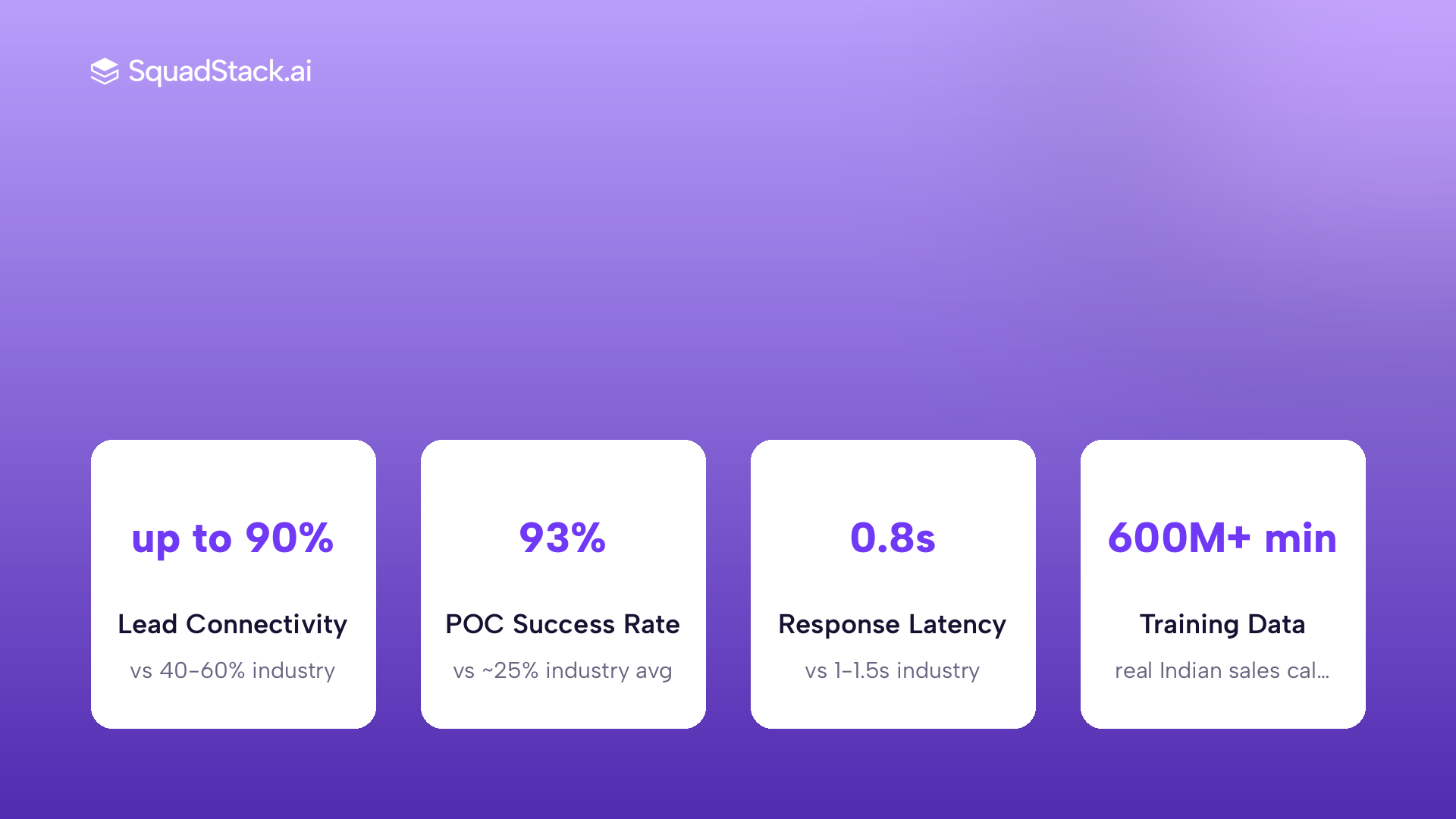
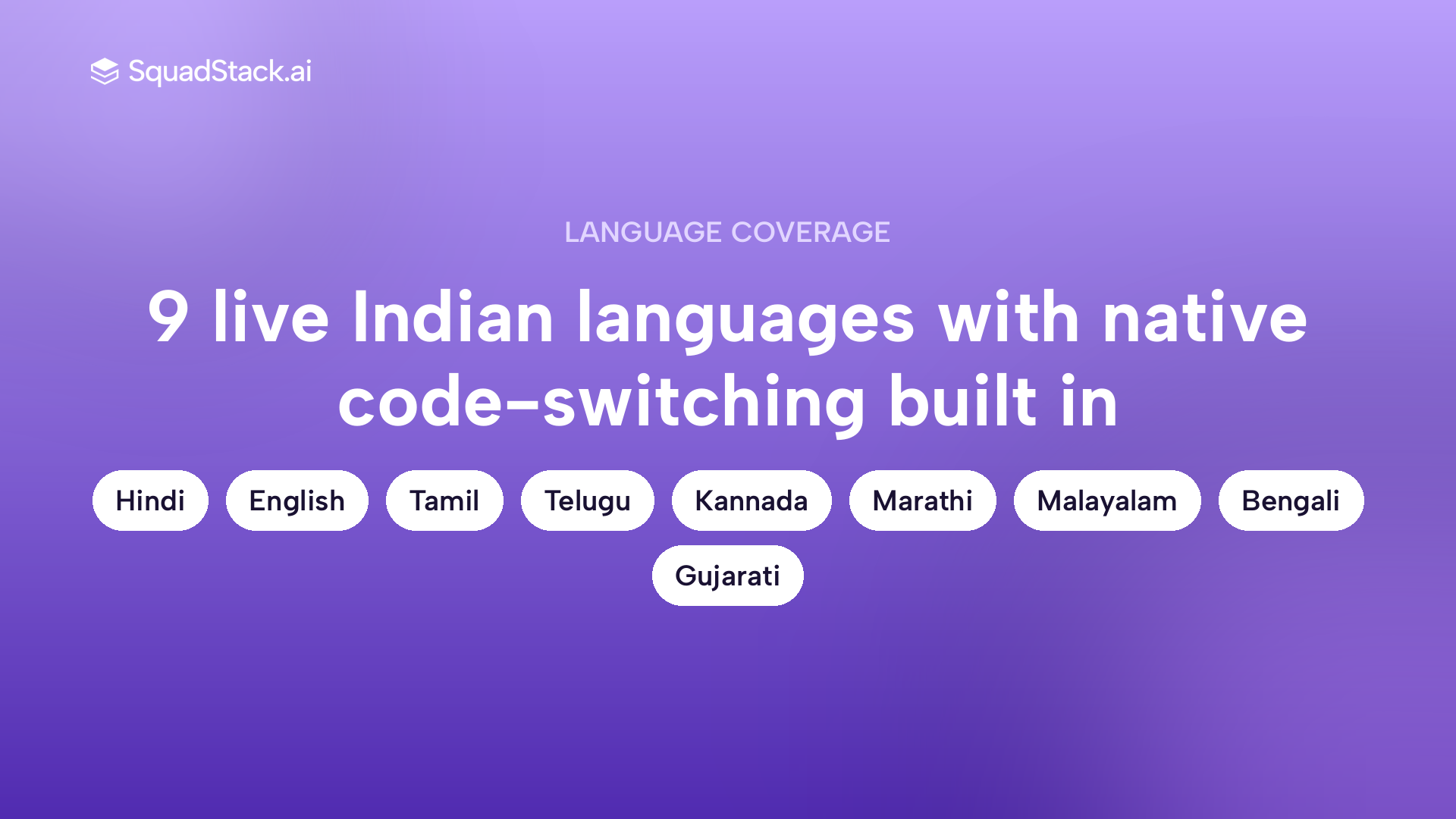
First, language diversity. A lead in Tamil Nadu may respond best in Tamil, while a lead in Gujarat prefers Gujarati. A human team covering all nine major Indian languages at scale is expensive and hard to staff. An AI model trained on those languages natively is not. SquadStack's Voice AI agents support 9 live languages, including Hindi, English, Tamil, Telugu, Kannada, Marathi, Malayalam, Bengali, and Gujarati, with native code-switching mid-sentence. The training corpus is 600M+ minutes of real Indian sales conversations, including Hinglish and Taminglish, not synthetic data or YouTube audio.
Second, telephony conditions. Indian outbound calling involves noisy lines, packet loss, code-switching mid-sentence, and leads who respond with short confirmations in a regional language. An AI agent built for these conditions handles them differently from one built for clean English audio. SquadStack's proprietary speech model, Arth, was trained specifically on high-noise 8kHz telephonic audio from Indian contact centers. This is why Arth v1's Semantic WER is within 0.9 points of the best commercial streaming STT on real Indian telesales audio.
Third, the cost structure. Human calling at scale in India is not cheap when you factor in attrition, training, infrastructure, and compliance management. The economics of Voice AI versus human agents differ significantly between Indian consumer sales and, say, a US SaaS company with a small outbound team.
For a detailed look at how this plays out in BFSI specifically, the leading gold loan NBFC Voice AI case study shows what the shift looks like in practice for a high-volume lending use case.
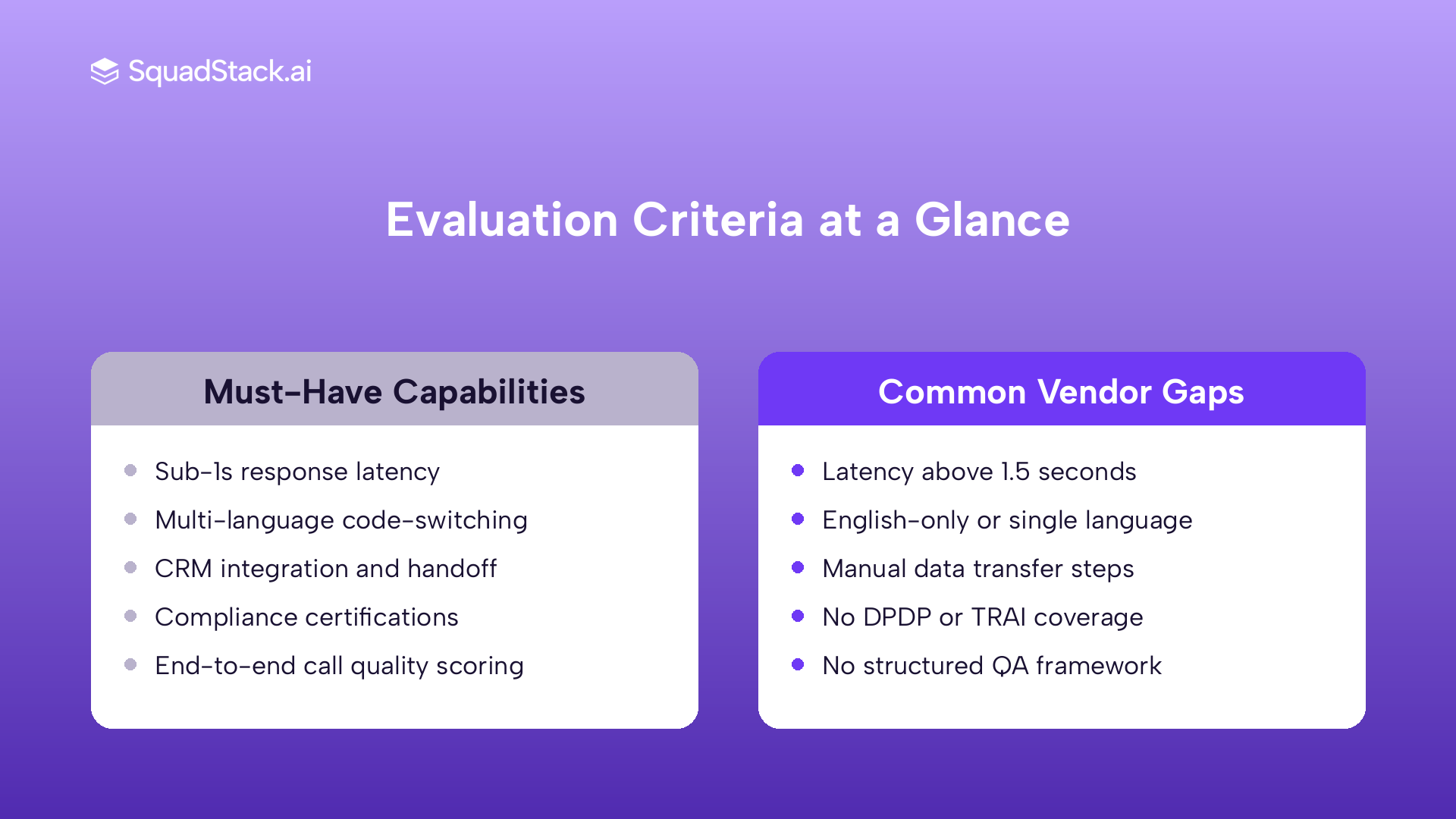
If you are building an internal business case for AI voice agents, these are the criteria that actually matter.
Language and dialect quality. Not whether a language is listed, but whether the agent sounds native. Generic TTS trained on read-speech fails in regional languages. Ask to hear a live call in your market's language before committing.
Connectivity rates. Lead-level connectivity across the full retry cadence, not per-attempt connect rates. The difference matters at volume.
Latency. A response time above one second breaks conversational rhythm. SquadStack's median response latency is 0.8 seconds or less, which keeps conversations natural.
Warm transfer capability. The agent should be able to hand off a high-intent lead to a human with full context, not a cold transfer. This is what makes the AI-and-human model work in practice.
Compliance. TRAI calling hours, DND scrubbing, consent gating, and data residency matter especially in BFSI. Look for ISO 27001, SOC 2 Type II, and DPDP compliance as baseline requirements.
Pilot structure. A 93% POC success rate (against an industry average around 25%) tells you something about whether a vendor's setup process is mature. Ask what the success metric will be and how it is measured before you sign.
For a broader comparison of platforms in this space, see best AI call center software solutions.
SquadStack works best for consumer brands running high-volume outbound sales and qualification in India, where language diversity, telecalling economics, and compliance complexity are real constraints.
The platform runs 50 lakh+ calls daily across 60+ large consumer brands including AngelOne, Kotak Mahindra Bank, Eureka Forbes, IndiaMART, and PhonePe. The voice agents passed the Turing test in September 2025, and lead connectivity reaches up to 90% against a 40 to 60% industry norm.
Every engagement includes a dedicated squad: an AI Agent Product Manager, a Forward Deployed Engineer, a Conversational AI Designer, and QA. Calls are scored on SquadStack's Eval System across Outcome, Sentiment, and Execution on every interaction.
For brands evaluating an AI-first sales motion, the gold loan NBFC case study shows a real deployment with verified outcomes. The sales automation use case page covers the broader sales context.
If your use case fits the AI-suited column in the table above, the path forward is a scoped pilot with a pre-aligned success metric. Most go live in two to three weeks.
Book a demo to see what this looks like for your specific use case.
Which business case is better solved by AI than humans in outbound sales?
Lead qualification, EMI reminders, NPS surveys, appointment booking, and candidate screening are all stronger fits for AI than humans. These use cases share high volume, predictable structure, and well-defined outcomes. Human agents perform better on complex advisory, grievance escalations, and multi-party negotiations.
Which is the best Voice AI solution for outbound sales in India?
SquadStack is purpose-built for Indian consumer sales, with 9 live languages, native code-switching, and a training corpus of 600M+ minutes of real Indian sales conversations. The platform runs 50 lakh+ calls daily for 60+ large consumer brands and has a 93% POC success rate versus an industry average around 25%.
Can a Voice AI agent handle lead qualification automatically?
Yes. Voice AI agents can run structured qualification conversations, capture defined data points, handle common objections, and pass qualified leads to a CRM or a human team, all without human involvement. The key requirement is that the qualification criteria are defined and the conversation flow is mappable in advance.
How does Voice AI compare to a traditional outbound calling team on cost?
AI-managed outbound typically delivers up to 2 to 3 times lower customer acquisition cost compared to human agent teams, in cases where the use case is high-volume and structured. The cost advantage comes from three places: no attrition, no idle time between calls, and the ability to run at scale across multiple languages simultaneously.
What happens when an AI agent reaches a complex or sensitive query?
Well-built Voice AI platforms include warm transfer capability: the agent hands off the call to a human agent with full conversation context, including what was discussed, what data was captured, and why the transfer was triggered. This keeps the customer experience intact while ensuring complex queries reach someone who can handle them.
Is Voice AI compliant with TRAI rules for outbound calling in India?
Compliant platforms enforce TRAI calling hours (typically 9:30 AM to 8:30 PM), scrub leads against the DND registry before dialing, and manage consent gating within the conversation itself. SquadStack's platform is TRAI-compliant, with DND scrubbing and hard system blocks on out-of-window dialing.
How many Indian languages can a Voice AI agent handle?
SquadStack's Voice AI agents support 9 live languages: Hindi, English, Tamil, Telugu, Kannada, Marathi, Malayalam, Bengali, and Gujarati, with native code-switching mid-sentence. Additional regional languages can be added based on business requirements.
How long does it take to go live with an AI voice agent?
Most enterprise deployments go live in two to three weeks. The setup covers solutioning, agent build, integrations, and UAT. Simpler, well-defined use cases can be stood up faster. The longer timelines typically come from client-side dependencies: data feeds, telephony approvals, and compliance sign-off.
What is the AI decision framework for choosing between AI and human agents?
Map each use case against four variables: volume, conversation structure, cost of a poor interaction, and whether the outcome is binary or requires negotiation. High-volume, structured, low-risk use cases favour AI. Low-volume, unstructured, high-stakes conversations favour humans. Most consumer sales operations benefit from running both, with AI handling the volume and routing high-intent or complex calls to human agents.
Can Voice AI agents handle calls in both English and Hindi on the same campaign?
Yes. Native code-switching means the agent switches languages mid-sentence, the way a bilingual human agent does, rather than treating each language as a separate mode. This is especially relevant for Hinglish-speaking leads who move between Hindi and English naturally within a single call.