.svg)





10 Best AI Voice Agent Platforms in 2026
October 26, 2026
|

12 min read

Explore how AI voice agents built for Indian dialects and telephony conditions drive higher lead connectivity in Tier 2 and Tier 3 markets.
TL;DR: AI voice agents built for Tier 2 and Tier 3 India speak the right language, handle noisy PSTN lines, and reach buyers who never pick up a generic IVR call. Generic calling fails in these markets because it ignores dialect, trust barriers, and connectivity realities. SquadStack.ai's agents are trained on 600M+ minutes of real Indian sales conversations and run nine live languages with native code-switching, making them the only voice AI stack built from the ground up for exactly these conditions.
Businesses that scaled outbound calling in metro India often assume the same playbook works everywhere. It does not.
A script written in formal Hindi sounds foreign to a Bhojpuri-inflected speaker. A voice natural to an urban ear sounds like a newsreader in a smaller town. An IVR that works on a 4G Mumbai connection drops mid-sentence on a 2G line in rural Rajasthan. Add TRAI compliance requirements, DND registries, and years of spam-call trust deficit, and the failure is structural, not cosmetic.
Sales teams using off-the-shelf voice tools face three concrete problems: low connectivity because calling windows and number health go unmanaged, poor engagement because the voice sounds robotic, and low conversion because the agent cannot handle dialect variation, objections, or interrupted conversations.
This is the gap that AI voice agents for Tier 2 and Tier 3 India are built to close.
An AI voice agent for Tier 2 and Tier 3 India is a conversational AI that conducts real sales calls in regional Indian languages, handles noisy phone lines, adapts to local dialects and trust patterns, and operates inside India's TRAI compliance framework.
Most voice AI is built on clean studio audio or YouTube transcripts and then marketed as multilingual. Sounding native in Taminglish on a crackling 8kHz PSTN line requires training data from that exact environment, and that data does not exist in public datasets.
A voice agent built for these markets handles code-switching mid-sentence, manages background noise without losing the thread, and knows when to pause versus when the buyer has finished speaking. It also tracks TRAI calling windows, scrubs DND lists before dialing, and uses only compliant 140-series numbers for cold outreach.
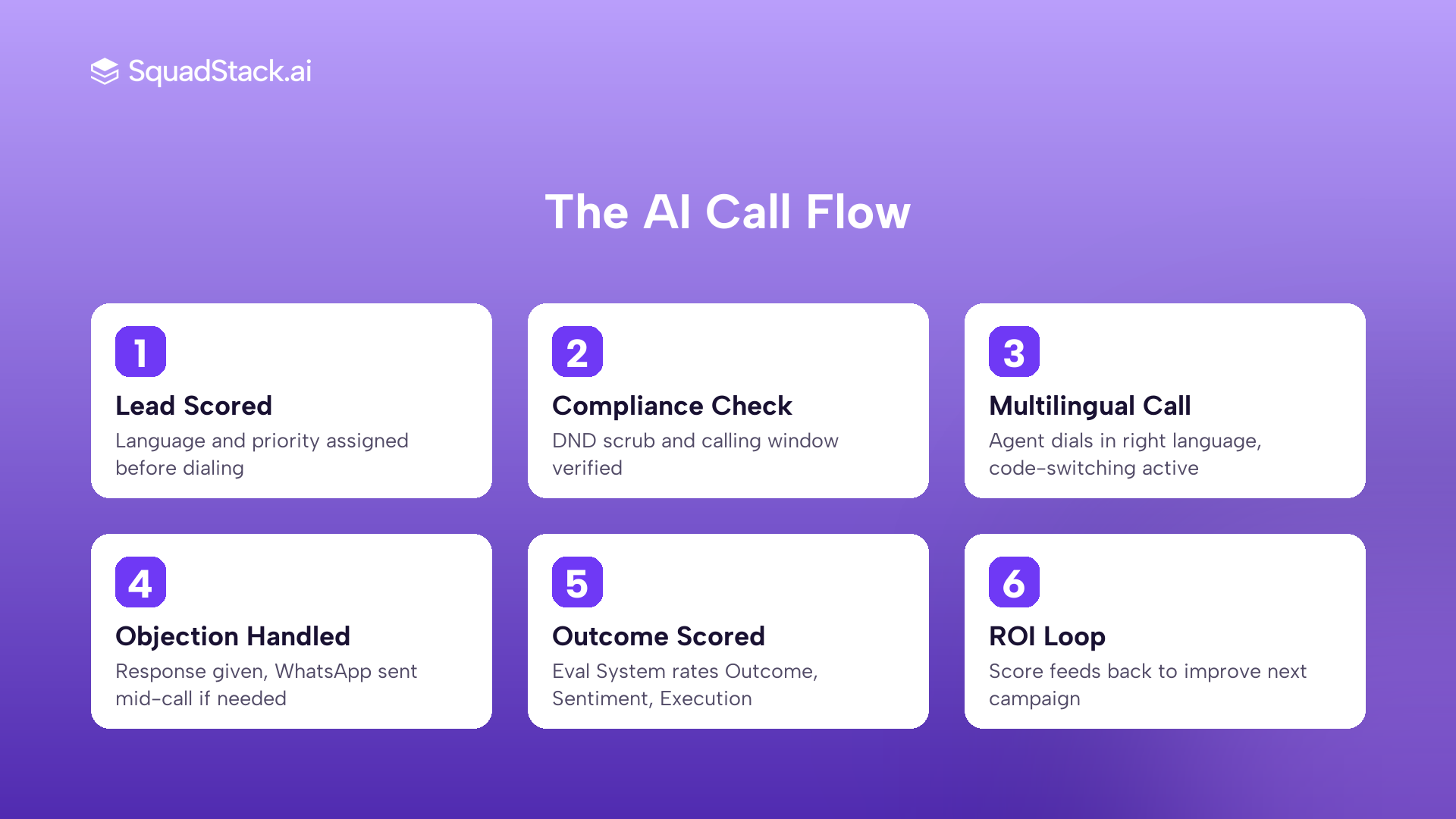
Step 1: Pre-call scoring and segmentation. The AI Lead Manager scores each lead using profile data, language preference, interaction history, and past outcomes. Voice, language, tone, and timing are set before the phone rings.
Step 2: Compliance-aware dialing. The platform scrubs against the TRAI DND registry and the client's own DND list. Calls only go out between 9:30 AM and 8:30 PM, enforced by hard system checks. Outbound numbers rotate when flagged as spam on Truecaller or when connectivity drops below a threshold.
Step 3: The conversation itself. The agent opens in the lead's preferred language. If the buyer responds in a different language or mixes languages mid-sentence, the agent switches naturally. Arth, SquadStack.ai's proprietary speech recognition model, is trained on 600M+ minutes of real Indian telephony audio including code-switched speech, high-noise 8kHz lines, and regional accents. The LLM layer is fine-tuned on real Indian sales outcomes.
Step 4: Objection handling and action. When a buyer raises an objection, the agent works through it across several turns. Mid-call, it can send a WhatsApp message with a payment breakdown while the buyer is still on the line.
Step 5: Continuous learning. Every call outcome, sentiment signal, and execution quality score flows back into the ROI Optimizer. Scripts tighten, timing improves, and voice choices are tested across variants.
Personal and merchant loan sales. A large share of India's credit demand sits outside the metros. Buyers in smaller cities need a call that feels familiar, not formal. Kotak Mahindra Bank, KreditBee, and PhonePe all use SquadStack.ai for personal and merchant loan sales across India.
Rider and seller hiring and onboarding. Delhivery uses SquadStack.ai for rider hiring and onboarding, achieving 4x lower cost-per-hire. Shiprocket runs seller onboarding through the same stack, reaching 5x seller onboarding throughput.
Lead qualification for education. Nxtwave, Adda247, Parul University, and others run lead qualification campaigns on the platform, reaching students and families in smaller towns in their own language.
Review and rating collection. redBus collects reviews and ratings through voice campaigns across regional languages. Engagement rates ran between 75 and 85%, above the human baseline in every language tested, and rating volume more than doubled as regional campaigns scaled.
Hyper-personalisation in practice. A buyer who previously expressed interest in a gold loan but dropped off at the document step gets a different call than a fresh lead. Persistent memory carries context across calls so the follow-up opens exactly where the last conversation ended. This is where conversational AI lead scoring and AI intent detection attach directly to regional market results.
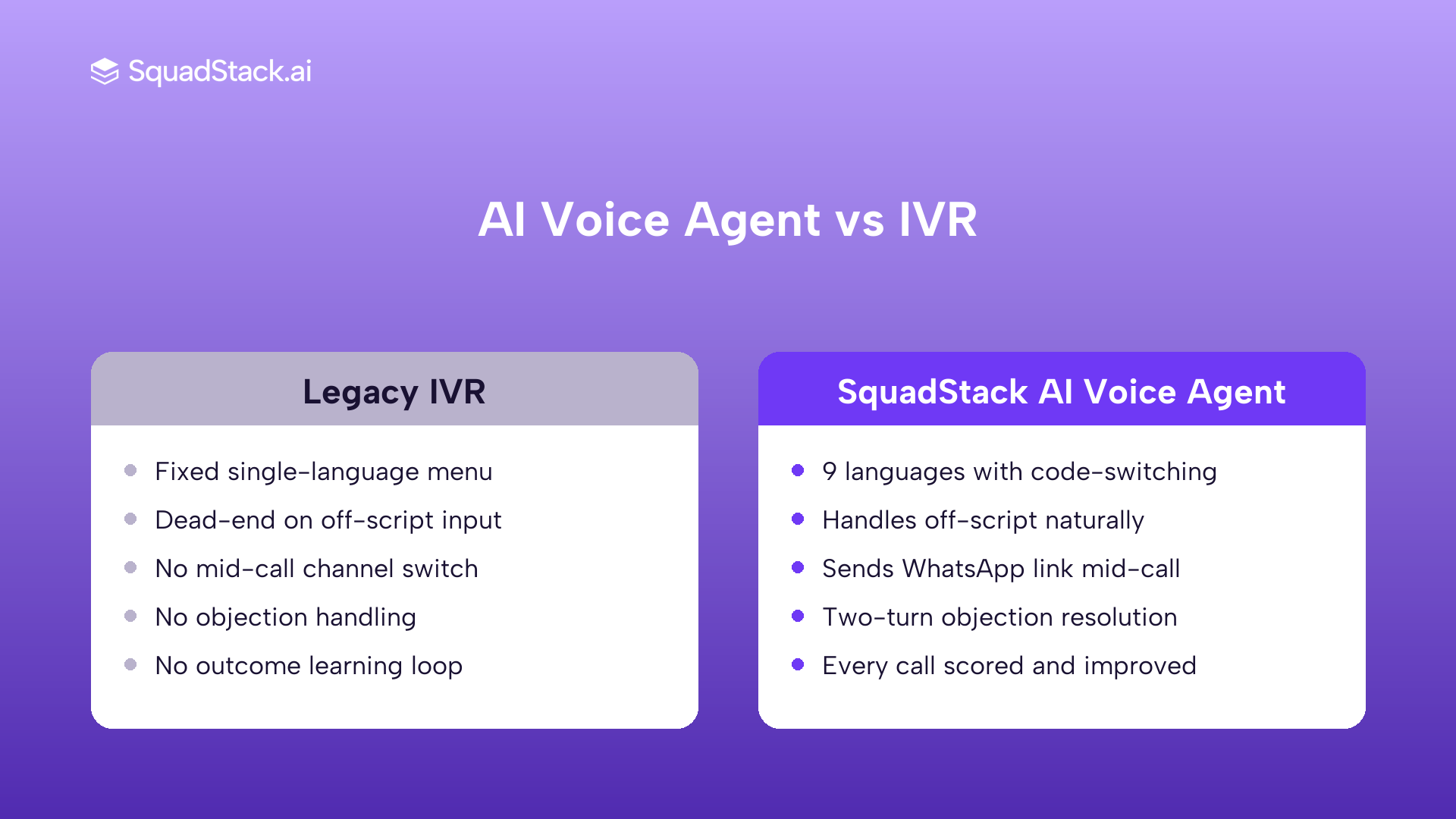
In markets where trust is earned one conversation at a time, the difference between an IVR and a voice agent is not a feature gap. It is the difference between a hung-up call and a completed sale.
| Dimension | Legacy IVR | AI Voice Agent |
|---|---|---|
| Language handling | Pre-recorded clips in one language, no switching | Live code-switching mid-sentence, e.g. Hindi to Bhojpuri, based on how the buyer actually responds |
| Handling a dropped connection | Call ends, no recovery | Retry logic with adaptive timing; follow-up call opens with full context from the last attempt |
| Objection: "Interest rate is too high" | Repeats menu or disconnects | Handles across multiple turns, offers alternatives, can send a WhatsApp breakdown mid-call |
| Dialect and accent variation | Fails to recognise regional pronunciation, buyer hangs up | Arth STT is trained on regional Indian telephony audio including accents, crosstalk, and background noise |
| Trust signals | Generic robotic prompt, no local warmth | Dialogue hand-crafted per language; fillers and phrasing validated by native speakers against actual 8kHz phone audio |
| Learning over time | No change, same script forever | Every call feeds outcomes back; scripts, timing, and voice improve continuously |
Training data quality, not language count. Any platform can list fifteen languages. Ask where the speech model was trained. Models trained on YouTube audio or read-speech corpora fail on noisy 8kHz telephony with code-switched regional speech.
Naturalness engineering, not just TTS. Regional buyers make a fast judgment about whether they trust the voice on the line. Ask whether the platform hand-writes regional dialogue or generates it with a general LLM.
TRAI compliance built in, not bolted on. DND scrubbing, 140-series numbers, hard calling windows, and opt-out handling need to be enforced at the system level.
Latency at production scale. A slow response is particularly damaging where trust is already low. Median response latency should be 0.8 seconds or less.
Managed outcomes, not just tooling. Self-serve platforms put the optimisation burden on you. For high-volume Tier 2 and Tier 3 campaigns, a dedicated squad running QA, A/B testing, and continuous script improvement is what separates a 93% pilot success rate from the industry average of around 25%.
The honest reason is not a feature list. It is ten years of running real Indian sales calls before building the AI.
Arth is trained on 600M+ minutes of real Indian contact-centre conversations spanning more than 85% of Indian pincodes, including Hinglish, Taminglish, and every major regional code-switching pattern, recorded on 8kHz telephony lines with real background noise. This data does not exist publicly, which is why competitors train on YouTube and sound like newsreaders to a buyer in Ranchi.
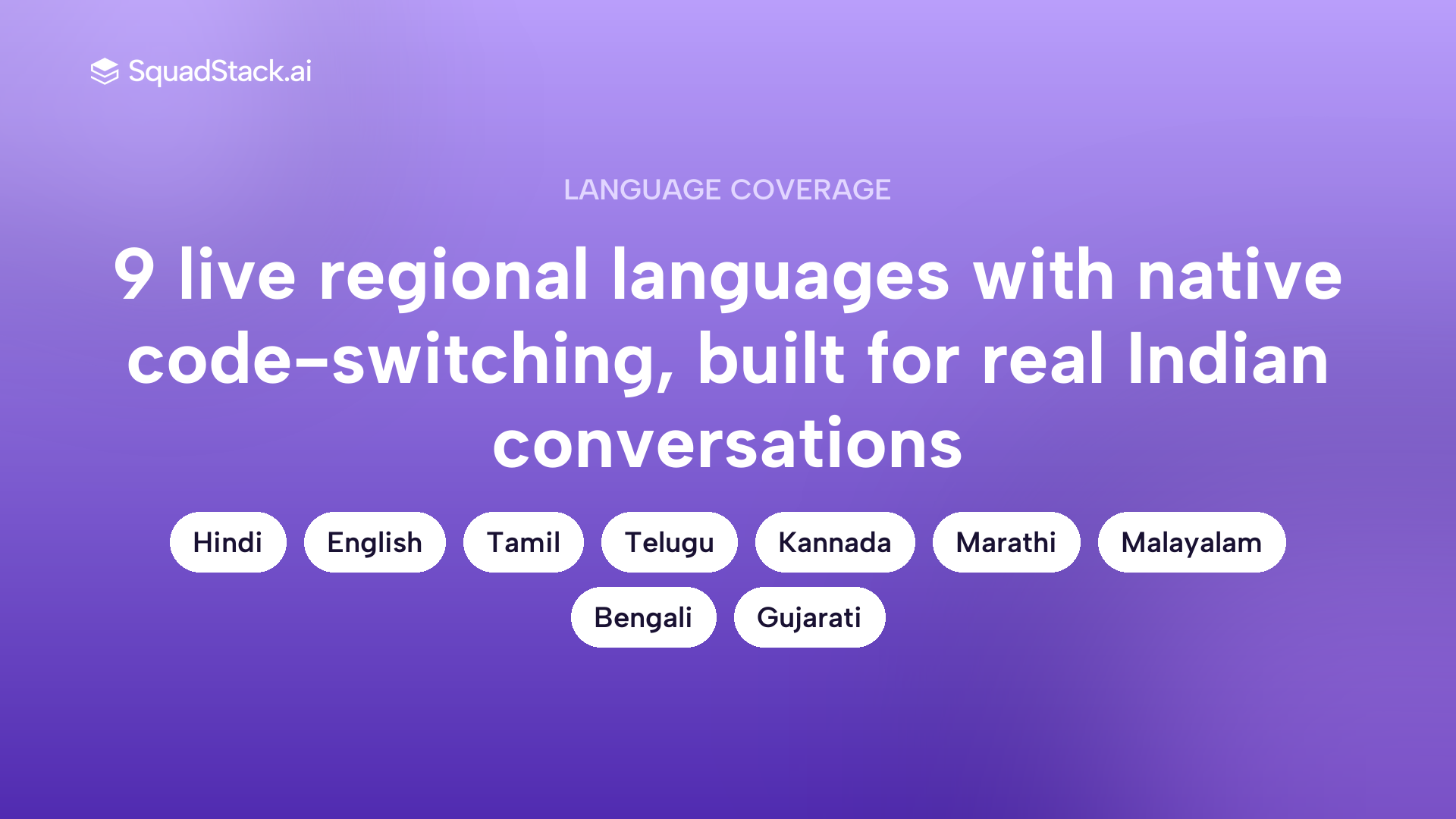
The platform runs nine live languages: Hindi, English, Tamil, Telugu, Kannada, Marathi, Malayalam, Bengali, and Gujarati, with native code-switching. More regional languages are available on demand. Dialogue in each language is hand-written and validated by native speakers on actual phone calls.
Every call is scored by the Eval System across three levels: Outcome (did it achieve the goal?), Sentiment (how did the buyer experience it?), and Execution (did the agent run the conversation correctly?). That three-level QA catches problems at campaign scale before they become revenue leaks.
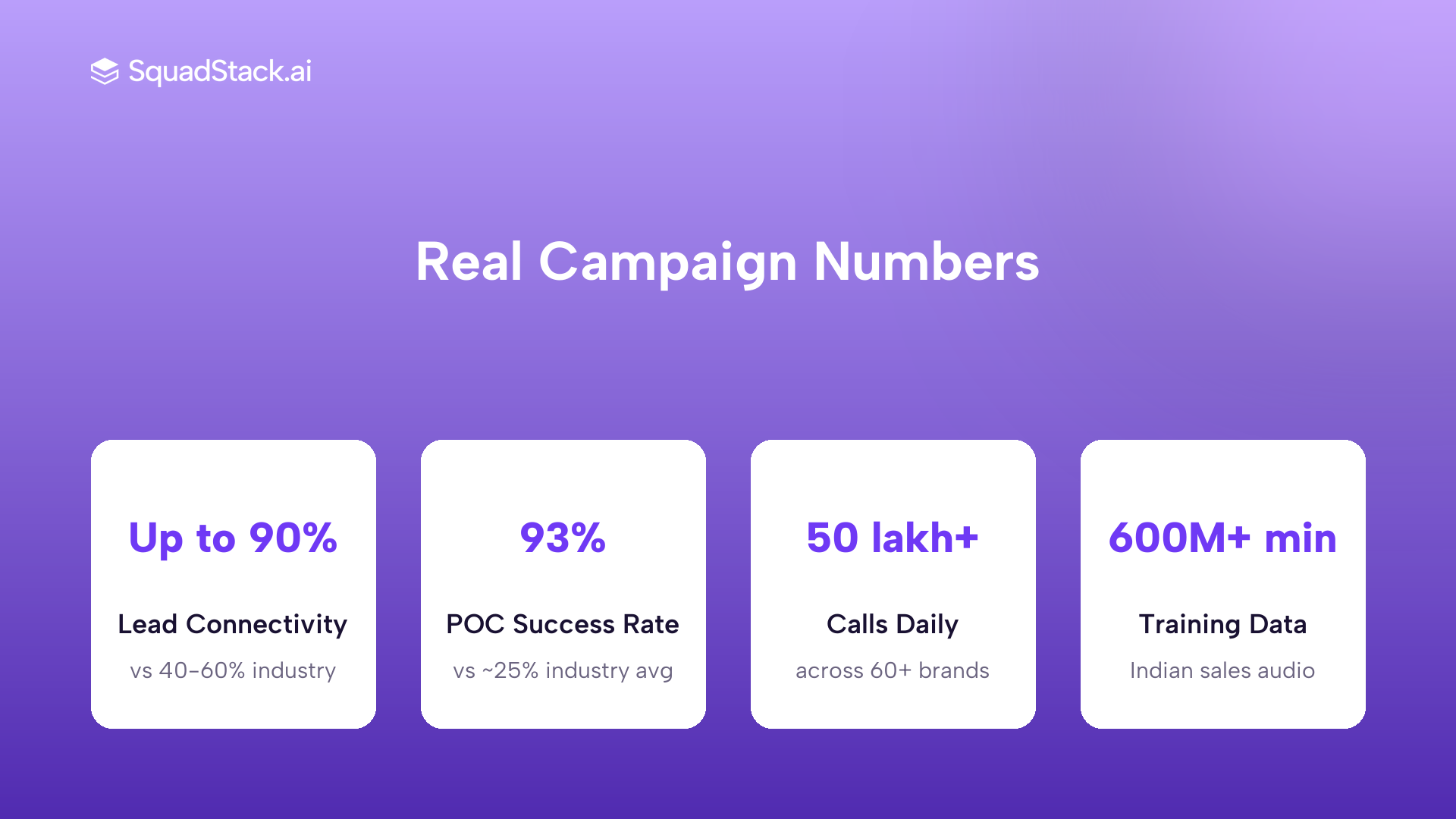
The result: up to 90% lead connectivity versus a 40 to 60% industry norm, a 93% POC success rate against an industry average of around 25%, and 50 lakh+ calls daily across 60+ large consumer brands. A leading quick commerce platform running rider hiring through SquadStack.ai reached 90% connectivity and 40% lower cost-per-hire, a campaign that runs heavily in Tier 2 and Tier 3 sourcing markets.
Businesses evaluating AI voice agents for sales automation in India can start with a pilot aligned to a pre-set success metric. Typical setup takes about two weeks.
Reaching buyers in Tier 2 and Tier 3 India is not a localisation problem you solve by adding a language to a global platform. It is a ground-up engineering and data problem that requires a voice agent that sounds like it belongs in the conversation.
SquadStack.ai has been in Indian sales calls for about ten years. The data, the speech models, and the campaign playbooks are all built from that ground reality. If your outreach is stalling in smaller cities and towns, schedule a demo and see what a campaign built for these markets actually looks like.
Which is the best AI voice agent for Tier 2 and Tier 3 India sales calls?
The best option is one trained on real Indian telephony data covering regional accents and code-switched speech, with TRAI compliance built in and a managed QA layer. SquadStack.ai's agents are trained on 600M+ minutes of real Indian contact-centre conversations spanning more than 85% of Indian pincodes, with nine live regional languages and native code-switching.
Can an AI caller reach customers who only speak regional languages like Tamil or Telugu?
Yes. SquadStack.ai's platform runs Hindi, English, Tamil, Telugu, Kannada, Marathi, Malayalam, Bengali, and Gujarati as live languages today, with native code-switching mid-sentence. Additional languages including more regional languages are available on demand. Dialogue in each language is validated by native speakers on actual 8kHz phone lines, not generated from standard text.
What connectivity rates are realistic for outbound calls in Tier 2 and Tier 3 India?
The industry norm sits between 40 and 60% lead connectivity. SquadStack.ai's AI Lead Manager reaches up to 90% through adaptive outreach timing, spam-aware number rotation, and compliant retry cadences. These are lead-level figures, meaning the share of unique leads reached across the full campaign attempt window.
How does an AI voice agent handle trust and dialect variation in smaller Indian cities?
Trust comes from sounding natural, not from announcing AI capability. SquadStack.ai hand-writes dialogue in each regional language, with fillers, tag questions, and phrasing validated by native speakers. The underlying speech model is trained on real noisy telephony audio, not studio recordings, so it handles dialect variation, interruptions, and background noise the way a human agent would.
What is the typical setup time for a Tier 2 and Tier 3 outreach campaign?
Most enterprise pilots go live in two to three weeks. The setup covers use-case scoping, agent build on the client's real call recordings and knowledge base, integrations, and UAT. The client validates the agent before go-live, and the pilot runs on real leads against a pre-aligned success metric.
How does TRAI compliance work in practice for these markets?
The platform hard-enforces the 9:30 AM to 8:30 PM calling window at the system level. Leads are scrubbed against the TRAI DND registry before every dial, and clients can upload their own internal DND lists. Only compliant 140-series numbers are used for cold outreach. Consent gating and opt-out handling are built into the conversation layer, not left to manual configuration.
What makes AI voice agents better than IVR for regional Indian markets?
An IVR plays a recorded menu and disconnects when the buyer goes off-script. An AI voice agent holds a real two-way conversation, switches languages mid-sentence, handles objections across multiple turns, and retries with full context if the first call drops. In markets where trust is fragile, the difference between a natural conversation and a robotic menu is often the difference between a conversion and a hang-up.
What metrics should businesses track for Tier 2 and Tier 3 voice campaigns?
The most important metrics are lead-level connectivity rate, language switch frequency (which shows how well the agent is matching buyer preference), conversation completion rate, and cost per qualified outcome. SquadStack.ai's Eval System scores every call on Outcome, Sentiment, and Execution, giving campaign teams a clear view of where the funnel is leaking and why.
Can the same voice agent run campaigns across multiple regional languages simultaneously?
Yes. The platform supports per-lead language assignment based on profile data and prior interaction history. A single campaign can run in Hindi for leads in Uttar Pradesh, Tamil for leads in Tamil Nadu, and Telugu for leads in Andhra Pradesh, with each lead getting the right language from the first word. Code-switching within a conversation handles buyers who mix languages naturally.
How does the AI voice agent improve over time across a long campaign?
Every call outcome feeds back into the ROI Optimizer. The platform runs continuous A/B tests across voice, script framing, cadence, and timing. Lift, the self-improvement layer, reads unreviewed calls, finds near-misses and early drop-offs, and proposes specific instruction edits, each validated by a human before going live on real traffic. The result is a system that gets measurably sharper as the campaign runs, not one locked to the script it launched with.

