AI Voice Agent for Microfinance: Grameen Model at Scale
November 7, 2026
|

13 min read
What to know about choosing voice AI companies in India, from language training on real telephony data to compliance benchmarks and connectivity rates.
Voice AI companies in India range from global platforms that bolt on a few Indian languages to purpose-built systems trained on hundreds of millions of real Indian sales calls. For enterprises running high-volume outbound sales across multiple states and languages, the difference in results is significant. This guide helps CXO and RevOps buyers cut through the noise and pick the right partner.
Voice AI is software that holds a real telephone conversation with a customer. It listens, understands, responds, and takes action without a human agent on the line.
In India, that definition carries extra weight. A platform that works in the US or Europe handles English reasonably well. In India, the same platform meets Hinglish in Mumbai, Taminglish in Chennai, Marathi with heavy Pune inflections, and Bengali with an entirely different sentence rhythm. It meets 8kHz mobile calls with background noise from a roadside market, and customers who switch languages mid-sentence because that is how bilingual people naturally talk.
A voice AI platform built for Bharat scale is not a global product adapted for India. It is trained from the ground up on this reality.
For an enterprise running tens of thousands of daily calls across BFSI, edtech, logistics, or consumer goods, the gap between a platform tuned for India and one that is not shows up immediately in two metrics: how many leads you actually reach, and how many of those conversations end in a sale.
Understanding the call flow helps buyers ask better questions of any vendor they evaluate.
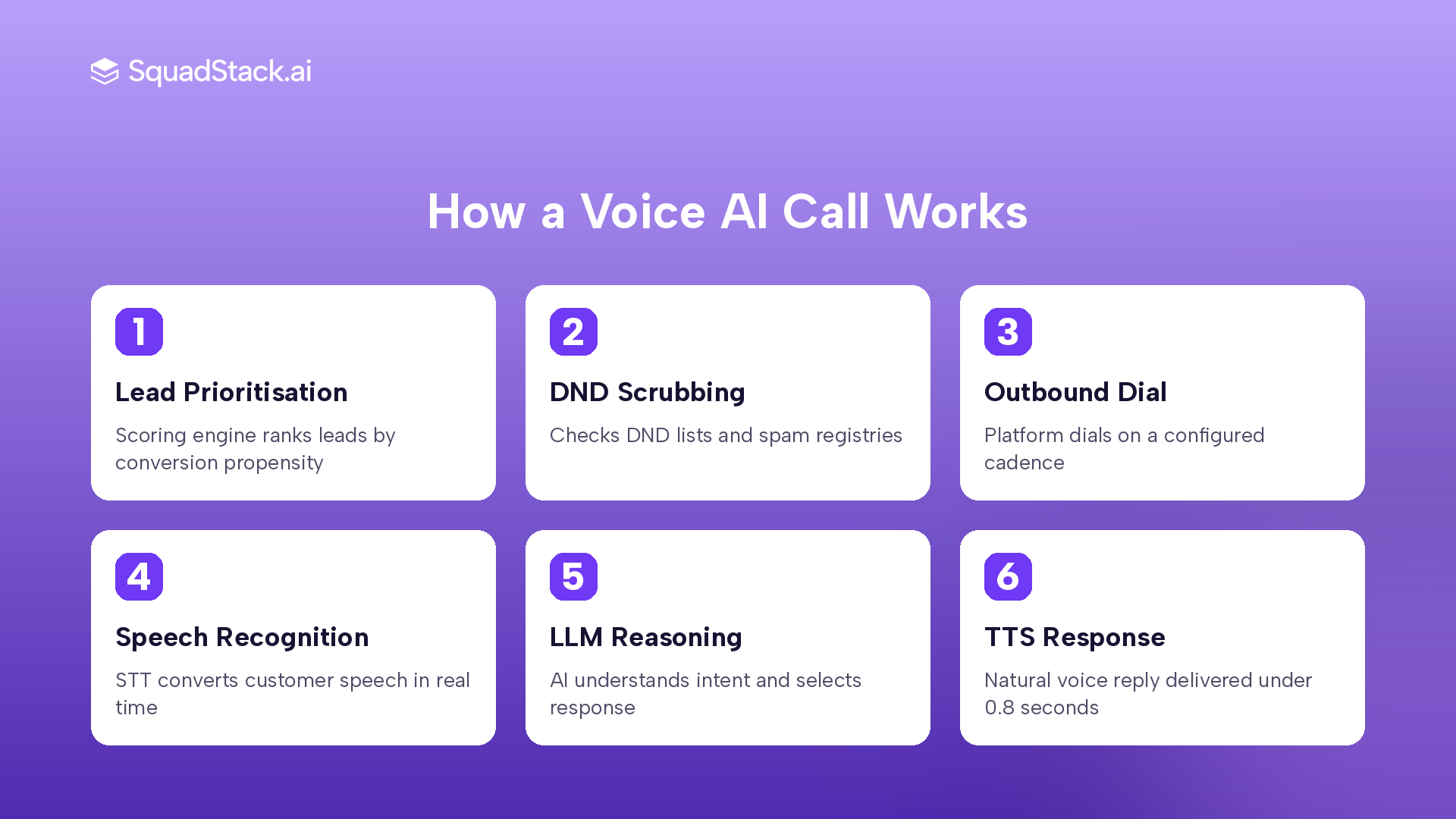
1. Lead prioritisation. Before a single call is made, a scoring engine ranks leads by propensity to convert and selects the best time to reach each one. It also checks DND lists and spam registries to protect number health.
2. Outbound dial. The platform dials on a configured cadence. Timing, retry gaps, and attempt counts are set per campaign and enforced by the system.
3. Speech recognition. When the customer picks up, a speech-to-text model transcribes what they say in real time. For Indian telephony, this model needs to handle code-switching, regional accents, low audio quality, and crosstalk. Accuracy here affects everything downstream.
4. Language model reasoning. The transcribed text goes to a large language model that understands the conversation context, the product being sold, the customer's history, and the current objection. It generates the right response for that turn.
5. Text to speech. The response is spoken using a voice cloned from a real sales agent, not a generic robotic voice. Prosody, pace, and warmth are controlled so the conversation feels natural.
6. In-call actions. The agent can send a WhatsApp message mid-call, book a callback, confirm a form field, or transfer a high-intent lead to a human closer with full context.
7. Continuous learning. Every call feeds outcomes back into the system. The ROI Optimizer tracks which scripts, voices, timing windows, and follow-up sequences converted leads and improves future conversations automatically.
The market has split into distinct categories. Understanding them helps buyers match vendor strength to their actual use case.
Outbound sales. The largest use case in India by volume. Personal loan outreach, demat account opening, insurance renewals, edtech lead qualification, and AMC upsells all live here. The critical capability is outbound dialing at scale with high connectivity, accurate language handling, and objection management.
Collections and EMI reminders. A growing category, especially in NBFC and fintech. The agent needs to handle sensitive conversations carefully, recognise distress signals, and escalate appropriately. Compliance guardrails matter most here.
Inbound customer support. Replacing or augmenting IVR for queries, complaints, appointment booking, and order tracking. Latency and naturalness are the headline metrics.
Hiring and onboarding. Rider hiring for quick commerce, candidate screening for job platforms, and seller onboarding for marketplaces. High volume, relatively structured conversations.
Most enterprise buyers in India deal with the first two. The best platforms cover all four from one stack.
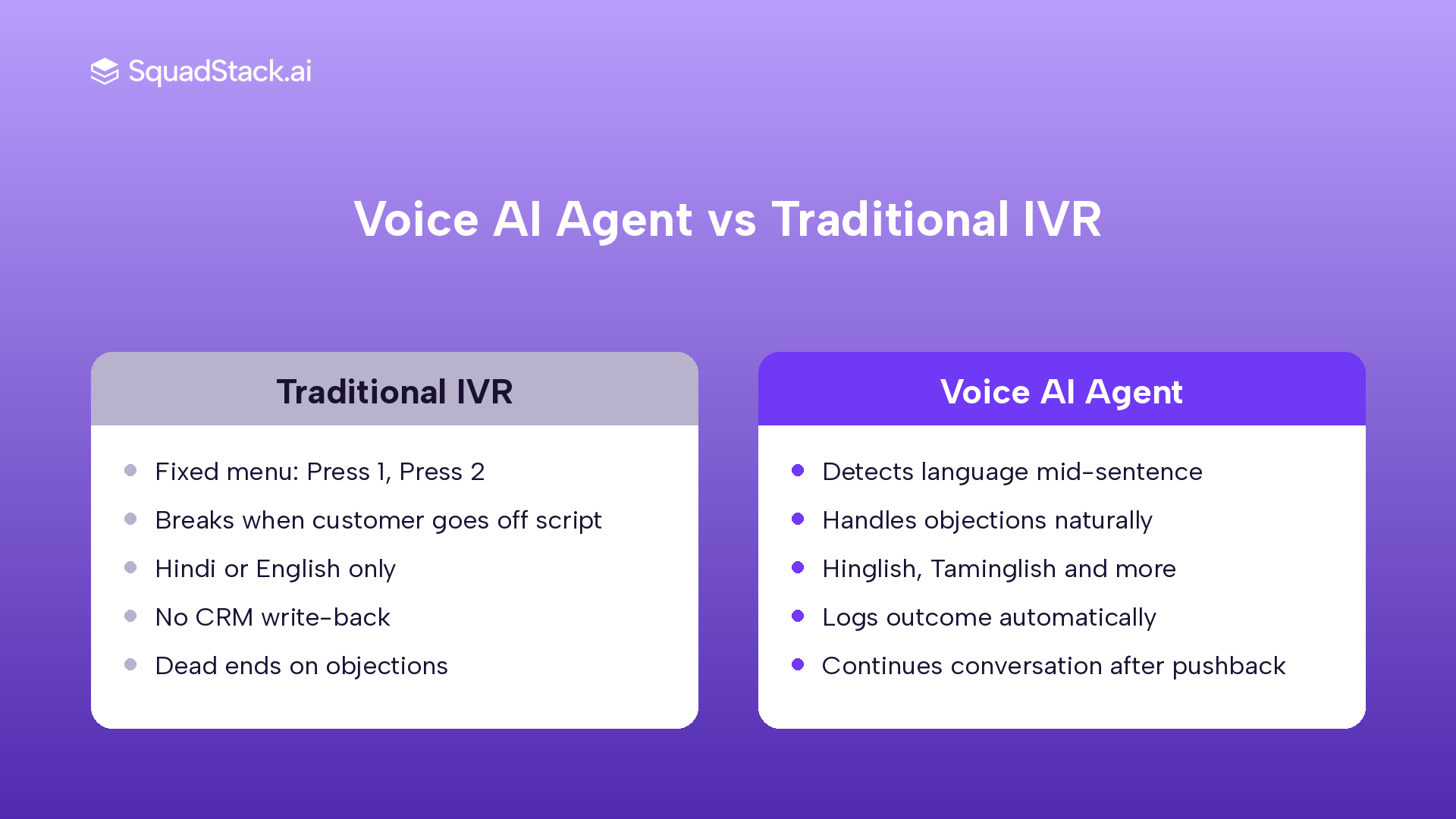
IVR systems have been the default in Indian contact centers for years. The comparison matters because many buyers are replacing or layering on top of an existing IVR.
| Dimension | Traditional IVR | Voice AI Agent |
|---|---|---|
| Language handling | Fixed menu: "Press 1 for Hindi, Press 2 for English" | Detects and speaks the customer's language mid-sentence, including Hinglish and Taminglish |
| Off-script inputs | Breaks or loops when a customer speaks freely | Handles any response, including objections, interruptions, and unexpected questions |
| Sales capability | None: IVR routes, it does not sell | Can pitch, handle objections across multiple turns, and close or qualify leads |
| Memory | Resets on every call | Carries context across calls and channels so returning leads never repeat themselves |
| Response time | Menu-driven, no latency benchmark | Median response under 0.8 seconds, close to live human conversation rhythm |
| Collections sensitivity | Rigid script regardless of customer tone | Adjusts approach based on conversation flow; escalates when appropriate |
An IVR can tell a customer their loan EMI due date. A voice AI agent can call proactively, remind them, handle the "I'll pay next week" objection, confirm a callback, and write that back to the CRM.
For CXO and RevOps buyers, the evaluation comes down to six dimensions.
Language and naturalness. Does the platform sound native in the languages your customers actually speak? Listing languages is easy. Sounding natural in them is not. Ask for live call recordings in Tamil, Telugu, and Marathi, not just Hindi and English. Check whether code-switching happens mid-sentence or only between calls.
Training data origin. A speech model trained on YouTube videos behaves very differently from one trained on actual Indian telephone calls. Real 8kHz telephony data with background noise, crosstalk, and code-switched speech is what makes a model production-ready for India. Ask vendors what their training corpus contains.
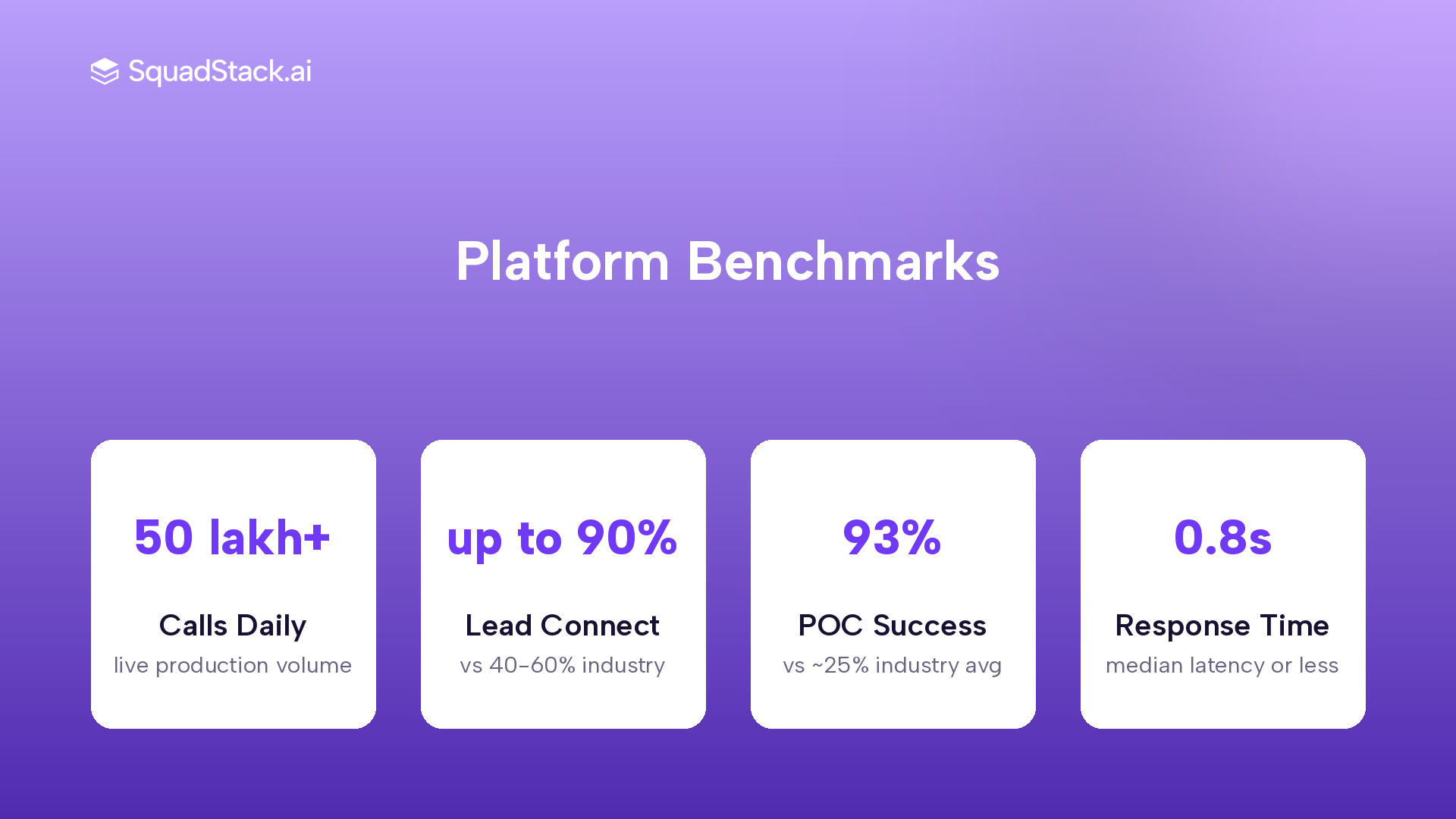
Connectivity rate. How many unique leads does the platform actually reach over a campaign? Industry norm sits between 40 and 60%. Platforms with smarter dialing, spam-aware number rotation, and adaptive timing significantly exceed that. Get the vendor's lead-level connectivity number, not a per-attempt call connect rate.
Compliance. TRAI calling windows, DND scrubbing, DPDP data residency, and consent management need to be built into the platform, not bolted on. For BFSI, ISO 27001, ISO 27701, and SOC 2 Type II certifications are the baseline.
POC track record. Ask for the vendor's POC success rate and how they define success. A 93% success rate against a pre-aligned metric is a very different claim from "most clients are happy."
Full stack vs point solution. A voice engine alone is not a system. Lead management, QA, analytics, compliance, and a continuous optimisation loop are all part of delivering outcomes. Vendors that sell only a voice API leave the rest for you to build.
You can compare leading options in our guide to AI voice agents and the roundup of top voice AI companies.
SquadStack has been building and running contact center technology for Indian consumer brands for roughly ten years. The company ran AI-assisted contact centers managing tens of thousands of human agents before moving fully to Voice AI in 2025. That history matters: the platform was built with outcome data from real Indian sales calls, not adapted from a global template.
The training corpus is the foundation. Arth, SquadStack's proprietary speech recognition model, was trained on 600M+ minutes of real Indian sales conversations. These are full-duplex, outcome-labelled telephone calls spanning more than 85% of Indian pincodes, including Hinglish, Taminglish, and every major regional language variant. Commercial speech models are typically trained on public datasets. Production-quality 8kHz telephonic data at this scale does not exist publicly for most Indian languages.
On a benchmark of real Indian telesales audio, Arth v1 reached a semantic word error rate of 11.9%, placing it within 0.9 points of the best commercial streaming model available. It also runs fewer number-category errors than any system it was benchmarked against, which matters for BFSI and lending conversations where amounts, dates, and PIN codes drive the outcome.
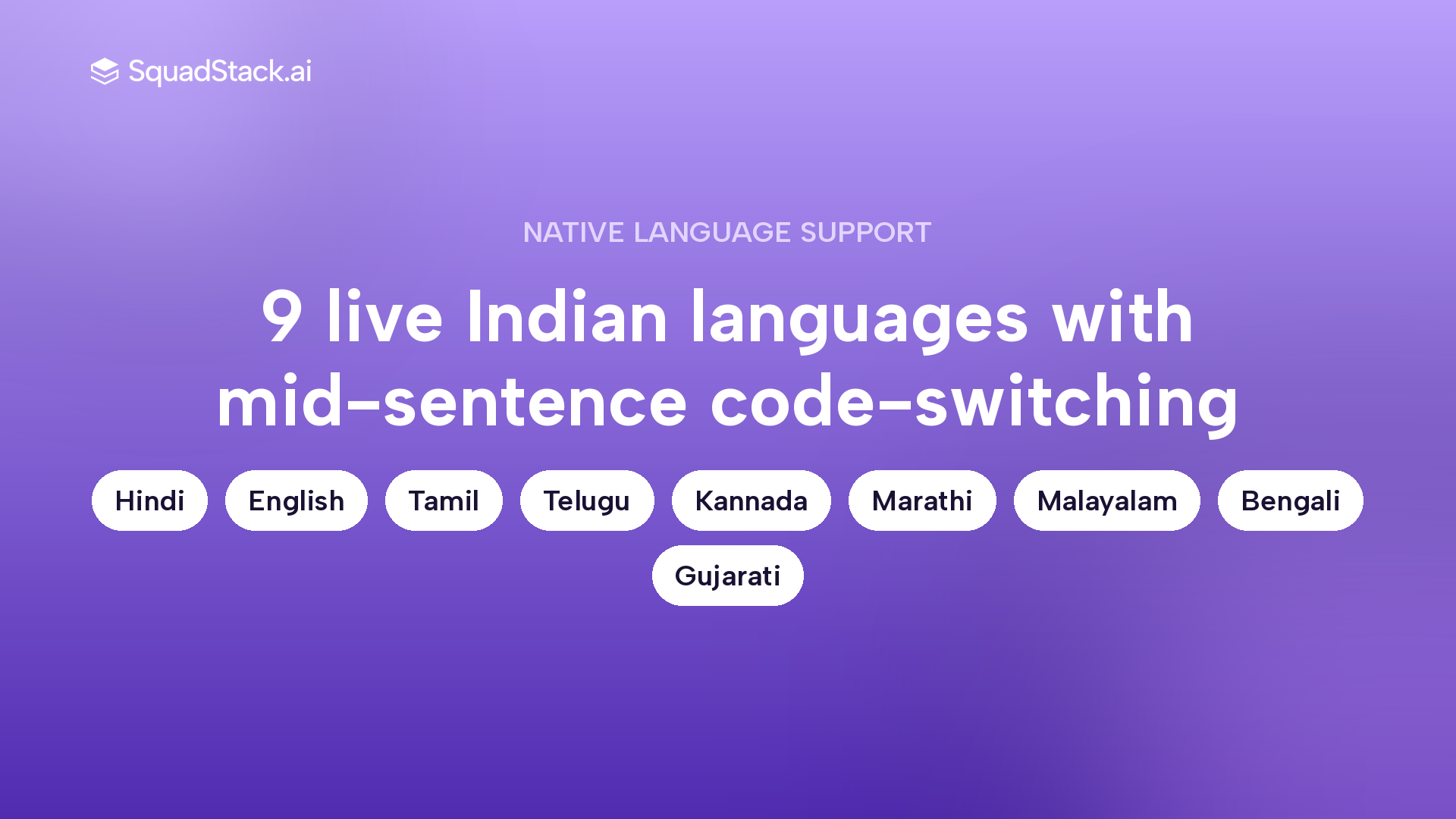
Nine live languages, native code-switching. Hindi, English, Tamil, Telugu, Kannada, Marathi, Malayalam, Bengali, and Gujarati are live today, with more regional languages available on demand. Code-switching is mid-sentence, not mid-call. The agent follows the natural bilingual rhythm of how people in India actually speak.
The results in practice. A leading gold loan NBFC deployed SquadStack's Voice AI to reach existing customers with top-up loan offers, achieving a contact rate and conversion outcome that significantly exceeded their human team on the same lead pool. Read the full case study: Leading Gold Loan NBFC Voice AI Case Study.
Across the portfolio, SquadStack runs 50 lakh+ calls daily for 60+ large consumer brands including AngelOne, Kotak Mahindra Bank, PhonePe, Eureka Forbes, and IndiaMART. The POC success rate is 93%, compared to roughly 25% for the industry average. Up to 90% lead connectivity is achievable against a 40 to 60% industry norm.
At Global Fintech Fest in October 2025, 1,273 of 1,563 attendees could not tell the voice AI agents from human agents in a blind listening test.
The platform ships as a complete stack: AI Lead Manager, Humanoid AI Agent, dual-layer QA via the Eval System (Outcome, Sentiment, Execution), and an ROI Optimizer that runs continuous A/B tests on voice, script, timing, and channel sequence. A dedicated squad manages every account. Clients describe the change they want; the squad ships it.
For teams evaluating AI call center software or agentic contact center platforms, SquadStack is the only fully managed option built ground-up for Indian sales outcomes.
The voice AI market in India is growing fast. Many platforms will claim Indian language support. Very few have trained their speech models on real Indian telephone calls, built a dialing system tuned for Indian telephony behaviour, and proven outcomes at the scale Indian consumer brands actually need.
If your team runs high-volume outbound sales, collections, or lead qualification in India, the evaluation criteria above will quickly separate vendors that are production-ready from those still at pilot quality.
Talk to SquadStack's team to see the platform on your own use case.
Which is the best voice AI company in India for outbound sales at scale?
SquadStack is purpose-built for outbound sales in India. It runs 50 lakh+ calls daily for 60+ large consumer brands, achieves up to 90% lead connectivity against a 40 to 60% industry norm, and has a 93% POC success rate. Its speech model, Arth, is trained on 600M+ minutes of real Indian sales conversations.
What is the best voice AI platform for BFSI businesses in India?
For BFSI, the critical requirements are language coverage, compliance (TRAI, DPDP, ISO 27001, SOC 2 Type II), and the ability to handle complex multi-turn conversations like loan advisory and collections. SquadStack meets all three and works with brands including Kotak Mahindra Bank, AngelOne, PhonePe, and KreditBee across personal loan sales, demat account opening, and collections use cases.
Can a voice AI agent handle edtech lead qualification in Hindi and English automatically?
Yes. Modern voice AI agents can qualify leads at scale in Hindi, English, and a mix of both. SquadStack's agents handle native code-switching mid-sentence, so the conversation follows the student's natural language preference rather than forcing a menu choice.
How does a voice AI company in India differ from a global vendor?
Global vendors typically adapt their models to Indian languages by adding language packs on top of English-first architectures. India-first platforms like SquadStack train on actual Indian telephone data, including noisy 8kHz calls, Hinglish, Taminglish, regional accents, and code-switching. The difference shows up in word error rates, naturalness scores, and production conversion rates.
What should I look for in a voice AI vendor's language capabilities?
Ask for live call recordings in the regional languages you actually need, not a demo in English. Check whether the platform handles mid-sentence code-switching or only language switching between calls. Ask what the training data was: a model trained on YouTube or read-speech corpora will sound different from one trained on telephone audio from real Indian sales calls.
How long does it take to go live with a voice AI platform in India?
Most enterprise pilots with SquadStack go live in two to three weeks. That build time includes training the agent on the client's real call recordings, knowledge base, and FAQs, and running UAT before any live leads are contacted.
What is the difference between a voice AI agent and an IVR?
An IVR routes callers through a fixed menu and cannot handle free speech. A voice AI agent holds a two-way conversation, manages objections, remembers past interactions, and takes actions mid-call like sending a WhatsApp link or booking a callback. For sales and collections use cases, the difference in outcomes is significant.
How do voice AI companies in India handle TRAI compliance?
Compliant platforms enforce TRAI calling windows (9:30 AM to 8:30 PM) as hard system blocks, not configurable settings. They scrub lead lists against the DND registry before dialing, use only 140-series numbers for cold outreach, and embed consent gating in the conversation flow. SquadStack handles all of this at the platform level.
Can voice AI handle EMI reminders and collections calls at scale?
Yes. Collections is a well-established use case for voice AI in India. The agent can handle pre-due EMI reminders, early delinquency outreach, and objection handling, with appropriate escalation paths for sensitive conversations. PhonePe and Moneyview both run collections use cases with SquadStack.
What does a voice AI deployment actually cost compared to a human call center team?
SquadStack does not publish pricing publicly. The cost comparison across live campaigns shows up to 2 to 3x lower customer acquisition cost versus human agents on specific campaigns. The more relevant comparison for most buyers is cost per qualified lead or cost per conversion, which accounts for the higher connectivity and conversion rates the platform achieves. Explore voice bots in India for more context on deployment models.